• Start Here
  • Articles & Interviews
  • Field Notes
  • Speaking
  • About
Menu

Black Sheep Baptist

Street Address
City, State, Zip
Phone Number

Your Custom Text Here

Black Sheep Baptist

  • Start Here
  • Articles & Interviews
  • Field Notes
  • Speaking
  • About

‘Try That in A Sundown Town’

July 26, 2023 justin cox

This article originally published at BaptistNews.com
Image: Baptist News Global

A small radio rested in my grandmother’s kitchen — one of those gadgets stained by time and the touch of hands that saw a day’s labor before sunrise. On it played nothing but Country Gold.

As pintos simmered on the back eye of the stovetop, the Oak Ridge Boys inched us closer to lunch. Alabama’s “There’s No Way” mixed right in with the cornmeal. And Marshville’s own Randy Travis gave us something cool to listen to during the summer of 1986.

Last night, I dug your picture out from my old dresser drawer.
I set it on the table, and I talked to it ’til four.
I read some old love letters right up ’til the break of dawn.
Yeah, I’ve been sittin’ alone, diggin’ up bones.

We’d listen to Randy and other salt of the earth saints until Maw-maw’s “stories” came on in the early afternoon, and we found ourselves shoved gently outside. As I got older, I drifted away from country music, ashamed of how it made me feel or how it made others feel about me. Sure, we watched Hee Haw, but I tried hard not to sound like Roy Clark and Minnie Pearl.

As I got older, the idea and identity of country music changed. The business of Nashville went full-blown mainstream. Pop producers replaced the troubled troubadours of the destitute. Polished tunes pandering to the masses did little to convert me. A mantra of “sell, sell, sell” replaced those reconciling hymns working out why some humans have to live like dogs.

Years passed before I finally accepted a homecoming call courteous of those old Outlaw voices. Those who touched on eschatological matters sang of the human condition’s depth, struggle and beauty. Some penned songs that would have fit nicely into a pew hymnal. They brought me back and turned me toward the next generation of musicians dealing with the lowly, the lonely and those made to feel inferior because of where they came from — a class of people associated with a particular landscape consisting of street lights and horses in equal supply.

I’m talking about small towns. 

There’s been an awful lot of talk about small towns lately, especially in country music.

Last week, entertainer Jason Aldean caught fire with his single “Try That in A Small Town.” Released in May, the song didn’t become the talk of social media until the music video dropped just over a week ago. Since then, a divided nation of listeners continues to widen the chasm from one another, letting loose words of support or outrage toward Aldean.

Under pressure, Country Music Television pulled the video, which pushed the song’s popularity. As of the writing of this article, the video has reached more than 12 million views on YouTube.

What garners all this attention? Well, for the uninitiated, the video depicts violent altercations between law enforcement and civilians in urban locations: convenience store robberies and department store lootings, buildings set on fire, and tear gas raining down from above on any and all not complying with white conformity.

In the video, these images play on the backdrop of the Maury County Courthouse in Columbia, Tenn. — a place with a history. A race riot erupted there in 1946. The slaying of a child of God, 18-year-old Black teenager Henry Choate, at the hands of a mob took place there in 1927.

I wish I could say the Maury County Courthouse was one of a few halls of injustice in the South where detestable acts of hate occurred, but it isn’t. Too many small towns and their government buildings house similar stories.

“Whether Aldean or his team of producers knew this history is debatable. What isn’t, however, is they don’t seem to care now that they know.”

Whether Aldean or his team of producers knew this history is debatable. What isn’t, however, is they don’t seem to care now that they know.

Needless to say, the video conjures all sorts of feelings. When not depicting metropolitan areas as new Babylons, the lyrics written by Kelley Lovelace, Neil Thrasher, Tully Kennedy and Kurt Michael Allison (yes, let it not be lost that Aldean didn’t even write the song he is adamantly defending) accompany picturesque propaganda.

Backyard football games, duck hunting and families standing beside classic roadsters appear as if you’re watching an old home movie.

Cuss out a cop, spit in his face.
Stomp on the flag and light it up.
Yeah, ya think you’re tough.

Baseball games, hopscotch and a group of farmers supporting one another flash in a series of slides Dinesh D’Souza and Dr. Brodsky from A Clockwork Orange would be proud of.

Got a gun that my granddad gave me
They say one day they’re gonna round up.
Well, that shit might fly in the city, good luck.

Scenes flash with a message pointing to a reinforced truth that our country was great while under the banner of white America’s idea of heaven. What happens to those that challenge this truth?

Well, try that in a small town.
See how far ya make it down the road.
Around here, we take care of our own.
You cross that line, it won’t take long.
For you to find out, I recommend you don’t
Try that in a small town.

In short, fool around and find out. Don’t think it won’t happen to you if you step out of line. Find yourself in a small town where a group of folk has all the power and calls all the shots, do things the way they believe should be done, where they don’t feel the need to entertain outside agitators. You’ll find out the way others have.

Those like James Chaney, Michael Schwerner and Andrew Goodman. Student activists who worked in Neshoba County during the summer of 1964.

Murdered in the small town of Philadelphia, Miss. 

Those like Matthew Shepard. Abducted by two men. Tied to a fence post, severely beaten, left to die.

Murdered in the small town of Laramie, Wyo.

Those like Emmett Till, a child kidnapped from his relative’s home.

Lynched. Murdered in the small town of Drew, Miss.

I could keep going. There are too many like James Byrd Jr. (murdered in Jasper, Texas).

Too many like Jonathan Daniels (murdered in Haynesville, Ala.).

Too many like Carol Jenkins (murdered in Martinsville, Ind.)

Unlike Aldean and most of the songwriters who wrote “Try That in A Small Town,” I grew up in a small town. Yes, there was a sense of community there. Folks did try and help one another during hard times. All that is true, but the promise of violence always was present — hidden behind masks of civility.

As a child, I saw those masks and sheets when the KKK marched and handed out flyers in the heart of Kernersville, N.C. Later, I would learn who they were, what they did and that some behind those masks lived in my small-town community. People like that live in big cities and small towns.

Whether Aldean wants to sing a song about such facts is something we will have to hold our collective breath to see.

If he does, might I suggest his songwriters go for a more accurate title to fit their lyrics; “Try That in A Sundown Town.”

A Pastor With No Vision

July 26, 2023 justin cox

This article originally published at GoodFaithMedia.org
Image: Stock Photo Illustration (Nathan Dumlao/Unsplash/ https://tinyurl.com/5n76fr7p)

If you’re a sadist and enjoy seeing someone squirm with discomfort, I invite you to watch me suffer through a business meeting. In such a setting, one discovers I take on the desperate actions of a fish snatched out of the sea.

Flailing around, eyes bulging with panic, praying for a return to the deep blue or a quick and painless death. When discussing budgets, finances, and anything involving numbers, a prolonged excruciating demise for me is preferable.

Now, I want to tell you that other types of meetings are different.

I want to tell you I receive a healthy dose of self and vocational worth when discussing church attendance, the number of new member prospects, and outreach opportunities.

I want to tell you my disdain for meetings rest on Robert and his intolerable rules of order.

But the truth is I harbor ill feelings toward most meetings because of the expectations lauded upon me in such spaces. My designated roles and title conjures specific, shall we say, projected suppositions that leave me spiraling into a Lovecraftian abyss.

Those like Lead or Senior pastor. And God help me, the pretentious moniker Executive pastor. I find each a shallow descriptor pulled from corporate jargon.

I thought I walked willfully away from such lingo when I departed the manufacturing world over a decade ago, blissfully erecting a headstone over the dogma of all things Six Sigma. However, I have yet to bury the burdensome perception that I’m a little more than a religious office manager.

I admit, this isn’t all that surprising of a revelation. One needn’t look far to discover countless faith-based leadership books and programs pandering to churches looking to embody a very Wall Street concept of “bigger, stronger, faster” success.

Hell, even the current seminary experience offers a “lead or get out of the way” concentration track tacked on to its Master of Divinity degree. This has produced a modern ministry model that inevitably demands a pastor to operate more as a CEO than a system-challenging prophet.

In this office, one is continuously asked to manage and address a specific query. What’s your plan for us? What’s your vision for this church?

Since arriving at my new call, I’ve bobbed and weaved around this question with the grace of Muhammad Ali. So far, I’ve worked my way off the ropes by stating, “It would be a little pompous of me to believe I know what’s best for this community when I’m still getting to know it.” This sting would allow me to float away to fight again another day, but a retorting jab only works for so long.

There finally comes a time when the question must be answered. As I approached the end of my first year there, I thought of the concept of vision. As I did, I decided to reacquaint myself with Dietrich Bonhoeffer’s Life Together. He minces no words when dealing with most leaders’ supposed visions.

“God hates visionary dreaming; it makes the dreamer proud and pretentious. The man who fashions a visionary ideal of community demands that it be realized by God, by others, and by himself. He enters the community of Christians with his demands, sets up his own laws, and judges that brethren and God Himself accordingly,” he writes.

The martyred German’s words are with me as I grab a chair at a recent diaconate meeting. On cue, a board member tosses this loaded question at me again. With all the honesty, humbleness, and sincerity I can muster for an evening meeting, I deliver, “I don’t have a vision for you.”

There’s a pause, and all air goes out of the room. Eyes dart, making contact with one another before glancing down at shoes. I lean back and take a deep breath before continuing.

“I don’t have a vision because what will happen at this church isn’t up to me. It’s up to you all. You have to remember, I’m a Baptist minister. I can’t even vote at any of our meetings.

In fact, I’d argue I have the least amount of power in this church. My voice and opinion have a soft influence, but even that feels contrived.

I don’t want to influence or coerce you. I don’t want you to think like I think or believe what I believe. At best, my words and actions, I hope, inspire you to consider an alternative way of living out your faith.

My call is to point out multiple visions, possibilities, and paths you can choose to journey down. I can’t make these decisions for you, but I’ll be there as you and this community try to answer them.

I’m not your boss, I don’t have an agenda, and I certainly don’t hold all the answers. My presence is best used walking beside you, not in front or behind you. Not pushing you, or worse, dragging you across a line I determine is admirable.

I don’t have the energy to impose my will, and my shoulders aren’t looking to hold anything up alone. If changes occur, if there’s a vision to be had, it will be because of what the congregation decides, not me.”

A mighty wind sweeps through the room, and I can breathe again. I imagine my answer to this group differs from what Dale Carnegie would have delivered. Would Simon Sinek or Rick Warren say something similar? I doubt it.

And maybe, just maybe, that’s not a bad thing. There may need to be an anti-leadership TED Talk in the near future.

That’s a meeting I might consider sitting through.

Back to the ATL, hungry for a welcome home

July 26, 2023 justin cox

This article originally published at BaptistNews.com
Image: Baptist News Global

Let’s start with a bit of disclosure.

I’m not afraid of flying. Really, I’m not.

But as the plane I’m on starts to descend, I realize I’m afraid.

Not beacuse we’re rapidly losing altitude. There’s been no abrupt change in cabin pressure. No air masks have dropped, and I’m not jumping into action because I’m the only person sitting in one of the exit rows. There’s been no last-minute bout with teeth-rattling turbulence. This has been a smooth and uneventful flight. In fact, the only moment where my eyes rolled and my stomach lurched was when the airline announced they were charging for Planters peanuts.

This fear is different, causing me to feel like I’m standing at the mouth of a dark cave and my flashlight batteries are running out. I know I have to go in, but I feel unprepared, just like I do now, unsure of what will happen when I land.

When this plane touches down, my feet will grace Southern soil for the first time in almost five years. And as silly as it might sound, I’m worried if the home I left, the South I left, remembers me.

A memory circles around me like a vulture. One where I visited an old stomping ground I hadn’t frequented in 10 years. Some life-giving times happened there. Some heavy and intoxicating moments took place there too. Upon my return, I was sure I’d feel connected as I once did. Back when I was as much of a fixture as the Friday night fiddle player and the thick and encroaching ivy covering the brick exterior. I knew the place no longer belonged to me in less than five minutes. The faces I saw around me were the new occupants. I was only visiting.

I’m afraid the South will treat me the same, which nearly breaks me.

I stroll off the plane expecting Atlanta to welcome me with a sweltering, humid hug typical of early summer. Smothering me the way a grandmother or great aunt’s embrace might. Instead, the ATL greets me with a cool-laced kiss that makes the light denim jacket I have on seem like not such a bad idea after all.

“I stroll off the plane expecting Atlanta to welcome me with a sweltering, humid hug typical of early summer.”

I graciously accept my good fortune, grab the keys to my rental car and receive a sign I know is coming from God almighty herself. On the halo-shaped stretch of road known as I-285, the heavenly hosts nudge me toward the billboard reading “Bojangles Famous Chicken and Biscuits.”

I knew this would be my first stop and first meal.

Since being called away from the South, I have tried to find meaning through different practices. I’ve worn my accent on my sleeve, accepting it with a bit of pride I didn’t know I had in me. I’ve consecrated kitchens and turned them into sacred spaces to invoke my people’s spirits and unique foodways. This has left me tasting my way through the tidewater of Virginia and experimenting with the sweet Sonkers of North Carolina. I’ve dabbled in the richness of low-country recipes and even tried my hand at the profound regional offerings of an Alabama barbeque sauce good enough to sop up white bread. All have grounded me and affirmed I can carry the South with me wherever I go.

Yet, I’m discovering some things aren’t portable, and there are some things even Amazon cannot deliver. A Cajun filet biscuit is such a testament. Coasting down the beltline, I realized I was missing more than spicy yardbird wrapped in wax paper. I missed the experience of receiving one. The early morning drives where I’d wait ever so patiently in those long lines inching my way around the drive-through lane. Congregating with others needing the exact fix of bo-rounds and sweet tea. It would seem my concept of comfort extends beyond the food to the ritual of obtaining it.

Rituals and remembrance are dangerously powerful. Step into any church building, and you’ll whiff their alluring aroma along with hints of incense and last Sunday’s casseroles. There are rituals we look to continue and the ones we’re brave enough to create. Both offer transitional opportunities.

Like doors, rituals can be passed through and, in turn, be closed and left to mark the former. They allow one to move into the future or venture back into the past. As I pull into the parking lot, I think of the words of fellow Southerner and theologian Tom F. Driver. “To lose ritual is to lose the way.”

As I place my order, I silently pray I’ve retained the ability to enjoy this simple offering of fried goodness. The first bite seizes my soul and leaves me in a transcendent state. Yes, I still have it, and this ritual still has value.

For the next several days, I’m walking in and out of those ritualistic doors of value. I participate in the ritual of gathering in person with classmates I’ve never seen from their shoulders down. We worship, study and eat together every day. We are an incarnational community. Present with one another. Struggling to resurface from the half-life we’ve been in the last three years. Together, we reinvent the ceremony of proximity that includes the elements of space, time and relationship.

By the end of the week, I’m drained yet somehow complete. My appetite is too. I enjoy meals from around the world thanks to the strip malls running up and down Buford Highway.

I suck down hand-crimped dumplings and destroy monster Mandarin lion’s head meatballs at Northern Chinese Eatery. I use two hands to carry a paper plate filled to the breaking point with Indonesian cuisine courtesy of Batavia in Doraville. I chat about Hot-lanta’s living conditions with Makayla, the bartender on duty at the French-themed Blind Pig Parlour Bar. Our conversation is natural, turns spiritual, then back to her gushing over the beauty of her city.

While holding the muddler, she holds my attention, explaining the ingredients of the custom cocktails she concocts on the fly for me. As I stir my drink and take a sip, I’m blown away by her attention to detail and humbled by the consistent heavy pouring of hospitality I’m receiving from the South. I could walk out of The Blind Pig tonight and be content with all I’ve experienced. Still, there’s one more ritual to enact before I say my goodbyes, head to the airport and home to my family.

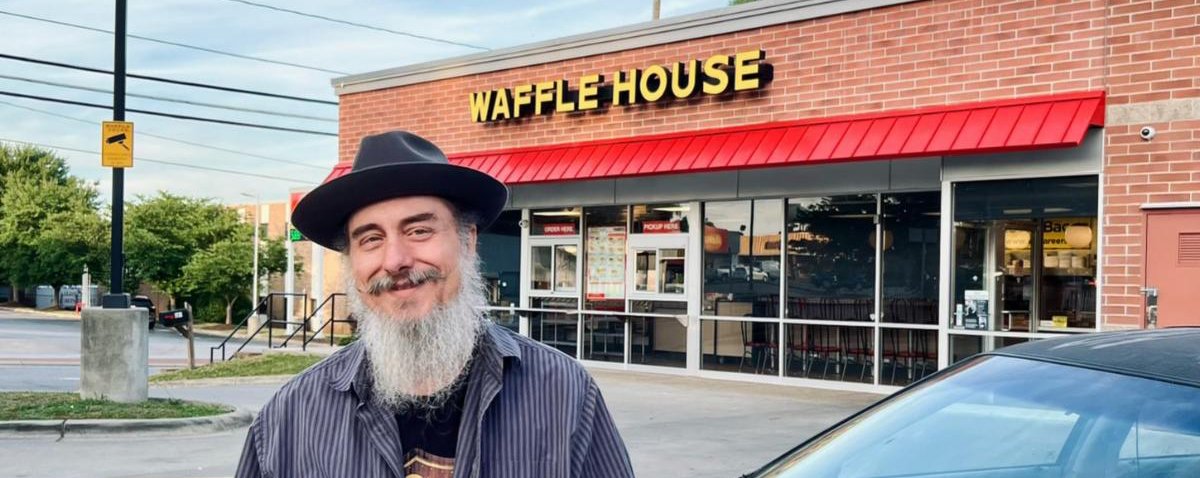
I need to visit the shrine that is Waffle House.

“Where Bojangles was my welcome-back meal, Waffle House will be my farewell bite. Nothing crazy.”

Where Bojangles was my welcome-back meal, Waffle House will be my farewell bite. Nothing crazy. I’ve eaten too well the last few days for tatters scattered and covered. As much as it pains me, I’m passing on the grits too. Instead, I go for the classic, the pinnacle of culinary excellence: Coffee and a pecan waffle smothered in a liquid most outside of Vermont would recognize as syrup. The place is mostly empty, with more staff than patrons. This is good since I need a booth. I need to sit where there is an empty space across from me.

Empty chairs placed around a meal have meaning. Signifying a readily available space, a literal seat at the table, to any who need it. For those of Polish heritage, particularly during Christmas, the expression Gość w dom, Bóg w dom is lived out.

A guest in the home is God in the home.

A reminder: Those we welcome to our tables can bless us as much as we can bless them. So keeping an open seat is a hopeful practice to encounter the holy. It’s a ritual of expecting and welcoming a blessing from another.

“Those we welcome to our tables can bless us as much as we can bless them.”

I keep this seat open for such an opportunity.

And in the same way, other expressions of faith leave a chair open for a beloved prophet; I leave this open for a prophet I knew named Don. We spent time in many Waffle House booths together, and this visit was no different. His spirit and memory are here with me now. I wonder if I’ll ever eat in a Waffle House again without making sure there is an empty seat for him.

Finally, with the coffee consumed and the cup empty, when I can’t muster another bite, I go to the counter to pay my check. I’m greeted with the sounds of familiar warmth wrapped in a southern drawl.

“Was it good, baby?” The angel behind the counter asks.

“Yes, ma’am. Thank you for that. Thank you for feeding me and feeding my soul. I haven’t been in a place that sounded like me in a long time. I appreciate listening to you sing as you cook. Thanks for serving me a bit of home.”

“Hot dog, baby! I like to hear that!” She says, clapping her hands. “You have a blessed day, baby,” she said.

I told her I was off to a good start.

Amen, and amen. Until next time ATL. Thanks for remembering me.

Not in friendly cooperation: The SBC and me

July 26, 2023 justin cox

This article originally written for ChristianCitizen.us
Image: Sun setting over a lake and a Bible. Photo by Aaron Burden on Unsplash

93.2 miles due east as the crow flies.

One hour and 32 minutes, give or take, depending on the never-ending construction that is Interstate 40.

This is the distance from the place of my birth and upbringing to the town of Wake Forest, North Carolina.

Affectionately known to those in the Tar Heel State as the location of where the “school used to be,” a college became a university when Big Tobacco came calling with the promise of a School of Medicine. A deal and a handshake delivered it back to those who chartered the school, the North Carolina Baptist State Convention. This Southern Baptist Convention (SBC) regional body planned to repurpose the campus and solidify an educational foothold in the Southeast, welcoming a new crop of students to pursue theological studies in the fall of 1951.

Five years later, the last remnants of the former Wake Forest College left the campus for the greener burley leaf tobacco-producing pastures of Winston-Salem. What grew from the fallen school’s stump became Southeastern Baptist Theological Seminary. For the next several decades, both institutions would experience prosperity and growth. They would face challenges, rising to some and succumbing to others.

What transpired for the SBC seminary in Wake Forest in the 1980s and 1990s is well documented. A resurgence/takeover of the conservative variety changed the school, other affiliated seminaries, and the entire denomination; it could be argued that it changed the course of the United States or, perhaps, sped it up in the direction it was already heading. In the end, a winner was declared, but everyone actually lost.

I will make the unforgivable faux pas and assume you’ve heard much of this story in some form or another. There have been enough raised glasses of grape juiced filled with triumph as there have been tear-filled chalices of sorrow collected in solemn remembrance.

Now, I didn’t live this. My parents were not Sunday School-attending Baptists. What family we did have that attended a Baptist church only did so because they had a fallout with the Methodists. My formative years coincided with the schism, yet I never knew it was happening in my backyard. I wonder now how many fringe-attending churchgoers went unaware too? Let’s face it, it’s a tricky topic to address on Easter morning or at a Christmas Eve service. Being blissfully ignorant has its advantages until it bites you in the ass.

My ass-biting moment came years later when I entered theological education. With Southeastern under new moral micro-management, accommodating seminaries and new divinity schools begin popping up to allow landing spots for those distressed of conscience. Be it serendipity or a level of divine providence I’m uncomfortable claiming, I landed at institutions that became such shelters. Classmates whose parents attended the old flagships like Southeastern spoke of their scars. Former professors of such institutions shared experiences with enough prodding, their relived trauma laced with a Titanic warning: nothing is unsinkable.

With the expulsion of Fern Creek Baptist and Saddleback Church, labeled as not fit for “friendly cooperation,” I’m confident that I don’t need to be in friendly cooperation with the Southern Baptist Convention or those that would suppress a woman’s call to preach and pastor.

This is the narrative I inherited as I became more comfortable in my uncomfortableness of being a Baptist. This right-in-the-rearview mirror story of lingering loss continues to shape me. Like an old injury acting up when the dark clouds close in, my spiritual bones ached this June at the news, as unsurprising as it was, of the SBC dispelling a handful of churches over those communities’ decisions to ordain and call women pastors. It would seem the pursuit of what one considers biblical orthodoxy can snap the frailest of freedoms.

Set aside the idea of local church autonomy for a moment, and let’s try to come to terms with an individual’s soul freedom. I imagine this notion of freedom is radical enough to include women. If not, the SBC and any other like-minded Baptists will have to relinquish any talk of a priesthood of all believers and abruptly stop affirming the ability of every person to relate to God without the imposition of a third party. And before any self-back-patting Baptists think they’re off the hook by hanging their ecclesiology hats of affirming women on the loose nail of church autonomy, maybe a closer look at the number of women holding pastoral roles in said groups would quiet the self-congratulatory chest pounding. Or at least move the needle in admitting the current hermeneutical lens needs a new prescription. If that’s the only reason women are supported, there’s a conversation long past due. And suppose women are seen, called, and affirmed by those floating in moderate-lukewarm waters. In that case, other voices can and should join them, and be welcomed with just as much enthusiasm and ease. That’s the kind of pride a domination or fellowship could be proud of, right?

Now there was a time I’d entertain a distinctly different lens than my own. In some instances, I still do, since self-constructed echo chambers, while satisfying, become horridly dull after a while. There was a time, too, when I wanted to be known for what I was for instead of what I was against. I’m discovering sometimes you have to do both. Be that as it may, in the case of women being called to preach and pastor, I don’t believe I can gain anything from the opposing view that says they can’t.

Thinking of this, I was reminded last week of a voice of a friend and mentor. I was still in an idealistic phase of my seminary experience when this occurred. For a few months, a group of rabble-rousing Baptists and other oddballs hosted informal chats at a local on-campus watering hole at Wake Forest University. There was diversity present, but most of us Baptist folks were on the progressive side of things. I came away from one of those meetings thinking about what would happen if we invited someone, perhaps a professor from Southeastern Seminary, to attend a future meeting. They could offer a different viewpoint, and maybe, just maybe, we’d have a chance to experience a truce passing for an act of reconciliation. I shared this with my friend to see what he thought, hoping I’d get an encouraging “atta boy.” My friend, of course, lived the schism. He watched friends and mentors get shown the door. He had seen communities broken and families split. Silence hung in the air between us for only a few seconds until he finally said, “That’s real amicable, Justin. I’m not gonna sit here and tell you not to do it, but for me, I’ve had those conversations. In fact, I’ve had too many of them. And I just don’t have any more left in me. That time has passed.”

With the expulsion of Fern Creek Baptist and Saddleback Church, labeled as not fit for “friendly cooperation,” I’m confident that I don’t need to be in friendly cooperation with the SBC or those that would suppress a woman’s call in any way. No, that conversation, that time, has passed, and I have nothing else to say. Nothing else needs to be heard, either.

I’m sure those who disagree with me would tell you the feeling is mutual. That might be the only thing we agree on.

Here’s to falling out of friendly cooperation.

ChatGPT and me. Thanks, but no thanks.

July 26, 2023 justin cox

This article originally appeared in ChristianCitizen.us
Image: Close up of a web browser open to OpenAI. photo by Jonathan Kemper on Unsplash

I have reached an age where I do not understand new things. Sitting and watching my oldest child navigate the complexities of apps on the family iPad as she flows effortlessly from game to game is evidence of my inability to assimilate.

Sure, I play the games. Even engage them, but I don’t get the appeal. I’m lost to the attractiveness of it all. The chasm-like disconnect is palpable. Maybe my father felt something similar watching me play Donkey Kong on our then cutting-edge 8-bit Nintendo Entertainment System.

Wait. Hard stop.

Why am I describing this as a shortcoming, as a flaw? Societal pressure? Am I struggling in an attempt to stay humble and grounded in my own self-awareness? Or am I succeeding at full-on personal flagellation by pointing out in sniper-like precision my inability to adapt? Is it fear that motivates my words? Is my sense of relevancy crumbling under the weight of post-modern times?

It feels like I’m standing at the end of a tunnel waiting on a torch to be passed to me that I know isn’t coming. I know this because I look ahead, I watch my oldest and realize the light is ahead of me. I look down and wonder, what do I do with the coldness left in my hands? Do I chase the warmth up ahead? Do I try and build my own fire? Can I be content? Can I thrive and carve out my own space in the darkness of my life? Will this light I offer draw others to me?

The developing talks and discussion around ChatGPT have caused quite a stir as they enter a territory I feel I have some stake in; the art and discipline of capturing words.

I snap back into the present, thoughts swirling, leaving me with a feeling as if I’ve just stepped off the Zipper at a local carnival. I know my feelings are manipulated by more than the Mario Kart and Wild Kratts apps glowing from the seductive tablet. My aversion is a growing gesture of hostility for all I don’t see as necessary.

These and similar thoughts have been simmering like a crock-pot in my mind. The developing talks and discussion around ChatGPT have caused quite a stir as they enter a territory I feel I have some stake in; the art and discipline of capturing words. What is ChatGPT? In the basic sense, it’s operating software. Think DOS on hyperbolic steroids. ChatGPT generates language with basic prompting using Artificial Intelligence technology. Imagine telling Siri to deal with an unnecessary email from your co-worker and having it done in the amount of time it takes to empty your garbage. Imagine telling Alexa to produce a blog post, program some computer code, and write an academic paper as you decide on Thai or Korean for dinner. And because ChatGPT utilizes reinforcement learning from human feedback (RLHF), a sensation mimicking back-and-forth conversation can happen between a human user and a chatbot. It’s still unclear, or debatable, how much a bot “remembers” from multiple chats with a user. However, discussions are taking place about the potential.

I’ll set aside the comparisons to Terminator’s Skynet, The Matrix, and Her and limit my focus to the circling whirlpool of worth I detect slipping away—not only a loss of creativity but a loss of relationships. This may sound dramatic, but I openly struggle to accept words possessing influence generated on a capture-all motherboard wrapped, packaged, and sent down an assembly line Henry Ford would be jealous of. I’m falling short of coming to grips with progress while clutching my wordsmith pearls of vanity.

As a minister and a Baptist one to boot, I’m constantly searching for the incarnational. I long for flesh and blood, a real presence across from me. I don’t see AI text generation meeting this need.

As a preacher, writer, dare I admit on some micro level, a public theologian, I perceive my words as a tool to construct connections with others. A link calling us to grander interconnections. An invitation to hunt for something greater than our own reflections. An act riddled with levels of intimacy, with as much emphasis on listening as speaking, a practice vanishing quicker by the day. When I write an article like the one you are reading right now, I provide half the needed space to give it life and meaning. The other portion is filled in by others like you. To read what I say and choose to agree or disagree, to decide to build off my thoughts or determine to kick my feeble ramblings to the curb. Leaving them and my ego to die along the shared-for-mass consumption road. This interaction with another soul is something I don’t believe AI can replicate…yet. Yes, we’ve established AI can fill a blank page, but it’s incapable of possessing an actual voice. It leaves us with a compilation of nothing but regurgitation dumped nicely into an informational ashtray. If chatbots are the new oracles of technology, a fateful discovery awaits those who bow at its altar—one where we realize we’re emptying ourselves into a hollow shame.

In 1987 the prophet from Kentucky, Wendell Berry, penned an infamous essay on a newfangled contraption; the computer. Berry believed this new innovation would demand much from him. Berry wrote, “In order to be technologically up-to-date as a writer, I would have to sacrifice an association that I am dependent upon and that I treasure.”[i] The association Berry was referring to was his spouse Tanya. She was, and is, his editor and contributor to many of his literary works. To introduce a computer, even with the promise to advance his writing prowess, was to lose a dynamic of their relationship he, and, I imagine she, had no desire to move on from since they did not view their relationship as outdated or needing an upgrade.

As a minister and a Baptist one to boot, I’m constantly searching for the incarnational. I long for flesh and blood, a real presence across from me. I don’t see AI text generation meeting this need. Are there benefits? I’m willing to concede and say there are, but I’m okay with missing out on them. I’ve been casually late to most everything in my life, so I’m built for the task of having the next hot trend pass me by. Only this time, maybe I’m not so much missing what’s happening but openly rejecting the invitation. I’m comfortable to continue producing the imperfect sentences, stories, and relationships I know are all my own.

Tina Turner kept the divine flame burning

July 26, 2023 justin cox

This article originally appeared in BaptistNews.com
Image: Tina Turner in concert at Murrayfield, Edinburgh. (Photo by Colin McPherson/Corbis via Getty Images) via Baptist News Global

At the age of 42, I walked down the streets of New York City for the first time. In my initial observation, I conceded and admitted the hype was real.

The city that never sleeps is the measuring stick of the known world and worlds yet to be known. And second, it’s fast.

I worked hard to ensure I kept up the pace, and so, I hit the ground at a run. My steps were quick and precise. My train number and destination were memorized. I had spent the following week making sure I wasn’t going to come across like a tourist or green-horned rube.

Of all the recommendations I read and received from more seasoned travelers, two stood out to me:

Act like you’ve been there before.

And for God’s sake, control the urge to look up. Keep the gazing at skyscrapers to a minimum.

I caught myself fighting this urge more than once, but can you blame me? It’s difficult not to ogle at something towering above what it surrounds. Monuments of ingenuity like the One World Trade Center, Empire State Building and The Brooklyn Tower make one marvel. And draw eyes, demand attention, invites wonder.

Tina Turner was a skyscraper.

And like them, she rose high and transcended, becoming something other. She went beyond those created boundaries of what an entertainer was supposed to be and came to represent so much more to so many people.

It was impossible not to gaze up at her. On stage, she was a dancing fire. Her trademark legs kicked up and created embers of unrelenting resilience. With nothing but a spotlight, she dazzled and absorbed all air out of a venue, no matter the size. Hers was a wild, vaporous, combustible spirit igniting and inspiring many.

For this alone, she commanded attention, but there were other factors. I stared over the years like others did.

“She dealt with and named those who wanted to put out her divine flame.”

I stared because she shared with the masses her struggles. She bravely talked about the pain she experienced at the hands of her partner. She dealt with and named those who wanted to put out her divine flame.

As a minister, I’ve been with people willing to share their trials and tribulations one on one. Their doing so is nothing shy of a courageous feat. Tina Turner processed her grief and displayed her transformation with all eyes upon her. She embodied the truth that resurrection is possible for those who feel their lives had been ended by their abusers.

Hope is a beautiful thing to witness somebody live out.

I stared too at her spiritual growth. The young girl from Nutbush, Tenn., a place where there’s:

A church house, gin house
A school house, outhouse

Where,

Twenty-five was the speed limit
Motorcycle not allowed in it
You go t’the store on Fridays
You go to church on Sundays

Where,

You go t’the field on week days
And have a picnic on Labor Day
You go to town on Saturdays
But go to church ev’ry Sunday

In such a place, Turner built on and deconstructed her inherited faith and explored paths that gave her comfort. Her embracing of Buddhism was well documented, and Turner credited its practices with saving her life. She would even pen a memoir in 2020, Happiness Becomes You, where she shared her spirituality and encouraged others to explore their own paths leading to consolation.

“Seek out that which gives you meaning and embrace the shifts in your understanding.”

Her own walk was a testimony: Seek out that which gives you meaning and embrace the shifts in your understanding.

So far, my reflections here come with a slight caveat. I write them as an adult who has lived and watched this skyscraper from afar all my life. This last bit I want to share is the first time I remember seeing her, and like that first walk in NYC, that memory is etched in my mind.

It must have been 1986 or 1987. I don’t recall how long it took for Hollywood films to become VHS tapes, that process is lost to time. Regardless, my parents rented a movie from our local Action Video store. I didn’t know who Mad Max was, or why he was thrust into the arena of the Thunderdome. I was too young to capture the plot. Yet, when the character of “Aunty Entity” was on the screen, I couldn’t take my eyes off her. I remember thinking to myself, “She’s beautiful.” When she told a young Mel Gibson he was “nothing but a raggedy man,” her infectious smile made me think it was a compliment. I wanted to be a raggedy man too.

As I sit thinking of the Queen of Rock and Roll this evening, maybe I still do.

Here’s to the true Queen of Bartertown, whose silhouette will forever dominate changing skylines.

These are some of the best pastors I know

July 26, 2023 justin cox

This article originally appeared at BaptistNews.com
Image: The Queer Eye team, from left, Karamo Brown, Bobby Berk, Jonathan Van Ness, Antoni Porowski and Tan France. (Photo by Iiana Panich-Linsman/Netflix — © IIANA PANICH-LINSMAN/NETFLIX)

Upon three different walls, I’ve hung my grandfather’s long gun. It first rested above a purple-painted fireplace in our home in North Carolina. When we moved to Vermont, it found a new residency in the parsonage’s dining room. Now in Connecticut, it appears between the stacks of books in the study that houses a growing library.

We’ve secured the piece each time with a set of gold-painted imitation antlers. A cheeky choice for a single-shot firestick a farmer used to hunt rabbits. The rifle hasn’t seen a single .22 caliber bullet fill its chamber since the man who traded for it passed more than 20 years ago. The only bunnies in its sight now are made of dust, of which there are many.

Like a dog that won’t hunt, I’m the grandson who doesn’t either. I’ve never fired it or any other gun in my life. This makes me as rare as a registered Democrat in Wyoming. A Southern man with a virgin trigger finger who couldn’t pick out a box of ammunition if his life depended on it.

This status, I’m sure, has landed me on the NRA’s prayer list. Its members desiring to lay hands on me for a multitude of reasons.

Why have the gun? It’s my grandfather’s.

Same reason I have my grandmother’s soup bowls. They were hers.

Relics have been made of less favorable items.

While maw-maw’s vessels still carry ham-hocked flavored legumes often, paw-paw’s rifle represents something less practical — the weight of a lesson: “If you hound after something long enough, you’ll get it.”

While I never chased after a hare, stalked a deer or assisted a wild turkey into crossing over into the great beyond, I have pursued other game with equally reckless abandon. For starters, words have been a consistent pursuit.

Running after a turn of phrases and strung-together expressions has been a hobby and a curse. On good days, I catch up to my prey and have something to show for it with a filled page or two. On other days, I count my loss and return home empty-handed. They call it writing and not publishing for a reason.

Not limited to idioms, the search for meaning, my faith, is another beast that often gives me the slip. I’ve been climbing my own Seven-Story Mountain for what feels much longer than several years. This journey has taken me into pews, led me to seminaries and placed me behind a pulpit. Moving me down a path that gets me closer but moves my target away in a taunting but caressing fashion. Sophia winks at me as she slides forever out of my view.

“Spooring” is when you track after the scent of an animal. My grandfather had a pack of hunting dogs that aided him in his endeavors. I suppose I have something similar — a beagle-like Advocate leading me in the dense forest of the world. A Spirit prone to spoor. Pushing me to notice where the holy exists. Catching my eye and compelling me to share what I’ve seen with others in case they want to join the expedition of what lies beyond the veil of their knowing. As is often the case, what one searches for is right in front of them.

And so I came to a query in my spiritual travels last week. A question posed by Christianity Today on its social media platforms asking its followers to “name examples of positive portrayals of Christians in TV and film.” The standard answers were there as expected.

Eric Liddell and Chariots of Fire.

The entire cast of the Chosen series.

Denzel Washington in The Book of Eli.

Martin Scorsese’s Silence with Andrew Garfield.

Others chose characters from The Waltons, Seventh Heaven, and the Andy Griffith Show. I’m sensing a heavily influenced Eurocentric pattern here.

Yet, I was glad to see Dawn French’s Vicar of Didbley receive a few mentions and another British series, Father Brown.

Ned Flanders from The Simpsons even made an appearance along with a smattering of appreciation for Jack Black’s Nacho Libre.

These were all fine answers, but not the ones that came to mind for me. No, what popped into my head was another series entirely. One I feel embodies the love of neighbor like no other. Constantly producing an over-the-top kind of affection that brings on the blushing of cheeks and too-many-to-count heart-inducing “awe-shucks.”

So what is this example of positive Christianity on TV? Netflix’s Queer Eye.

Antoni Porowski, Bobby Berk, Jonathan Van Ness, Tan France and Karamo Brown are some of the best pastors I know. Their presence manifests real change. They reach out and enter into the lives of those who are hurting and suffering. Their infectious cheer is impossible to ignore, spreading faster than insecurity at a middle school dance.

Over the years, they’ve helped a grieving widower move into the next chapter of his life, assisted a pair of sisters wanting to commemorate their late father’s memory by revamping the family restaurant, and even performed some needed theological work and deconstruction down in Georgia when a faith-filled mother needed help with a family life center on top of reconciling the way her gay son was treated by others in her church.

They’ve done it all, their lives a testimony of living out loud the “good news.” Showing up to support gay and trans people, pointing them to the LGBTQ community and the Pride available to them. If anybody is preaching through word and action that everyone is made in the Imago Dei better than the Fabe 5, I haven’t heard or seen them. Lord knows I’ve been on the lookout for such.

As my spouse and I make our way through the recently dropped seventh season, I wonder how much longer churches will continue to sin by not having a minister of inspiration or affirmation on staff. I know some weeks I could use a little Van Ness — “You’re strong, you’re a Kelly Clarkson song, you got this” — gracing mixed in with my passing of the peace. I wouldn’t turn down a Wednesday evening of sabbath-infused self-care either. Just saying.

With Pentecost nearing and a holy fire burning within, I’m getting a hounding nudge to seek what my faith has been missing. Beatitude-laced voices and queer eyes, proclaiming to me just how big God can be. That is something I can hunt after.

Going out for coffee and finding nourishment instead

July 26, 2023 justin cox

This article originally appeared at BaptistNews.com

Image: 123rf.com

“I’ve got to get out of this office.”

I don’t know if I say these words aloud or if they’re just in my head, but on cue, I push away from a computer screen I’ve been staring at too much for the last couple of weeks and make my way toward an exit.

“I’m stepping out for a minute,” I announce to the office manager before throwing myself into the heavy double doors leading outside.

With jacket buttoned and collar up, I step out of the church and set about pounding the pavement on an excursion to procure an additional cup of joe. The wind whips and snaps around me, demanding my attention as I try and push my hands deeper into my pockets away from its bitterly cold touch.

It would appear my body knows what to do, even if it fails miserably in achieving warmth. A saunter down the sidewalk to visit the local barista, while needed, is just an excuse. The truth of the matter is I need to clear my head, and while the cold air doesn’t blow all the stifling cobwebs away, it helps.

Nevertheless, my escape is tainted. Even with a short walk, I’m conditioned to plan and prioritize. Already I’m thinking of what comes next after coffee, and my mind meanders back and forth, unable to stay focused. I find myself recalling the most random conversations from the past week. Some provide hints of consolation, while others leave me no option but to force a smile and drop my gaze. All prompt me to wonder if anything actually ever changes.

This thinking takes me on a much longer journey than the one leading me to the Java shop.

I should be decompressing after surviving multiple Easter services, but the training I can’t seem to shake kicks in, and I slip into an all-out Ignatian-like Examen. Plagued with an inner dialogue of guiding questions, I try and name where I’ve encountered the divine presence lately and end up instead trying to answer where the divine presence has found me.

“I try and name where I’ve encountered the divine presence lately and end up instead trying to answer where the divine presence has found me.”

This opens a floodgate of vulnerability I’m not ready for as I try and name my location in the grand unfolding of creation.

Where am I in the universe? Somewhere between the struggle and the reason. Working frantically to stay out from under a wheel I’m both pushing and in danger of being crushed by. A conflicted state. Loathing what I see as my pedantic knowledge and envious of those who wield it better than I do. Burdened with a calendar full of loose ends. Left alone to gaze upward at the heavens, shouting in desperation at the bewilderment of the stars. Trusted to entertain and outwardly romanticize the ruins of Christendom while secretly dismantling what remains of it.

And like with any thoughtful query, I’m led to answer another: How am I right now?

Oh, a mess. Filled to the brim, running over, numb and up to my ears with institutionalism. Whittled down so much that I’m inching closer to my worse fear — afraid of being dull, boring and my words irrelevant.

Maybe the scariest thought I can share, and be ever so honest, is I don’t know how I feel any more, and that scares the shit out of me. Hear me when I say I still experience weekly joy. Receiving it from my family and in other surprisingly unconventional places. Maybe my struggle has to do with reaching an age where the purpose is foggier than it used to be. Yeah, that’s a helluva self-reflection, especially coming off Holy Week.

Pushing ahead, I realize I don’t often get the opportunity for this level of self-reflection, to turn inward, not when so much of my attention gets called elsewhere. I won’t spend time creating a trope of the chaotic days of ministers. I’m willing to wager you’ve heard enough of them or at least better ones than I could offer here.

For good or bad, the rumors are true. There is an all too real and slightly intoxicating desire to be busy and needed. Unfortunately, clergy have plenty to choose from to supply this fetish. Yet, for a couple of years now, the old standbys aren’t creating the same kinky sparks they used to.

“There is an all too real and slightly intoxicating desire to be busy and needed.”

Carried by my musings and lost in self-absorption, I almost miss someone calling my name. Out of an existential daze, I slip. Eyes scanning for the beckoning source when they finally land on two familiar faces. A pair of endearing rascals who operate a local business I hebdomadally frequent.

Even before their establishment officially opened, I began a relationship with them. Those of similar frequencies tend to search out and find one another, and so was the case with us. I was drawn to them, and they to me. We hit it off right away as people of a shared pitch.

Our chat picks up where we left off last time, conversation coming naturally. We laugh, cajoling one another with our recent doings and antics. Our back-and-forth banter is never forced, a noticing I tuck away, reminded yet again of the obvious fact I have a hard time doing the same in the presence of other pastors when we’re discussing subjects outside our vocational duties. My baroque flair often collides with my peers’ civilized professionalism.

Case in point. Before parting, one of my newfound compadres regales me with his undertaking of concocting homemade mead. In fact, the glowing yellowish and brown bottle he’s holding is filled with his fermented experiment.

“You wanna try it?” He asks.

I don’t hesitate, “Abso-freakin-lutely,” I say.

And there, off the beaten path of fetching coffee, my thirst for meaning is quenched after he untwists the cap. And with a swig, I sense what Mircea Eliade wrote of when he championed the term “hierophany,” the manifestation of the divine in the regular.

For me, this is seen and tasted in the floating and blended contents courteous of a man’s endeavor and bees’ efforts. I long for more ministry moments to be like this, not only for myself but for others.

We part ways shortly after this, and I continue back to the task at hand. Going through the motions needed to grab a coffee, but even before I get back to the office, I know my bean juice will be set aside and left to grow cold. My warmth for the day already achieved. My reason is secure. My purpose is still intact.

Here’s to helping others recognize the possible sacredness in everything.

Ministers, when’s the last time you frequented your local dive bar?

July 26, 2023 justin cox

This article originally appeared in the ChristianCitizen.us
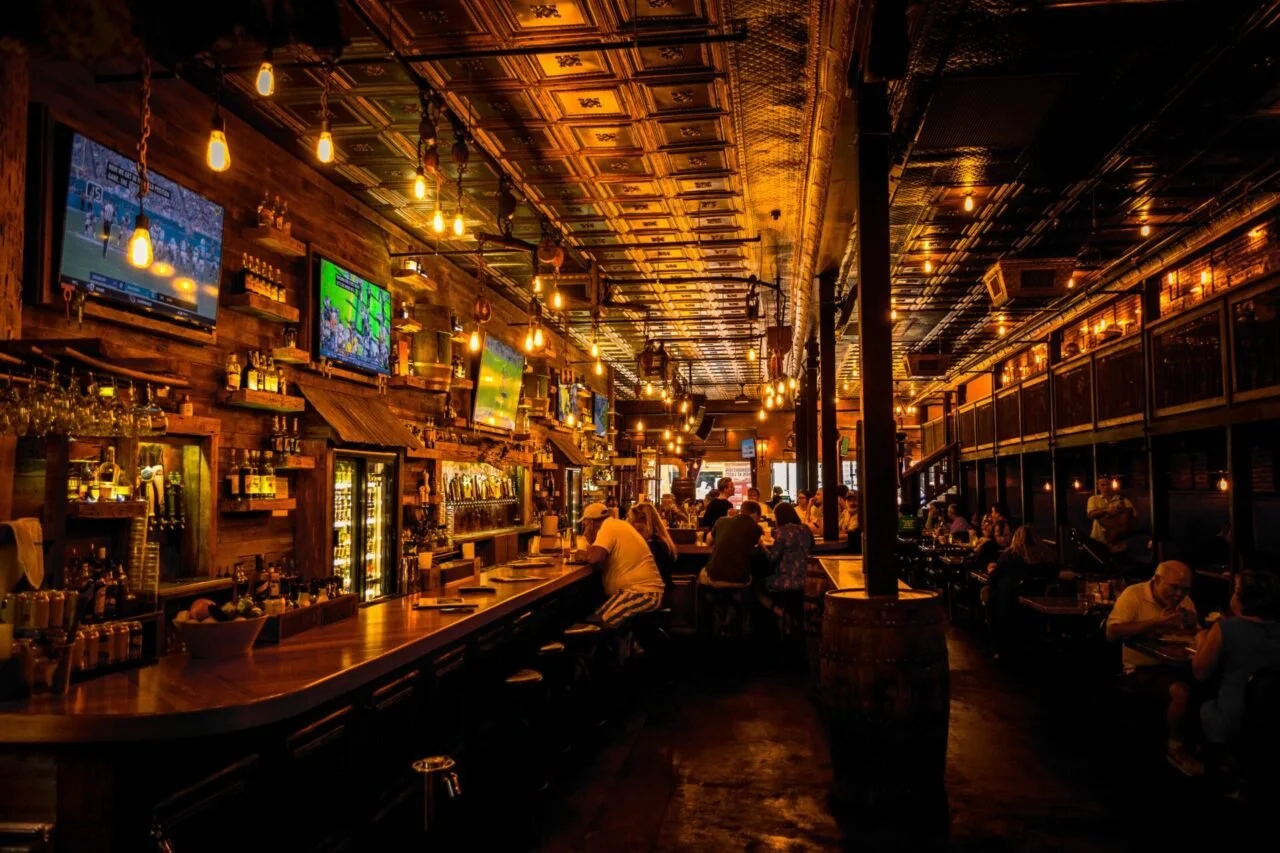
Image: Bar interior. Photo by Eric Tompkins on Unspash

*First, a disclaimer. The below reflection deals with a setting that could be problematic for some. Please consider it a mere suggestion to locate a space that welcomes you wholly.

I pull out the chair on the high-top table, and my companion does the same. We begin exchanging standard pleasantries, playing catch-up as we sit down. It’s been a few months since we made this happen. This is common when you’re both clergy and serve in adjacent towns. The demand of the steeple puts one in a bubble, and it’s harder to pop than you might think. The last time we met we fed the stereotype of pastors inhabiting their “second office” at a house of roasted beans.

As we settle in, there’s a pause in our conversation, and with her eyes glancing, she tells me, “You know, I don’t think I’ve ever been here before.”

Today we’re not meeting in a coffee shop. We’re not hitting up a Panera Bread, nor was it my invitation to sit under the alluring and comfortable fins of the goddess of Seattle, Starbucks, or the drip-king of New England, Lord Dunkin.

No, on this early Tuesday afternoon, we are sitting somewhere I feel I can let my hair and layers of suffocating semblance down. A spot oozing with austere simplicity. A setting built for a bawdy existence, filled with the backdrop of mindless chatter that could easily be mistaken for confessions, where the ceiling catches genuine prayers, and utterances resemble that of speaking in tongues stick to humming and buzzing walls as the hours dip into the night. Here, a combined chorus croons, sharing a hoped-for relief and reprieve from tomorrow’s problems. If Rod Serling was lending his voice at this moment, his reveal might go something like this: “You’re traveling through another dimension, a dimension not only of sight and sound but of mind. A journey into a wondrous land whose boundaries are that of imagination. Your next stop, your local Dive Bar.”

Those chasing some judgment-free sanctuary can find it between dingy neon lights and polished taps. Teetotalists, socialites, the lonely, scenesters, hipsters, blue and white-collar workers, the elephant and the donkey, regulars, and the stranger; God’s image marking them as sure as they have tabs needing to be settled. All are welcome, and all will be served.

My colleague and I have come to such an institution looking for the same, and I can’t think of a better place for two ministers to meet. 

Here at the dive, I’m exposed to a rare equality. My presence alone passes as my infinite value. I’m just Justin, and being him is enough.

You might ask yourself, what makes a dive bar a dive bar? Let us first determine what it is not. A dive bar isn’t the preferred choice of beer nerds and snobs. Forget debates distinguishing which porter is the smoothest or which coast grows the best hops. You’ll have little luck finding a group of folks in the back trying to recreate an elixir from an 18th-century German monastery. There are no monks at the dive bar. This isn’t a microbrewery. Instead, you’ll find saintly patrons congregating around their favorite watering hole where their coins of the realm can be stretched. There typically is a fair amount of diversity present, more than you might encounter during Sunday morning worship. So be prepared to spot a pair of hands with painted black fingernails inches from a set caked with dirt and grime courtesy of a long day’s work at the nearby tire shop. A good dive draws a mix of people to go along with their mixed decor and cocktails.

Why go to such a place, you ask? Allow me to enlighten you.

Such taverns of ill repute have and continue to offer much more than choice libations. Sure, I like an establishment whose cooler is two or three degrees below the health department’s recommended setting, resulting in my first sip being a test of fortitude to determine whether I have any sensitive teeth in my head. What else? How about a bartender with a little relational flair tucked away for a bit of witty banter when provoked? Or at least one possessing a steady hand for pouring a respectable pint of Guinness. Fan of fried items paired with a decent burger or sandwich? If not, I’m unsure if I, or our Lord Jesus, can help you. Prefer musical offerings ranging from Waylon Jennings to Depeche Mode instead of multiple flatscreen TVs? The dive bar’s jukebox has you covered. Or maybe like me, you have a penchant for sitting under low lighting. I believe entering and exiting a dive should feel like entering and exiting a cave. I want my center shaken during those trespasses. I want to walk out into the late afternoon and be taken back by the sun’s brightness. Like in the book of Joshua, time should stand still in a dive.

But there’s more to it than that, so let me elaborate.

On top of ambiance preferences and fried mozzarella sticks, a dive bar provides agency of choice. You can remain seated and lean into an intimate discussion. Or you can stand jostling, anticipating the spark of connection. There’s permission given to cherish being in public with no requirement to interact with others. You can mingle with folks or choose to ignore those beside you. You can be present yet exist somewhere else. It’s the opposite of “Cheers”; not everyone needs to know your name. There’s beauty in this for a person who does a fair amount of required engagement and talking most days. I’ve discovered grace in a space where I can utter less than 20 words in a couple of hours. I can absorb what’s around me, and that’s enough.

But of all the things I mentioned, none is more sincerely true than admitting this is one place where I feel I can be the most authentically me.

I can be irreverent, insecure, and a walking mess of emotions. I can be quiet. I can sing too loud when a good tune comes on. I can show up with my problems or caddie along a bag of celebrations behind me. I can be me here when, in most other places, I’m expected to be someone else. How can this not be sacred? To be received with communal hospitality. Where those shouldered around me couldn’t care less about my eschatological view or what atonement theory I think is better. Here at the dive, I’m exposed to a rare equality. My presence alone passes as my infinite value. I’m just Justin, and being him is enough.

Fellow barfly and ragamuffin priest Brennan Manning once said, “God loves you unconditionally, as you are and not as you should be, because nobody is as they should be.”

I continue to learn this lesson in those dive bars I’ve visited. Maybe Manning did too.

Cheers.

Baking Chocolate Chip Cookies as Pastoral Care

July 26, 2023 justin cox

This article was originally written for GoodFaithMedia.org

Image: Stock Photo Illustration (Credit: Lisa Hanly / Unsplash / https://tinyurl.com/47m3ej7f)

I’ve constantly struggled throughout my life at having to do something a particular way because folks told me there was only one way I could do it.

Since middle school, I’ve dug in my heels on plenty of hills of resistance, starting with any math teacher who ever stood before me.  To a kid who hated numbers, my eighth-grade algebra instructor was the stuff of adolescent nightmares.

For a type of eternity only a 13-year-old can know, I tried for a year to stay out of his sight, attempting in vain to blend in with the cheap linoleum floor and painted concrete walls.

Perhaps it was the attention-seeking haircut, overly ripped jeans and a pair of Converse so abused that copious amounts of duct tape were required to hold them together that made this endeavor difficult? I imagine my first expletive-laced sincere prayer was released as an inaudible whisper during class.

Every petition I lifted up through clenched teeth for momentary invisibility went unheard, leaving me called upon time and time again to come forward and show my peers how I achieved the answer to the previous evening’s homework assignment.

“Come on down, Mr. Cox. Let’s see what you came up with,” his authoritative voice would say.

Chewing broken glass would have been less painful. What kind of sadist gets excited when they come across ac + bc = c(a + b)? I’ll take the prose of Beowulf any day.

With chalk still sliding, I’d hear, “Can anyone tell me where Mr. Cox went wrong?” The cult of the arithmetic-inclined would raise their dirty paws.

“He forgot step three,” an eager voice would chime from behind my knife-exposed back. As always, my formula was off. I’d pose faux positivity, roll back to my seat and begin counting the remaining minutes of suffering I had left.

Sometimes, while my method was off or out of sync, I’d still luck out and get the correct answer. Sure, my way took longer and created what many saw as more complicated and unnecessary steps, but it worked for me.

I came away from algebra class with one certainty; my way was never the right way.

Since then, I’ve done enough self-work to realize my self-worth does not need squaring or to be perfectly placed between parentheses. I now see my unconventional approaches to problems and situations in the same light as R.A. Dickey’s knuckleball: uniquely beneficial and a thing of beauty if brought out in the right moment.

Case in point: what some of my more refined collar-wearing colleagues might appropriately label a “pastoral counseling session.”

These types of sit-downs are typically done in a relaxed and non-threatening environment. The office of a minister is a likely go-to spot. Another, an open and empty sanctuary. A cliche coffee shop might work in a pinch for a more informal sit-down. At-home visitations go over well too.

All expected suggestions and part of a relied-upon formula. However, sometimes you have to let go of the expectations and formulas.

“Did you remember that I was coming?” This was said with a smile, but I could tell my visitor was reeling a bit.

In the doorway of the church’s commercial kitchen, she loomed. Looking intrigued but hesitant. On the other hand, I was a man in motion, stringing movements together in a dance of fluidity as she looked on.

“Of course,” I say back. “I just thought we could make some cookies while we met. That alright?”

Apparently, it was. For the next hour, she emptied herself, telling me everything from how she came to be part of our faith community to the current dark night of her soul. All the while, I spun, added chocolate chips and scooped cookie dough on trays.

My busyness never came close to stifling our conversation. Instead of sitting across from one another, positioned between an office table of separation and continuing to climb a frozen mountain of rigid unmoving expectations of what we should be doing, we rolled unexpectedly like the sea tide.

Our dialogue advanced and pulled back until finally crashing into one another in an explosion of recognition of the other’s presence.

It must have been the second batch when I offered her a cookie. They were warm but, thanks to the whole wheat flour, already developing a snappy texture worthy of mastication.

Their crunch acted as a third voice in the room, calling us to grow quiet while we enjoyed their deliciousness. Finally, she broke the silence.

“You know, I didn’t know I needed a cookie today. This is wonderful. I’ve never done anything like this before.”

I had to agree. It was different, unscripted and experimental. A way of counseling I had never tried. An example I hadn’t run across before in any book with Wayne Oates’ name printed on the cover.

After she left, and I’m alone cleaning the kitchen, I hear the voice of that math teacher in my head: “Let’s see what you came up with Mr. Cox.”

“Something better than you could have imagined,” I reply with a confidence I didn’t possess all those years ago.

And somewhere deep within my spirit, I know this is true.

Maybe, just maybe, my roundabout way might be the right way after all.

‘Grandmas make the best banana bread’

July 26, 2023 justin cox

This article was originally written for BaptistNews.com

Image: 123rf.com

With the morning sun wrapping rays around the two windows in the bedroom, causing a pale light to creep steadily in from their edges, my oldest child rustles the bedsheets. It’s like she can feel the idea of warmth, the promise of warmth, better than my cold toes pressed beside a space heater ever could.

This isn’t surprising. She still sleeps in the bed with me, a treasured ritual I’m not ready to let go of yet, and her body temperature would rival an incubator. A gift I’m thankful for during New England winters. She’s awake now, which means I’m awake.

“What day is it?” she asks. Time, calendars and schedules hold no power or importance to her. I tell her it’s Monday. No preschool for her today. From somewhere downstairs, there is the noise of her younger sister sliding across the wooden floor on her “busy bee” toy she received for Christmas.

She hears this, her gaze meets mine, and a second later, she flips the heavy blanket back over her head. I hear a muffled “hide” come from her burrowed state. I indulge her as I often do and scurry under the covers.

There, lost to the world and with our noses inches apart, she whispers, “Is today my birthday?”

“There, lost to the world and with our noses inches apart, she whispers, ‘Is today my birthday?’”

Her actual birthday was earlier this week. Her birthday party was a few days later. I can see how this is confusing to someone still struggling to distinguish which shoe goes on the right foot some mornings. I tell her no and try to explain she has a whole year before the next one.

“I’m still this many, right daddy?” She says the number and holds up her hand. I tell her she’s right. She then asks me how old I am. I use her method and hold up both hands and appropriate digits; a four and two stare back at her.

“Four two?”

“Forty-two,” I tell her.

She looks again at my hands and then into my face.

“That’s too many,” she says.

Under the blanket, engulfed in her warmth and shared darkness, the truth escapes me more effortlessly. “On most days, it is kiddo.”

On most days it is.

Those “most days” fell in succession this past week. In my 10 years of congregational ministry, I can’t recall a heavier load of 24-hour periods.

A kid’s birthday, complete with Trolls-themed decorations and multiple renditions of “What’s the time, Mr. Wolf?” resulting in children scattering in every direction when “dinner time” finally flies from someone’s lips.

My mother-in-law was visiting from the Midwest to celebrate the occasion with us. We enjoy her visits, long or short as they can be, but it doesn’t change the fact there’s another adult in the house, and routines get shaken and stirred to breaking points.

The beasts needing weekly slaying were present. Staff meetings, emails, phone calls, sermon preparation, worship planning, visitations to schedule. A full calendar, one producing an emptiness that left me to wonder if I’m doing any of it at an adequate level.

“With plates spinning, I picked up two more.”

With plates spinning, I picked up two more: an Ash Wednesday service and a book study series to kick off Lent. I’ll give up this year what I’ve given up the last few: any notion of time for myself. And like the pandemic, I have a funny suspicion I won’t believe those voices telling me Lent is over when I look around and see myself and others are still living in the wilderness.

Finally, there were the funerals. Two celebrations of life, four days apart. I’ve officiated six since the first of the year.

Funerals are hard. They are difficult. They are draining. To say otherwise would be to downplay the significance of loss. In those spaces, I’ve learned my best practice is to take care of practical concerns first and then ask questions that allow me to shut up and listen. Talking for a preacher is easy; you’re expected to. Listening and learning to be quiet? Not so much. It’s a skill, and fortunately, I knew to hone it long before I received the “Rev” in front of my name.

I spent time with both families and took notes as they told me about the ones they loved. A man who was involved in local sports, coaching his own kids, grandkids and a slew of others. His passing was unexpected. A woman whose ancestors are founders of the community where I now reside. Her people literally built the town. Sitting with her family, I learned her granddaughters think her banana bread is the best in the world.

Both are people I didn’t know from Adam.

And somehow, I’ll lead both families through one of the most emotional days they’ll ever experience.

By the second service, I was operating on muscle memory. The funeral director, who I’m comfortable calling by his first name, came into my office and asked how I’m holding up. I didn’t have the energy to put up the facade.

“Right now, I’m toast.”

He didn’t reassure me we’d get through the next hour. He didn’t even give me anything resembling a rehearsed regurgitation. No thoughts and prayers from him. He just looked me in the eye and said, “I bet you are.” Sometimes being seen and heard is more than enough.

I don’t remember too much from the service. My notes worked as my crutch, and I leaned on them as much as I did the pulpit. All but the part about the banana bread. When I mentioned this detail during the eulogy, I locked eyes with both young women telling them, “Grandmas always make the best banana bread. Mine did too.” When everything ended, I was thanked and told the departed would have loved what was said.

“The family and friends there shifted their feet, appearing as if they didn’t want to leave but were unsure of what to do if they stayed.”

The following morning, we gathered for the act of committal at the cemetery. It was cold. A winter storm was closing in, and flurries of snow kissed the ground and the foreheads of a family looking to say one last goodbye. My part was short. The presence of death is finalizing, often lingering longer than it should, but this wasn’t the case here. It felt quick, and the family and friends there shifted their feet, appearing as if they didn’t want to leave but were unsure of what to do if they stayed. I stood off to the side, feeling more like a trespasser as the seconds ticked on. With my purpose no longer needed, I try blending in with the headstones around me. Slowly the family found their footing and began to move, and somewhere amid handshakes, a wrapped bundle of tinfoil was placed in my hand.

“We went home after the funeral yesterday and made this. We heard you like to bake and wanted you to have some too.”

For once, my reputation preceded me in a good way. The granddaughters had made their grandmother’s banana bread to remember her. Sharing one last story of who she was to me in a way I could take into myself. Now it was my turn to thank them.

I left soon after. Climbing into my vehicle, I peeled back the tinfoil, pinching off a chunk, and was filled with the gospel that grandmas really do make the best banana bread.

Most days, be they days of Lent or any other exhausting time, I need reminding of such goodness. I blasted the heat on my face all the way home — barely noticing the drying tears still clinging to my cheeks.

If my daughter saw them, I’m sure she would say they’re “too many.”

Bless your heart for producing professionals and satisfied saints when radical prophets are needed

July 26, 2023 justin cox

This article was originally written for BaptistNews.com

Image: "St. John the Baptist," El Greco

A recent webinar with my alma mater made me realize theological schools and the church face the same challenge today: How to be risk-takers in a world that only values stability.

Let me say upfront, I’m not someone you’re likely to catch at an alumni weekend. I didn’t even show up for my own graduation. Yet the task and the outcomes matter to me.

And so I sat, floating faceless in the purgatory that is Zoom, listening for the neatly packaged future of Wake Forest University School of Divinity.

To say the last several years at Wake Divinity have been tumultuous would be an understatement. The loss of Dean Gail O’Day in 2018 (may she rest in peace) left many in mourning. There was hope and excitement around the hiring of Dean Jonathan Walton. However, his involvement and vision were hindered by a global pandemic. Walton recently departed to become president of Princeton Theological Seminary.

Now despite my contrarian ways, I’m proud of my education, even though I realize post-graduation I haven’t come close to mastering a damn bit of divinity. If anything, it mastered me. I know how fortunate I was to have studied under professors I’d stack up against anyone in their respective fields. Yet, I know institutions are institutions. Big, demanding, self-serving.

All this brings to the surface some of the insecurities I’m still trying to sort out. Maybe it’s because a person with my upbringing never felt at home in a place covered in ivy. Goes to show one can earn a cap and gown and still have difficulties wearing them.

As the meeting progressed, words and phrases flowed forth from transitional leadership, bumping into and skipping over one another, reminding me of the Sony Discman I had velcroed to the dashboard of my first car: “Challenges” — skip — “Cultivate” — skip — “Sustainable” — “Community” — “Opportunities.”

I know the standard drill in an interim period. The point is to stay afloat, reassure donors and redirect worry and concerns for a date found later on the calendar. I’ve heard this familiar message coming from pulpits, too, because I’ve been guilty of the same. I’ve preached over the heads of my congregations with just the right amount of empty padding. In those moments, I’ve witnessed their faces when I’ve lost them — eyes glazing over like they’ve come off the conveyor belt at a Krispy Kreme.

I had that look on my face during this webinar. Feeling an uneasy sensation in the pit of my stomach, I began to understand the challenges of being on the other side of the conversation.

“There needs to be an element of danger to religious education if it’s to be deemed worth a damn.”

What was it that was missing here? What has been missing from my own sermons when congregants’ eyes glaze over?

I looked around my desk, grabbed a pencil with the eraser bitten off and scribbled in a notebook: “Nothing about this seems dangerous, so does any of it matter?”

A message for theology schools and churches alike. Where’s the gamble? Where’s the danger?

There needs to be an element of danger to religious education if it’s to be deemed worth a damn. A type of danger capable of inflicting change, challenging established ideas and perceptions. Could we offer enough scrappiness to make the principalities and powers take notice and feel threatened? Is this what’s missing from seminaries and churches alike?

Yes, we can be comfy and nonabrasive, like a morning drive with coffee and K-Love pumping on the radio, but this makes any talk of resurrection suspect.

With more compassion than I knew I had, I breathed out three words in an empty room while shaking my head at the folly of it all: “Woe to you.” An old-school indictment with the same double entendre as “Bless your heart.”

“Woe to institutions and churches alike for attempting to play it safe when dangerous spaces are what the world needs.”

Woe to institutions and churches alike for attempting to play it safe when dangerous spaces are what the world needs. Bless your heart for producing professionals and satisfied saints when radical prophets are needed.

Wake Forest isn’t alone in navigating these waters. Divinity schools aren’t the only institutions struggling with these issues. Far from it. Many face the same indictment, whether their enrollment numbers reflect it or not. Churches and search committees will have to give an answer for desiring clean-cut, no-wave-making mascots and be made aware they flirt with the disaster of running out of people before their endowments dry up.

With this in mind, I was reminded of the words of Wendell Berry in Jayber Crow describing an institution as a floating island: “It was preparing people from the world of the past for the world of the future, and what was missing was the world of the present, where every body was living its small short, surprising, miserable, wonderful, blessed, damaged, only life.”

What do I hope for my alma mater? The same thing I hope for the church: A recognition of the fragility of it all. This would show trust, vulnerability, and the realization we all need a whisper of audaciousness in the face of avarice — something to cause the suits in the establishment to furrow their brows in worry.

Doom-scrolling, sourdough starter and three kinds of kin

July 26, 2023 justin cox

This article originally appeared at BaptistNews.com
Image:123rf.com

During a late-night doom-scrolling session on my phone, those all-knowing algorithms of social media converged and hacked up a hairball-like collection of my recent online search results.

Cosmic Creepers, our jumpy black cat, a master of regurgitating all things grossly arbitrary, couldn’t have done a better job himself of producing intriguing clumps of information worthy of my disdain and curiosity.

Searching for sleep but finding no rest, my thumb flicked upward, pushing me ahead in search of meaning like the main character from a Cormac McCarthy novel. Hoping the universe would show me a sign somewhere between status updates and trendy memes, I started to notice I was being bombarded with ads for bread starters. Specifically, a sourdough of West Coast origins whose roots date back 200-plus years.

A small time capsule of flour, water and the work of angels collecting yeasts in the ethereal plans. A holy trinity whose essences combined produces a substance worthy of being broken over Communion plates. A starter, a small but crucial addition, gives needed lift to those looking to raise loaves. A starter, working like a set of lungs, breathes life into where it goes.

The one being subliminally peddled to me has been going strong since Nat Turner received a sign from the heavens sending him revolting for freedom’s sake.

“The last thing I need is another Mason jar filled with questionable contents pushed to the back of the fridge.”

I held back from clicking the enticing link. The last thing I need is another Mason jar filled with questionable contents pushed to the back of the fridge. I’ve got a regular Beekman’s World science lab happening behind jars of Duke’s Mayonnaise, containers of buttermilk, not to mention forgotten vessels of Ghosts of Starters Past. Opening the door to grab a snack is an experience equal to peering down into a valley of dry levain. In such moments I’m left hoping and praying they’ll all live again.

I scrolled on, but like a beagle hound catching a scent, I couldn’t shake an idea from my head.

How could something so old, small and seemingly trivial continue to create? Have you ever seen the minuscule amount of starter needed to make bread? We’re talking 50 grams, give or take.

I’ve scraped heftier things off my shoe while walking through a neighbor’s yard. Their property riddled with the efforts of two large canines whose fertilizing capabilities would cause Shetland ponies to blush. Both cases are downright impressive, if not a little off putting in odor.

Tackling the art of bread making, wading into the kneading-waters, a revelation awaits: the devil is in the details. Meaning the most infinitesimal of elements has the most impact.

I sat with this thought for an afternoon, swirling it around like a fine spirit, afraid to drink too hurriedly or deep out of fear I’d miss appreciating it. One thought turned to another, and my lens of faith broke down the door the way it tends to do in a disruptive fashion. My answer came in a series of contemplative questions:

  • What part of my faith lies dormant, waiting to be activated?

  • What tiny ingredient impacts my character and feeds a hunger for how I desire to live my life and call in the world?

  • What wild agent causes my soul to bubble over and push outward, challenging all it comes in contact with?

I don’t know if I arrived at a definitive answer, but my heart fluttered, and my spirit sharpened when I thought of kinship.

Where I’m from, there are three types of kin.

You’ve got blood-kin, those who share a piece of your genetic makeup. I’m not a good enough writer to describe how our blood-kin connections bind us to one another, especially on occasions when difficult conversations ensue. Leaving me shaking my head at the chasm, the folly, the unsettling gap unfurling in my genealogy. All I can muster to myself and to anyone listening is, “Yeah, I know cousin so-in-so is out there, but hell — they’re family.” While they might get regulated to arm-length status, blood-kin are within reach, for better or for worse.

“Yeah, I know cousin so-in-so is out there, but hell — they’re family.”

Then there are kinfolk we choose to build and create with. People who are invited in or crash into our lives. Some of them met us at the lunch table in fourth grade, where our bond was sealed over having the same Fruit by the Foot snack in our matching Teenage Mutant Ninja Turtles lunchbox. Others greeted us at our college dorm as room or hallmates, walking awkwardly with us into a future we couldn’t plan for even if we tried. Or, some caught the Letterkenny reference in the work break room when we announced to the group, “pitter-patter, let’s get at ‘er.” Many in this category I would accompany to investigate a strange bump in the night. Maybe.

And finally, there is the kin I never met. Those I’ve heard of, learned about in classrooms and stumbled upon in citations. Most entered my life through a portal composed of dripped ink and paper. Their thoughts pouring into me are the same as the ones I’ve never been bold enough to speak aloud. Regulating them to be held in a state of prostration beside me as I lay in bed at night. Offering me proof of some soul existing out there, in another time and place, who were and are like me. My spiritual kin.

Who are they? A people the Rev. Daniel Featly would describe as indecent “dippers.”

A brood who held no loyalty to institutions but were compelled by their convictions. They sought total separation between church and state. Refused to bear arms against another in the name of war. Opposed the death penalty. Would not serve on juries to judge others or swear on a Bible, even if it had the king’s name on it. A people who believed encounters with the divine were the business of an individual and their Maker. A freedom extended to all.

To live counter to this was to practice an abhorrent faith.

What happened to these people?

Where are these baptists today?

Felix Mantz, Menno Simmons, Hubmaier, Grebel, Blaurock, Joan Boucher, Smyth, Helwys, Anne Hutchinson, Bunyan, Roger Williams, Backus, Hannah Lee Corbin, Leland, Helen B. Montgomery, Rauschenbusch, Thurman, King? Where are these unapologetic voices crying in today’s wilderness?

Why do I struggle, in the words of sparse steeple attendee, the prophet farmer Wendell Berry, to accept their “contrariness as my inheritance and destiny?” The invitation, their call, for me to journey down the beaten yet out-of-the-way path behind them. My feet stepping where they stepped, on the unconventional brush first stomped down by the despised Galilean himself. Where will that path lead? Most likely being called everything but a child of God by those who would call me a neighbor right before the start of the next trustee meeting.

Being a pastor, a preacher, you learn to let go of much. You leave things behind in every move. Like an item dropped off at a holiday bazaar, you hope what you left finds a good home and takes root.

I have let much slip away, but my contrarian kinship, a life-giving “starter,” I tote with a reverence usually reserved for family heirlooms. Because in the truest sense, it is from my family, and I’m done apologizing for my upbringing.

Call me friend, brother, blasphemer, backslider, heretic, one of them bullheaded baptists, or s.o.b. So be it.

I know I’m in good company.

What Food Reveals About Shame Culture and Insufferable High Horses

January 31, 2023 justin cox

Stock Photo Illustration (Credit: Hermes Rivera / Unsplash / https://tinyurl.com/yrbvk567)

This article was written and first published for Good Faith Media on 1/30/2023

I’m a creature of habit. I like to tell people it’s my children who spiral if their nighttime routines get out of whack, but really, it’s me. I’m the one who comes a bit unglued without a rinse, lather, repeat structured order.

A recent evening culminated with a triumphant scene of my spouse and me basking in the silence of sleeping kiddos. This is the cherry on the sundae.

Finally, I can catch my breath and perform the monotonous. Scraping off uneaten noodles into the proper receptacle. Stacking dinosaur-covered onesies in Tower of Pisa fashion. And tuning out by tuning in to podcasts.

My playlist isn’t what you might expect. No Crackers and Grape Juice or Home Brewed Christianity podcasts for me. Been there and done that. I’ve drunk enough from those split chalices.

Theology and church-related shows are fine and dandy, but for the last 10 years, I’ve had one foot under a steeple and the other in higher education. This double whammy has left me dry and salty like Lot’s wife.

You can only talk shop so much, and I scratch that itch enough during the week. My library consists of shows stacked with eldritch horror stories and food-related content. I’ve chased chilly tales for as long as I can remember, but food? Where do I begin?

Food connects me with others. The shows I listen to cover topics ranging from different foodways involving people and regions, preparations, applications and intersectionalities – all coming together to make a one-stop hot pot of alluring accounts.

Listening to Proof, Gravy or The Sporkful podcasts, I can’t help but chase a recurring thought. This is what I wish practical theology was: relevant and helpful. Truth be told, I’ve gotten more excited about executing a perfect buttery and fluffy omelet than I have discussing patristics.

I see food representing the most intimate details of a person in the most tangible ways. What covers our plates showcases a level of vulnerability, often accompanied by a strong opinion about what and how a dish is made.

How do I know this? Just ask 10 people if macaroni and cheese is a main course or side dish, and watch the sparks fly (the correct answer for those keeping score at home is, it’s a vegetable, at least on the menus in my South).

Serve a dish without respecting the food or those seated beside you? You’ll likely wind up somewhere between a misunderstanding and an all-out unpardonable affront.

This brings me to David Chang. But first, a disclaimer. I like Chang. I’ve followed his rise in the culinary scene. I’ve watched and thoroughly enjoyed his appearance on series like Mind of a Chef and Ugly Delicious.

I’ve read his books and tried a few of his recipes. I ordered his products and devoured them. I appreciate what he’s brought to the food/hospitality industry over the last 20 years.

His restaurants, Momofuku Noodle Bar, Ko and Siam are all culinary expressions of his prominent presence, and he’s got the Michelin stars to back it up.

Chang is paving a new way with a voice still championing an old-school pay-your-dues mentality. He honors and reveres the chefs who came before him, making him an enigma who is actively leaving behind an industry that has shaped and given him meaning.

People, even those outside the James Beard Foundation, give him their attention. If this is your first time hearing Chang’s name or his backstory, know this: his voice wields power and influence.

Earlier this month, Chang shared his thoughts on Costco’s rotisserie chicken. He’s not a fan. Chang claims their birds are not properly seasoned and are pumped full of nitrates, making them inedible.

As you might imagine, he received pushback. Many defended the fowl as tasty, but most took Chang to task for looking down on a modern blue plate special. Their collective voices sarcastically egged on Chang while pointing out the value of a $4.99 yardbird that could be stretched into multiple meals.

As I followed this story, my mind grabbed two certainties. First, people have strong feelings about what they choose to eat. Don’t shame them for it. Second, folks don’t care to hear your views from up on your high horse. Don’t judge them.

Famous celebrity chefs aren’t the only ones who slip and forget these Solomon-worthy words of wisdom. Lots of people do, especially those hunkering down in pious pews.

As a pastor, I find myself walking beside those still trying to shed the skin of the snakes they met in churches.

Christians are some of the best heavy hitters at dishing out the one-two punch of shaming and judging. Shaming individuals for not conforming, requiring them to leave their thoughts and questions at the door. Or judging them as inferior by morality and understanding.

I do not know what is worse: looking down your nose at someone because you don’t believe their baptism stuck or informing them with smugness of how a Christmas tree doesn’t come down until January 5.

Gag me with a loaded Costco cheap chicken spoon.

And if you do, my hand to God, I won’t think more or less of you for it.

Midnight Phone Calls and Maintaining Friendships

January 15, 2023 justin cox

Stock Photo Illustration (Credit: alexandru vicol / Unsplash / https://tinyurl.com/5xsz6usa)

This article was originally written and published for Good Faith Media on 12/29/2022

My great-grandmother Grandmaw Martin used to say, “Nothing good happens after midnight.” As a young man, I lived the opposite of her statement.

In the witching hours, I experienced some of my most pleasurable, fool-induced joys and a series of brushes with dangerous dives into debauchery.

Yet, this has changed as I’ve grown older. While I still love the night, I’m prone to think if bad news comes, it comes under the stars.

Phones buzzing after the sun goes down leave me feeling as cold as a casket. Lasting anywhere from 10 minutes to an eternity, they change everything and leave you empty. So was the case with my last one.

The storm crow caller and I went back and forth in a rally that would have given Borg versus McEnroe a run for their money. Him giving me details. Me making statements sounding more like questions, my voice rising at the end of each sentence. I can feel confusion setting up shop in the lines of my face as much as I can feel the coloring leaving it.

Saying goodbye, I numbingly staggered downstairs into the living room and found the couch. How does one sit on the edge of something and somehow still manage to sink into it?

My spouse mouths a concerned, “What?” as I stare back at her. I start and try to relay the story, but my words fail me. Everything feels as if it’s failing me.

What utterances I can push up and out come slowly, like the hands of reluctant adolescents asked to pray at a Wednesday night youth group meeting.

Finally, I choke forth the words, “Don is gone. He died.” Gutted might not be the best word, but it’s the first that comes to mind.

Somewhere in my wails, gnashing of teeth and tearing of sackcloth, my tongue lets loose a truth, and immediately I feel exposed and vulnerable.

Why was this different from other losses I’d experienced?  This person was my friend. And I don’t have many of those.

This hits me harder than those misread cracks of pavement I’m prone to discover on my skateboard. Now rolling my way into early middle age, these misjudgments are harder to walk away from. So are the “cracks” I’ve missed surrounding authentic friendship.

This subject is tender, like my now creaking knees and ankles. Leaving me hobbling more than I’d like to admit as I tell those watching, “I’m fine.”

This isn’t to say I haven’t done well with acquaintances because I have. Hell, I’m a bona fide champion when it concerns having peers of the clergy variety.

What’s missing? It’s the rudimental and raw friendships I forged on the playgrounds of yesteryear.

I appreciate my fellow clergy peers. But honestly, I want to feel like I’m more than my vocation. I’m more than my job. I don’t want to surround myself with folks who do what I do. It’s an echo chamber of bland existence. One I’ve seen from afar and loathed.

Also, I wholeheartedly appreciate my relationships with parishioners, but those are always a bit strained due to an unnamed power dynamic. If enough of them gather around a committee table, they can ghost me out of their lives and out the front doors of the church.

Where I come from, friends don’t typically sign your paycheck, and I’ve got a hundred or more folks who think they sign mine. All this has produced a pastor who is great at being relational but whose close friendships can be counted on one hand, leaving me a few fingers to spare.

I shared as much with someone recently. And like my friend Don who passed, this person has consistently allowed me to be me in their company. Welcoming my contrarian ways and speaking words of life into mine.

I told him as much after not seeing him for several years, explaining that I didn’t want to go through the rest of my life not letting people know what they mean to me. I said all this while holding a squirming toddler, which made my authentic remarks seem clumsy.

He reciprocated the sentiment, and we offered one another an embracing right hand of fellowship. We departed one another with a prayer to do better.

A few weeks later, my friend passed along an article in The New York Times naming the issue we both felt. Written by Catherine Pearson whose work deals primarily with relationships, the piece dealt specifically with men and engaged in what has been labeled “friendship recession.”

She does diligent work, using her journalism skills to speak with voices ranging from mental health counselors to podcast hosts who’ve approached the subject. Building to a crescendo of desired companionship, Pearson describes a few helpful steps.

Some are what you might think, such as being intentional about your need for close friends and being prepared to work at it like any other meaningful relationship. She insists vulnerability is key.

We should tell others we care about them from time to time. Checking in with those we see as friends builds stronger bonds, so sending a random text goes a long way. And finally, find activities you can do together.

Wherever you go and whatever you do, just make sure you do it together.

It’s all practical advice and sounds good in theory. Meet people, share life with them, and be there for one another. Easy, right? There’s truth in these approaches.

And yet, I read these recommendations, and it’s hard not to feel a wave of inadequacy washing over me. What do I have to offer that would hold someone’s attention for any length of time?

My spouse, a saint in this department, would probably say otherwise, but she’s biased, kind and made from a stock richer than my own. She’s an unfair measuring stick to use on anyone else.

In addition, between my job and my family, I don’t have much time to give. At least, that’s how it feels. So, I wonder, why risk rejection? Or worse, a contrived and superficial closeness?

I’ve lost count of the times my ears have vomited after hearing someone say, “Yeah, I know Kyle! Love that dude,” and seconds later, say the same thing about the elusive McRib sandwich. Call me high maintenance, but I need to be on a higher pedestal than questionable boneless pork shoulder.

Setting my default cynicism aside, why do I feel compelled to work at this? Because I don’t want to gulp down another remorse, shame-filled whiskey Highball concoction like I had to when I heard about Don.

I don’t want to hear from others assuring me that he knew how I felt about him. And, while I’d like to believe he did, I’d rather cut back on the second-guessing moving forward.

I want to tell folks the things I should have told him, and maybe this makes me a candidate for someone’s close friend. Or maybe, I’m trying to walk too tight of a rope and will fall off as soon as I get distracted.

Either way, I can live with it.

Blessed are the mess makers

December 23, 2022 justin cox

This article was originally written and appeared in Baptist New Global 12/19/2022. Image credit, BNG

I am amazed at how the tiniest habits have followed me throughout my life. A cluster of repetitive acts stacked upon one another like gathering cornerstones.

Building my character while leaving me to discover who I am and who I’m still becoming. I notice them more as I’ve grown older, especially those passed on to me by others. My parents are the bearers of many of them.

As the child of a blue-collar third-shift worker, my job was to follow my father around the house before he left for work. Our nocturnal ritual involved touching stove knobs with our index fingers to ensure burners were indeed cut off. We did this before shouting words of confirmation through wood, fiberglass and steel. He’d Marco me with, “Is it locked?” I’d Polo him back with a “Yes, Pop. We’re good,” as I jiggled the handles of our front and back doors. Our collective conscience satisfied, he’d depart as the darkness arrived.

An accepted uneasiness existed until dawn broke, signaling the end of my sentinel duties. My reward for keeping the home fires burning: a Hardee’s Gravy ‘N’ Biscuit.

On top of my night watchman responsibilities, I could count on weekend house cleanings as much as I could Saturday morning cartoons. Baseboards wiped down, table tops dusted, toilets scrubbed to the best of a 14-year-old’s capabilities.

From those years, I fear my hands still faintly carry an aroma resting somewhere between bleach and Pledge. And while we did our fair share of deep cleaning, the true goal was an appearance of tidiness. Random pieces of mail? Stick them in a cabinet beside cereal bowls. Nails and hammer used to hang a picture from two days ago? Lose them in a junk drawer along with the 33 packets of Chinese takeout duck sauce. Just keep them counters clear. Our floors were the same way — desolate dystopian wastelands courtesy of Bissell and Swiffer. Backpacks, jackets and shoes were tossed into closets, buried deep with no coat checker to help to sort them back out.

“Everything had a place — the place being wherever it fit.”

But Lord, you never had to worry about dealing with clutter. Everything had a place — the place being wherever it fit. For better or for worse, it’s the mantra I can’t seem to shake.

My current living conditions challenge my inherited rearing. With two small children, the spaces I occupy now have become an archipelago of unwanted toys. Imagine the most tchotchke-filled Applebee’s you’ve ever been in, but in place of your uncle’s California Raisins collection sporadically splattered across the walls, it’s dumped all over your floor.

That’s home life for me.

Navigating an injury-inducing funhouse. Where heels are bruised on Melissa and Doug’s wooden milk cartons and toes are sheared off thanks to random chairs placed in once-cleared walking paths. Their blanket-covered presence bringing to mind an Occupy Wall Street tent scene. The odds of stepping on a broken crayon or a week-old shriveled pickle are not so much likely as they are to be expected.

Kevin McAlister would be proud. Maybe Jigsaw would be too.

For the past several years, I’ve been fighting my upbringing to keep all things Spic and Span. An uphill battle whose altitude reaches K2-like proportions. Expeditions in our living room alone leave me tottering over toys and the remnants of my children’s chaotic constructions. I’ve tried to ignore it the same way I learned to ignore the accumulation of leaves on a lawn. Passing them off to a weekend not existing on a Julian or any other known calendar. Yet, I can’t shake the constant scanning and sempiternal stumblings. Leaving me both loose and disturbed like the plot of land around a cemetery’s newest resident.

Recently I came again to this state of disarray, defeated and unsure how much more I could take. Here, in the throes of Duplo blocks and kinetic sand, my oldest had stockpiled a portfolio of artwork rivaling that of the Louvre. Projects consisting of crudely glued pictures, stickers and original sketches.

“Here, in the throes of Duplo blocks and kinetic sand, my oldest had stockpiled a portfolio of artwork rivaling that of the Louvre.”

None of these were the first. Only the next wave of what has been a steady stream of creativity spilling out from her preschool folder and appearing from bursts of inspiration in her room. An emerging muse she has with no start or end, leaving nothing but a trail to follow. I sort it the best I can. Gathering and collecting in hopes of preserving something I’m unable to name.

With my curating abilities in overdrive, her pieces wind up in the most unlikely but convenient places. Many of which happen to find their way into my library of books. Folded and creased between worn pages and busted spines, her art lingers like the unrelenting caw birds who frequent our backyard. Demanding attention, petitioning me, offering an awareness I’m apt to overlook if not careful.

And Lord knows, I’m trying to be more careful about the things I tuck away.

Recently I found one of her early portraitures while searching for a cookie recipe. A rough sketch but nonetheless distinguishable. Her small hands bringing to life the depiction of “peas in a pod.” I ran my hand over the slightly raised texture of pressed crayons, feeling the all-too-familiar sensation of losing my footing as I did.

No clutter or toys under my feet this time. The culprit was her and her art. Witnessing what she could do with so little while making me feel so much made my knees buckle. I stood there blindsided, realizing her small art pieces were more than makeshift bookmarks. They were guideposts of her presence in my life. Signs of her entering in, coming alongside, helping me find my place in a world which now includes the two of us.

If the stories of Martin Luther’s conversion hold any truth, with thunderstorms and crackling lighting making the divine known, my daughter’s penchant for Crayola offer the same to me.

Holding her illustration, I’m sensing I’ve spent a lifetime stumbling over all manner of things I should have been paying more attention to. The least of which were children’s playthings.

I’ve staggered through jobs and appointments, unaware of how I made it as far as I did.

I’ve lost traction in relationships with friends, relying far too often on their outreached hand to steady me before the two of us toppled over.

I’ve floundered with family, missing moments I can’t get back.

Always off somewhere, clinging to the transient, searching for the next hit of what’s around the corner. These constant pursuits have left claw and bite marks all over me. Like a stray cat that would have rather been left alone, my empty achievements came with self-inflicted wounds I’m still licking years later.

Sometimes the light going off in my head is ultraviolet, revealing hidden surprises like those found in some of the cheap roadside motels I’ve had the pleasure of crashing in for a night. Bringing to my attention all things I’d much prefer to stay in the dark about. Maybe this is the kind of light preached at revival meetings or at least the kind Hank Williams saw drifting along as a cowboy troubadour. A light hitting and leaving me as close to the Damascus Road as I’ve ever been.

“I’ve always offered better prayers knocked on my ass than the ones I’ve given on bent knees.”

I’ve always offered better prayers knocked on my ass than the ones I’ve given on bent knees. Dazed by the divine in the drawings of a 4-year-old, I swallowed self-assured hubris and muttered words of gratitude for the messes of my life, understanding they have shaped it for the better.

Those messes worthy of my attention.

Those wreckages worthy of reverence.

Those beautiful shambles I mistakenly passed over and swept away instead of surrendering my attention to. Truly a revelation.

A revelation I want to pass down to those sticky and glitter-covered hands of my children. Reminding them, like me, they’ll trip and stumble over themselves more than they will anything else. Hopefully, they’ll see their stumbles as holy highlights, leaving them captivated and eager for more of the same. Hopefully, they’ll heed some of my words and come to understand them in their own time. Until then, I’ll be right behind them — cleaning and supporting all their consecrated messes.

For the sake of my own selfishness, I’m hopeful they’ll continue to make them.

Blessed are the mess-makers indeed.

In Aunt Minnie’s kitchen, I learned about fellowship, food and family

November 23, 2022 justin cox

This article/reflection originally was written for and originally appeared in Baptist News Global on 11/23/2022. Image Credit my own.

Where the Appalachian region of North Carolina crashes against the central Piedmont’s rolling hills, I came of age. Where the exploitation of workers centered less on what took place in coal mines and instead played out inside the walls and on the lines of hosiery mills, my people lived.

In such a place, my family huddled near one another like balls on an uneven pool hall table. Collecting and sharing space while trying to position ourselves for a level of independence rarely felt or achieved.

My grandparents lived an earshot away from my childhood home, Aunt Sue lived beside us, and great-aunts Emmie and Minnie lived a short distance down the road. In our curio family, they were another level of exceptional.

My life and theirs were connected by blood and separated by more than cow pastures and tobacco fields. A learned chasm of contentedness was present, made possible by lives existing before and during the Great Depression and second World War. They were two of nine children. Two of seven who would reach adulthood. Two of seven held captive to a piece of land while their siblings orbited places and farms of their own both miles and worlds away.

Why these women stayed put and lived together, becoming co-matriarchs to my family, mimicking the Baldwin Sisters on The Waltons, is a story for another day.

Both possessed expressions and charms from another time, beautifully distinguishable as Blenko glass to any who wandered into their spheres. They were attached, and yet each was one of a kind.

Emmie, the older sister, dipped snuff and told stories about “haints.” She wore short-sleeve dresses with long strains of pearls. Aunt Em was notoriously competitive at card games, offering no quarter during Skip-Bo tournaments on rainy afternoons. Letting loose a cackle while she crushed the spirits of adults and children alike. Her choice of transportation would put most small boats to shame. I can still see her sturdy frame sliding behind the wheels of cars with more metal than an Ozzfest concert. I never knew her to be scared of anything except a rabid “mad” dog. Having been chased up a tree by one as a child, the trauma and caution around canines never left her.

Aunt Minnie was just the opposite. Swearing off tobacco products before I was born, her vice was sweets, especially boxed varieties of pecan ice cream. She let me win every board game we ever sat down to play. Her stories were less spooky in nature, consisting of Jack Tales and other folklore with roots in the mischievous and playful. Aunt Minnie never drove a car, satisfied with a perpetual shotgun status. Her wardrobe consisted of blouses and pants with fluctuating shades of tan and taupe. She was absolutely terrified of snakes, a trait she successfully passed on to me, and where Aunt Em seemed indifferent toward food, Aunt Minnie enjoyed cooking.

While not as polished a cook as my maternal grandmother, who worked alone for efficiency, Aunt Minnie warmly welcomed my small hands into her kitchen. Her presence and touch filled in the cracks of my inexperience — making what we created together whole and complete in a way my own undertakings never could.

It was she who introduced me to all sorts of simple dishes. Peas and dumplings. Boiled potatoes, smashed, covered with slabs of butter, and topped with salt and pepper. Green beans from the family garden. Her larder was stocked with the uncomplicated. Her stove was stripped of pretentiousness. Her oil-cloth-covered farm table ever ready to host our own America’s Test Kitchen.

Afternoons with her might see a heavy reliance on Betty Crocker or involve watching a German chocolate cake develop from scratch. She saw it as her responsibility to keep the neighborhood kids stocked with oatmeal, sugar and chocolate chip cookies.

“For Aunt Minnie, preparing food wasn’t only about what we made but how we made it.”

For Aunt Minnie, preparing food wasn’t only about what we made but how we made it. And most importantly, who we made it for.

She and Aunt Em have since passed on. I’d like to imagine they’re still accompanying each other on the other side of eternity.

For years I kept Aunt Minnie’s gifts to me tucked away. Buried in the basement of my recollections. A few years ago, I started sifting through those memories. Or maybe it’s the other way around; they began sifting through me.

The clearing of those cobwebs started with a parishioner asking me how I made my biscuits. “How ’bout I show you,” I asked? A date and time were picked, and I went to her house.

We made my biscuits and a cobbler-like dessert she pulled from a collection of worn recipe cards. While weaving around the kitchen, we shared techniques and stories. We had so much fun we decided to do it again. I brought out my jalapeno cornbread. She passed on to me a pie crust recipe I still use today. Between cups of cornmeal and shortening, we cut our lives into one another. Our words and laughter spilling over onto countertops like soft flour, unwilling to stay confined to its canister. Our appreciation for the other being the same — uncontainable.

The experience was infectious. I carried my desire to cook with folks to my new faith community. When I baked the bread for my first Communion service there, I was approached by a woman, pelting me with praise and dangling in front of me a bait I had no choice but to take.

“I heard you baked the bread,” she said

I Southerned up a quick, “Yes, ma’am.”

“You know I make pretty good bread myself,” she stated.

Grinning, I replied, “Prove it.”

I received an official invitation from her a week later.

June’s home was an interactive time capsule, with walls filled with a lifetime of collected cast iron and seasoned anecdotes. Her voice guided me over periods of her life, many involving her late husband. His presence was everywhere. His mastery of woodworking permeated and warmed our discussion.

“If Jesus had any tears left after the death of Lazarus, I believe, my hand to God, he would have wept again out of carpentry envy.”

If Jesus had any tears left after the death of Lazarus, I believe, my hand to God, he would have wept again out of carpentry envy. Small intricate carvings rested on larger pieces. The edgings and legs of dressers held thoughtful details my eyes had trouble catching. In the way falling snowflakes bombard a windshield, piling up and making it impossible to distinguish what lies ahead, June’s husband’s skill did the same, coming so quick I couldn’t properly process and appreciate it all.

As we moved from room to room, June’s hand would lightly brush a piece, drawing my attention to it, while she’d empty herself of how it came to be. I could have listened to talk about the functioning hearth in her living room all morning, but our bread was ready, and she insisted we enjoy it while it was still warm.

In a rare period of silence, June placed a thick and hearty piece of bread in front of me, and I struggled to suppress the impulse to tear into it while she secured her own. Unscrewing a small jar filled with a butter and olive oil mixture, she smeared a large dab on each of our slices. Finally, we indulged, our chewing a communal prayer, the only sound worthy of capturing the goodness we were simultaneously sharing.

My time with June was the first Communion cookery moment but not the last. In the past few weeks, I’ve wandered into other homes eating and preparing food with those intrigued enough to invite me and my family in.

Gathered around a large kitchen island, I witnessed a dozen hands equipped with peelers shed the skin of several pounds of local apples. Our collected slices of fruit soon found a home in a community bowl, growing higher and higher like some redeeming Tower of Babel. Not even the grabby hands of curious children scurrying about could topple what we had raised.

And while our combined efforts went smoothly, the demonstration of my pie crust was not as successful. Blame the unfamiliar environment, blame the Crisco, or blame the heavenly elixir resting in my Dubbel. My dough stubbornly refused to cooperate. I sheepishly apologized while making it work the best I could with all eyes watching.

“My uneven crimping glared at me with a judgment typically reserved for those who knew they had no business at Promise Keepers event.”

The pie would hold, but the imperfections stared back at me through the holes in the top of the crust. My uneven crimping glared at me with a judgment typically reserved for those who knew they had no business at a Promise Keepers event. With clocks ticking closer to our children’s bedtimes, I was forced to abandon my unbaked pie along with the gnawing of my shortcomings. However, the hosts assured me they would see it through.

And did they. Later that night, my phone buzzed from a text with an attached image. On the glow of my screen set my now fully baked pie, my mistakes covered by leaves cut out from our hostess’s extra dough from her own pie. Her message to me read: “Your pie is amazing! I love the texture, and it’s subtly sweet. I’m watching the Great British Baking Show right now and would give you the Paul Hollywood handshake.”

I read those words and thought they could have come from my Aunt Minnie. And just like that, I was back in her kitchen. Encountering the importance and goodness of supportive words and hands. Only this time, appearing like festive foliage on top of a rustic apple pie needing a little extra care. Those leaves, falling on, covering and encouraging me the way I imagine grace should. Spilling out on the paths of our lives and then amassed into piles. Ready to be jumped in whenever life gets a little too hard.

Aunt Minnie and her kitchen showed me how love and care can come together in the simplest ways.

Now my neighbor’s kitchens are doing the same. They’re a continuation of a space occupied by people who look to feed both my spirit and soul in ways food prepared with caring hands only can.

I’ll take the recipes shared with me and tuck them away. Pulling them out when I need them the most. Passing them on whenever I get the chance.

Halloween reminds me of that time I was called upon to lead a ‘cleansing’ at a family’s home

October 31, 2022 justin cox

Image Credit: Baptist News Global & 123rf.com

It starts in late September with the pricking of my skin and spirit; autumn creeps in. Resembling Tom Fury, the lightning rod salesman from Ray Bradbury’s Something Wicked This Way Comes, bringing with it “a storm like a great beast with terrible teeth.”

A welcome change, mind you, marking the start of a high and holy season while signaling the end of those unbearable sweltering summer days. My senses rise like a 1960s Cadillac antenna, becoming attuned to more than the changing leaves, the permeating presence of pumpkin spice, and the scent of Yankee Candles Crisp Campfire Apple. Every year it seems I’m reminded that to be alive during the month of October presents the invitation to welcome the foreboding.

And like a well-worn jacket, I find myself sliding easily into all things spooky. For example, my streaming services, usually plagued by the abyss of children’s programming, with disturbing recommendations for shows like Coco Melon and Blippi, are now filled with all manners of the odd and macabre.

I find myself backing off my regular rotation of food-related podcasts. Instead, returning to Old Gods of Appalachia and Scared to Death for my ominous nightly fix. As a tortured soul under a full moon, my choice of reading selections goes through its own metamorphosis. I feel practically possessed by a need to devour the Scary Stories to Tell in the Dark trilogy, but I can’t bring myself to stop there. I leave a trail of broken book spines in my wake. A growing body count of works by authors such as H.P Lovecraft, R.L. Stine and Billy Martin (formerly Poppy Z. Brite) find a new home beside my nightstand. Threatening to topple over like brittle and loose New England tombstones.

“There is a particular one I often think about when the temperature drops to pumpkin-carving weather.”

Horror films and books. Tales of terror and paranormal podcasts. All of it stirs and disturbs me, beckoning a response to recall and confront my own eerie encounters. Most of these bumps in the night I try to leave good and buried underneath loose floorboards in the recesses of my mind, but like any good “haint,” they manage to creep out. And while many are from my juvenescence years, there is a particular one I often think about when the temperature drops to pumpkin-carving weather. And it begins the way all good ghost stories do, with a “Hey, there’s something weird happening in my house.”

Now, I’ve been in places that looked haunted. The old homestead where my great aunts lived would give most folks nightmares. Large and looming. Set back off the road in between two large tobacco fields. An appearance suggesting my great-grandfather wanted nothing more than to make folks feel uneasy when he built it right after the Civil War.

I’ve wandered through old barns that looked to house something other than hay and feed. I’ve been in low and earthy basements filled with frightening feng shui. Where a stairwell, plunging down to the first circle of Dante’s Hell, wouldn’t have been totally out of place.

“If anything was unsettling about the place, it was how forgettable it was.”

Yet none of this was the case for the house I was asked to perform a “cleansing” on. A ranch-style home tucked away in what appeared to be an older neighborhood on the outskirts of North Carolina’s RDU area was nothing if not run of the mill. Brick, a low-pitched roof, and enough windows in need of blinds to warrant opening up a business account at the local Home Depot. If anything was unsettling about the place, it was how forgettable it was.

Walking up to the door, I wondered why I, of all people, a Baptist minister, was asked to do this. Well, invoking the spirit of New Orleans blues musician and psychedelic rocker, Dr. John, I’ll say “I was in the wrong place, but it might have been the right time.” I’d been ordained just the week before, and the person’s home I stood in front of knew this. With our paths crossing regularly, they felt comfortable approaching me about something bothering them. Something they understood as falling under my field of supposed expertise.

From our awkward first conversation about it, I wasn’t sure what they expected me to do. Maybe they thought churches passed out a standard exorcism playbook to newly appointed clergy? Maybe they thought my education and ministerial training covered this sort of thing? Did they want me to show up with a collar and stole in tow like in the movies? I silently hoped not as we continued to discuss the matter. They didn’t feel threatened by what they had seen or heard, but they were concerned. A few more discussions took place before I finally told them what I felt comfortable doing.

It wasn’t as if I didn’t believe this person’s story. It’s just that I’d never personally witnessed anything like the events they were describing. Unexplained shadows. Glimpses of people outside their windows who’d disappear after a second glance. Strange noises, unsettling whispers, heard by multiple people.

Nope, can’t say that I have. Those encounters were, and are still, above my priestly pay grade, and I wasn’t looking to change my clearance status, thank you very much.

“Those encounters were, and are still, above my priestly pay grade.”

Plus, it wasn’t as if I didn’t already know dark and malevolent forces existed. I have seen enough in the form of systemic oppression, levels of ingrained racism, capitalism run amuck, negligence in the care of creation, and the blatant hypocrisy of what passes as bipartisan politics to cause me to pull the covers over my head at night.

Forget a fear-induced “satanic panic.” What really scares the shit out of me isn’t an abandoned building with hooded figures gathering around a pentagram but a group of walking suits prowling Wall Street. Those are the powers and principalities I’m most worried about.

And so I gave this spiel, more or less, with a heavier dose of tact, before I went to the house. Making it as clear as I could. “This is how I view what you’re experiencing, and here’s what I think we can do. Does this sound like something you and your family would find helpful?” In the end, it was, and a house blessing was what we landed on.

Once inside, I read Scripture, blessed doorways and prayed over those there. The whole visit took less than an hour and was mostly uneventful.

Well, except for one part.

There was this storage room.

As I made my way through the house, I came across a small flight of stairs. There, peering down at me, was a door. When asked what lay behind it the family said it was a storage room. Filled with the clutter of a lifetime of living and old furniture.

As I bounded the steps, the air around me cooled ever so slightly. I reached out to touch the tarnished handle, only to discover it was locked. Strange, but not totally out of place, as there were small children in the home.

No one seemed to know where the key was. I laid a free hand upon the door’s surface, and there was a sensation. A responsive reaction to my contact. Not off putting, but did I feel an awareness present? With instinct and imagination blending together, I asked the family to join me at the top of the small landing. There I encouraged them to lay their collective hands on the door as I prayed.

“Was the look on their face suggesting they were feeling something too?”

Before closing my eyes, my gaze locked with another’s there. Was the look on their face suggesting they were feeling something too? I didn’t ask. Whatever mysteries lay waiting on the other side of the door, tucked away with random knick-knacks, weren’t going to get the chance to introduce themselves. Curiosity wasn’t going to kill this cat.

The prayer ended, the moment passed, and I left the family. Hopefully better off than when I found them. In the coming weeks, I touched base with them. They had nothing to report. The activity they were experiencing had ceased as best as they could tell. And as with any good ghost story, this one ends on a cliffhanger.

I don’t know what became of the family, losing touch with them a few months later. I’d like to think my role as a pastor in the situation was more offering comfort than dispelling evil à la Father Lankester Merrin. Yet, when those dreams of October come around, I think of them. I wonder how they are. I wonder if their house is still quiet and if they ever found the missing key to that peculiar door.

I wonder about all these things, but pray I never get an answer to them.

Happy Halloween.

This article was written and published for Baptist News Global on 10/31/2022

How Don Durham and I Became Neighbors

September 22, 2022 justin cox

The above piece was written and originally published on Baptist News Global.

In the first chapter of The Glad River, author Will Campbell introduces two main characters, Claudy “Doops” Momber and Kingston Smylie. Flung into the cold military-industrial machine, the men first cross paths during basic training.

Be it the impending war, or the need for authentic connection, they waste no time on small talk. Kingston opens up immediately and shares a revealing personal story about his upbringing. Exposed to a level of intimacy he isn’t quite ready for, Doops is left both intrigued and taken aback by the suddenness of Kingston’s vulnerability. A bond forms, linking the two in ways only a lifetime of proximity to another soul can do.

Doops senses this and starts the following dialogue:

Doops put his hand on the man’s shoulder and turned him around, looking directly into his eyes. “Do you trust me, Kingston?”

“Yes. I trust you, Doops. Do you trust me?”

“Yes. I trust you.” They stood shaking hands again, looking each other squarely in the eyes.

“Then we are buddies?” Kingston asked. Neither face showed any expression.

“Yes. We are buddies. I’m your buddy.”

“Are you my friend?”

“Friend?” Doops replied. “Friend.” He repeated the word but no longer as a question, his voice dropping. “That’s a stronger word. We’ll have to see. But we’re neighbors. Like I say, we’re neighbors. I know that much.”

Don Durham and I became neighbors over plates of Indian food in the summer of 2016. We became neighbors after a mutual friend thought it a good idea for us to know one another. I, a soul-searching “seeker” who was uncomfortable with being called a Baptist. Don, a bridge-burning nonconformist who had left the comfy position as president of the Cooperative Baptist Fellowship Foundation to farm and give away food.

The Don I met was several years removed from the mover and shaker who wore suits and carried a copy of the Wall Street Journal under his arm. Others can and have testified of that Don’s existence.

“He didn’t so much march to a different drum as he unburdened himself of the drum altogether.”

My Don was longhaired, bearded and sported bibbed overalls. He’d already traded in the slow-moving wheels of denominational life for the slow-but-life-giving tires of an old tractor where tinkering with the latter tended to produce more than the former. This Don was unfiltered and edit-free. No longer tethered to an institution, he didn’t so much march to a different drum as he unburdened himself of the drum altogether. Our states of perpetual dissension made us prone to find one another.

As we swapped backstories that day, I remember our food arriving. We shot each other looks trying to get a sense of who would bless the curry. It was Don who raised his fork in one hand, and as I recount the memory with all the tempting beauty nostalgia offers, a ray of sunlight streamed down through the windows, illuminating his head, making it appear as if the heavens had opened and God almighty herself had kissed the crown of his pony-tailed head. The unfolding scene produced a saintly halo around Don, making him a living and breathing icon an arm’s length away from me.

My sanctimonious vision was cut short when he offered an authentic set of words that immediately solidified our bond. Words I interpreted as heartfelt and holy. He hit me with, “Well, hell, Justin. I’m thankful for all this,” while motioning to the food and me, his present company.

I knew instantly he meant what he said, but I wasn’t aware this was the first prayer of a future friend. I wasn’t aware of how much his words would change my life in the coming years.

And I didn’t know the text I received from him earlier this month, informing me of his plans to attend my installation service, would be the last words I’d ever get from him.

“I mourned for the times we had and the ones on layaway.”

It was late at night when I received news of Don’s passing. It was one of those phone calls you hope is a mistake. The voice on the other end of the line was reliable, yet, I still could not believe it. Through spells of numbness, I sobbed. I mourned for the times we had and the ones on layaway.

Like many going through grief, I experienced a level of denial. Surely the news couldn’t be true. I resisted mentioning his name for the next few days. Hoping if I didn’t speak it, Don would somehow reappear, quipping like Mark Twain that “rumors of his demise had been greatly exaggerated.”

When Sunday morning came, an urge overtook me as I began to dress for just my second service at a new faith community. My usual garb didn’t seem fitting, so I slid into my Round House overalls with a dress shirt whose pattern resembled a farmer’s handkerchief. No tears from behind the pulpit as I shared with the congregation the reason for my attire. I told them I did so to honor a friend.

“In a sea of warm hellos, I stood trying to say farewell to a person I’m not ready to let go of yet.”

Maybe I was finally becoming a tactician practicing his trade. Or maybe I just didn’t have any more tears left to give. It was “Welcome Back Sunday,” after all, at Second Baptist Church, and in a sea of warm hellos, I stood trying to say farewell to a person I’m not ready to let go of yet.

How do you say goodbye to a neighbor, a friend, or a brother? One who has journeyed further down the path than you? What does one say as they begin to realize all the things they never said?

I wish I could tell him how proud I was of him.

I wish I could tell him how much I loved him.

Some might call it harboring regrets.

Regrets are often labeled as something worth letting go of. But there’s something to pining for another chance at a missed opportunity. Folks regret because they care. We long for a chance to get one more word in. One more sit-down.

Or, in the case of Don and me, one more wisdom-filled chat tucked away under the warm lights at a Waffle House counter.

My regrets rest in such places.

I find myself squeezing all those pangs of conscience into those faux-wood, burnt orange, cushioned booths. This is where Don and I used to share raisin bread and pieces of ourselves. Giving as much as we both gave. Realizing as we did, there were always some things we kept for ourselves. Holding back for other conversations with different people.

Don would introduce himself on the Bible Bash Podcast he co-hosted as a “hermit-like farmer and cantankerous curmudgeon.” And I suppose those labels stick with enough spit and grit clinging to them.

But I have to call bullshit on them too. A fact I know Don would appreciate.

“He lived on the fringe, but his circles were many.”

He was a hermit who loved company. A curmudgeon who loved people. I knew this before I read the words of others about him. I knew this before I received messages from friends and acquaintances who were part of the vast constellation of relationships Don hung in the skies of his own making. You see, Don created worlds with and for people. Sometimes you’d almost forget the standoffish S.O.B. cared for others as much as he did you. He lived on the fringe, but his circles were many.

In the final pages of The Glad River, Doops and Kingston lay to rest a third friend, Fordache Arceneau. Saying their own farewells, Doops offers: “What the Giver gave freely, we now return. Without apology for the grudge. We will long harbor and nourish the grudge. Not against the Giver. But against this day and its foolishness.”

Dammit, Don. I could empty a tankard of ink on you and still not capture what you meant to me. We talked about what mattered and what didn’t. We shared hard truths and told beautiful lies. You laughed when I told you I saw myself having a hard go in congregational ministry. “I’m glad you’re figuring that out now,” was your reply.

We talked of the South, of Appalachia and the food served on our family tables. You talked a lot of what I knew little of and listened when I decided to chime in. You asked me point blank if I knew who Will Campbell was, and when I shook my head no, you instructed me not to tell anyone I was a Baptist until I did.

I lived for the times during our conversations where you’d let go with a string of “right, right, right” followed by a hearty chuckle. We critiqued the empire and painted those who upheld it with colorful words. We talked about “our people.” Those we walked with, discovered and left behind. We listened to music and read books and shared our thoughts. We touched on the precious gift of family. We talked about the future, not knowing it would get away from us. All these things we did.

But most of all, I believe we just loved one another because we were friends.

I’ll keep watch over “the neighborhood,” brother.

I’ll keep watch until I catch up with you further down the path.

Navigating Loss and Processing Grief

September 7, 2022 justin cox

This article was written and published for Good Faith Media. Image Credit: Me

Sitting in the new library at home, a tidy but disorganized space containing bookshelves and a smattering of unopened moving boxes, I glance out the window and catch a glimpse of the night sky.

The trees cover much of my view, yet I can still make out the different shades creeping through the panes. The sun has been down now for more than an hour. Painted now with midnight, graphite and a heavy coal black.

If stars are burning in the heavens, my melancholy state holds their shine at bay, and I cannot see them. A close friend has died, and the world seems a bit darker in his absence.

Frederick Austerlitz the Fearless. Fred for short. Our Golden Retriever. Our Golden boy was laid to rest.

Comedian and sage George Carlin said it best. “It’s inevitable when you buy the pet. You’re supposed to know it in the pet shop. It’s going to end badly. You are purchasing a small tragedy.”

While this is a very personal reflection, I wanted to share how my family is navigating our loss to provide one example of what has been a constructive means for us to process our grief. Perhaps others will find it a helpful model.

I wasn’t there during the purchase of the tragedy named Fred. I would not meet my spouse, Lauren, until a year after she and her mother adopted Fred and his litter mate Moose. Yet, when we met, Fred loved me instantly.

Like many of his noble kind, his was a warm love. Genuine and given unabashedly. Often expressed with a tail wag that could scatter items resting on a coffee or side table with ease.

His affection for me was only trumped by his love of food. If the random cabinet door creaked open or the refrigerator cracked enough to let out a beam of light, Fred and his appetite were at my side.

Head raised with his Michael Keating-like eyebrows working, we shared many a late-night snack together. Because of all this, I loved him instantly too.

Like many relationships, ours changed over the years. The arrival of children altered our closeness. This transition was hard on us as we tried to figure out our new roles with one another.

While he wasn’t mean or snappy with our daughters, his attitude toward them was indifferent. His need for attention did not extend past Lauren and I, especially in his later years.

In the last year, we watched his decline. He diminished so quickly. As we prepared to move, Lauren and I started having those uncomfortable but inevitable conversations that all pet owners have.

Fred’s health took a dive a few weeks before the movers were scheduled to come, but he rallied. But a week after our arrival, he was showing all the signs that break a human companion’s heart. We called a mobile veterinarian service and prepared ourselves.

As I said, I was not there at Fred’s beginning. But I was there for his life’s conclusion.

As a minister, it was a space I’ve been in before. For fellow ministers reading this article and interested in ways to help individuals and families grieving the loss of a pet, what follows is the general process I’ve used that has been well received.

I have offered and been welcomed into homes to sit with people as they prepare to “lay their best friends down” one last time. I’ve sat on floors, rubbing their head and ears telling God’s furry creations that they were good and made life better for all that came in their paths.

In those moments, I usually shed a few tears myself. Some for the animal. Some for their human(s).

And some for the folly of humanity for trying to separate itself from God’s creation instead of realizing that they, like this animal, are part of creation. Practicing irreverent isolation causes one to miss the meaningful connection with the critters we share a world with and often walk beside.

Finally, I bless the animal with oil and offer a final prayer.

I did much the same when Fred’s time came. Only this time, I couldn’t find the vial I usually have on hand as it was still packed from the move. Instead, I went to the kitchen and found some olive oil, but my eye caught a small jar of honey.

Alone, I mixed the two substances together and headed back to Lauren to kneel beside Fred. As was his way when a bowl of any size approached him, his head came up. Hungry for whatever I had to offer.

I blessed his head, telling him the oil was affirming his holiness. The Creator was there with us, continuing in that mysterious way to make all things new, even in the face of tragedy.

And then, while caressing him, I told him I had added the honey. Something I had never added before and am unsure if I ever will again.

“Honey is sweet Fred, just like you. You were the honey, the sweetness, in our lives. You made bad days bearable and made us feel like we mattered. Thank you for reminding us of the goodness in this world. Let this honey and oil bless you the way you have blessed us. Rest easy, you beautiful creation of God. Amen.”

← Newer Posts Older Posts →

POWERED BY SQUARESPACE