• Start Here
  • Articles & Interviews
  • Field Notes
  • Speaking
  • About
Menu

Black Sheep Baptist

Street Address
City, State, Zip
Phone Number

Your Custom Text Here

Black Sheep Baptist

  • Start Here
  • Articles & Interviews
  • Field Notes
  • Speaking
  • About

Food & Faith Podcast Presents: Waffle House Theology - A Conversation with Justin Cox

March 16, 2021 justin cox
Facebookcoverpost (2).png

Had a wonderful opportunity to sit down and chat with Derrick Weston who makes up “one of the trinity” over on the Food and Faith Podcast. He along with Anna and Sam are folks I met during my time at Wake Forest School of Divinity. They have a passion for the intersectionality of sustainable agriculture, land and eco related-justice, environmental issues, and the significance of how food impacts communities., etc…And what those expressions have to do with a faith moved to action.

I truly love what they are bringing to attention and count myself fortunate of being able to add my voice to many others doing similar yet distinctive work in their own communities and neighborhoods.

If you’re inclined, give the interview a listen as Derrick offers me a space to explain what seeing the kitchen as a sacred place means to me and why my biscuit making is thought of as a “holy communion.” While you’re at it. Give their podcast a “like, follow, or review.” You can also find them on whatever podcast hosting site you use (itunes, Podbean, Castbox)

CLICK HERE TO LISTEN.

Cheers,

~tBSB

Southern Fried & Sanctified: “Yard-Bird”

March 9, 2021 justin cox
Facebookcoverpost (3).png

“Fried chicken and gasoline
I miss a woman but she don’t miss me
Fried chicken and gasoline”

~ lyrics from Southern Culture on the Skids

Lord, I could say a lot about fried chicken. Fried chicken is up there in the holy trinity of southern cuisine along with corn bread and grits. I can remember being in high school and a group of friends and I would peel out of the school’s parking lot and head straight for a “1-Stop” convenient store. 1 Stops’ were a realized establishment the musicians Southern Culture On the Skids described in the lyrics above; places where a person could fill up their gas tank, get a couple of pieces of friend chicken, and enjoy those heavenly “tater wedges” in a small red and white striped box.

Fried chicken was just everywhere in the south. I can remember buckets of it showing up at family “get togethers” which for a few years included fried chicken from Greenville, NC own “Hardee’s” or what some folks out west know as “Carl Jr.” Of course those below the state of Pennsylvania might have the pleasure of experiencing the deliciousness of Bojangles Famous Chicken & Biscuits. That was always my go to, but I’ve heard similar affinities for those pining for the taste of Popeye’s Chicken. I don’t know, Popeye’s never “hit” for me the same way Bojangles did. To each their own.

Oddly enough, growing up fried chicken was something we went and “picked up“ instead of something we made at home. I seem to have a few repressed memories of my grandmother or great aunts frying up yard-bird in the kitchen, but if those reflections are true these incidents were few and far between by the time I came on the scene. So when I began experimenting with making my own fried chicken I really was working from scratch. Honestly though, it wasn’t as hard as I thought it would be. Here’s what you’re going to need,

Ingredients: (this recipe calls for about 3lbs of chicken, adjust as you need to)

1/2 cup of salt, a gallon or so of water, 3lbs of chicken, cup of buttermilk (nice to have a bit extra handy), cup of self-rising flour (I’m a fan of White Lily), tsp of salt, tsp of fresh ground black pepper, and enough Crisco shortening, vegetable oil, or canola oil for frying. You’re going to want bout 1/2 inch standing in your pan.

This recipe is a combination of two different southern cooks, Ronni Lundy and Bill Smith. Lundy (who I’ve referenced before) is the queen of Appalachian cooking and Smith spent a good deal of his impressive career at Crook’s Corner in Chapel Hill. Click HERE & HERE for their appropriate cookbooks.

IMG_20210308_170422631.jpg

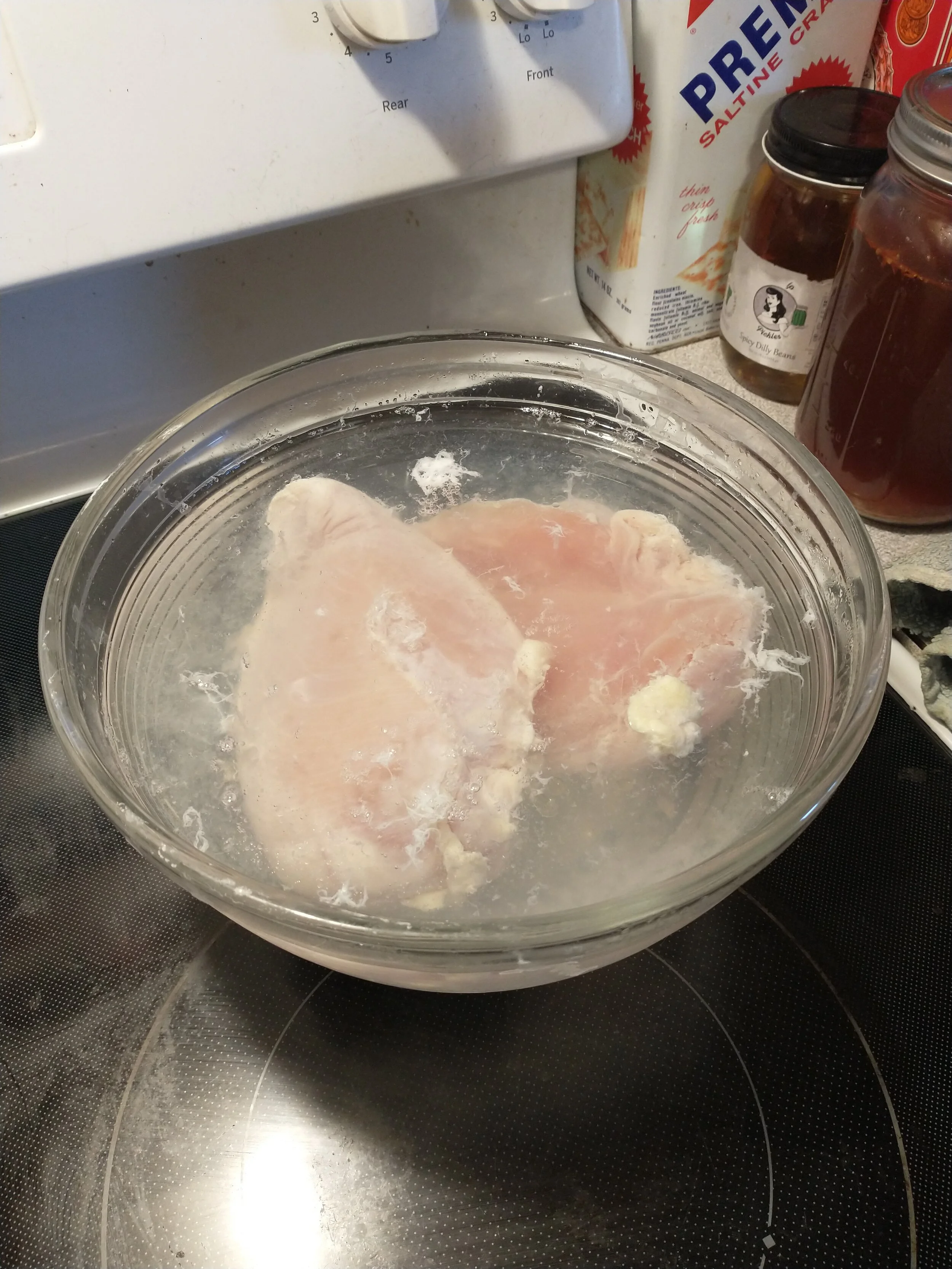
Grab a large bowl and whatever kind of bird your working with, bone in or boneless, and place them in the bowl. Take your salt and a quart of water and heat in a small pot. Stir and allow it to come to a boil. Remove from heat and add to your chicken. Top off the chicken with your remaining room temp water. Sit to the side. Smith recommends that once the water is cool to transfer to the fridge and cool over night. I haven’t done that yet. Usually I do this step around lunch time and allow the chicken to sit in the brine for 4-5 hours. By supper time it’s good to go.

IMG_20210308_170942071.jpg

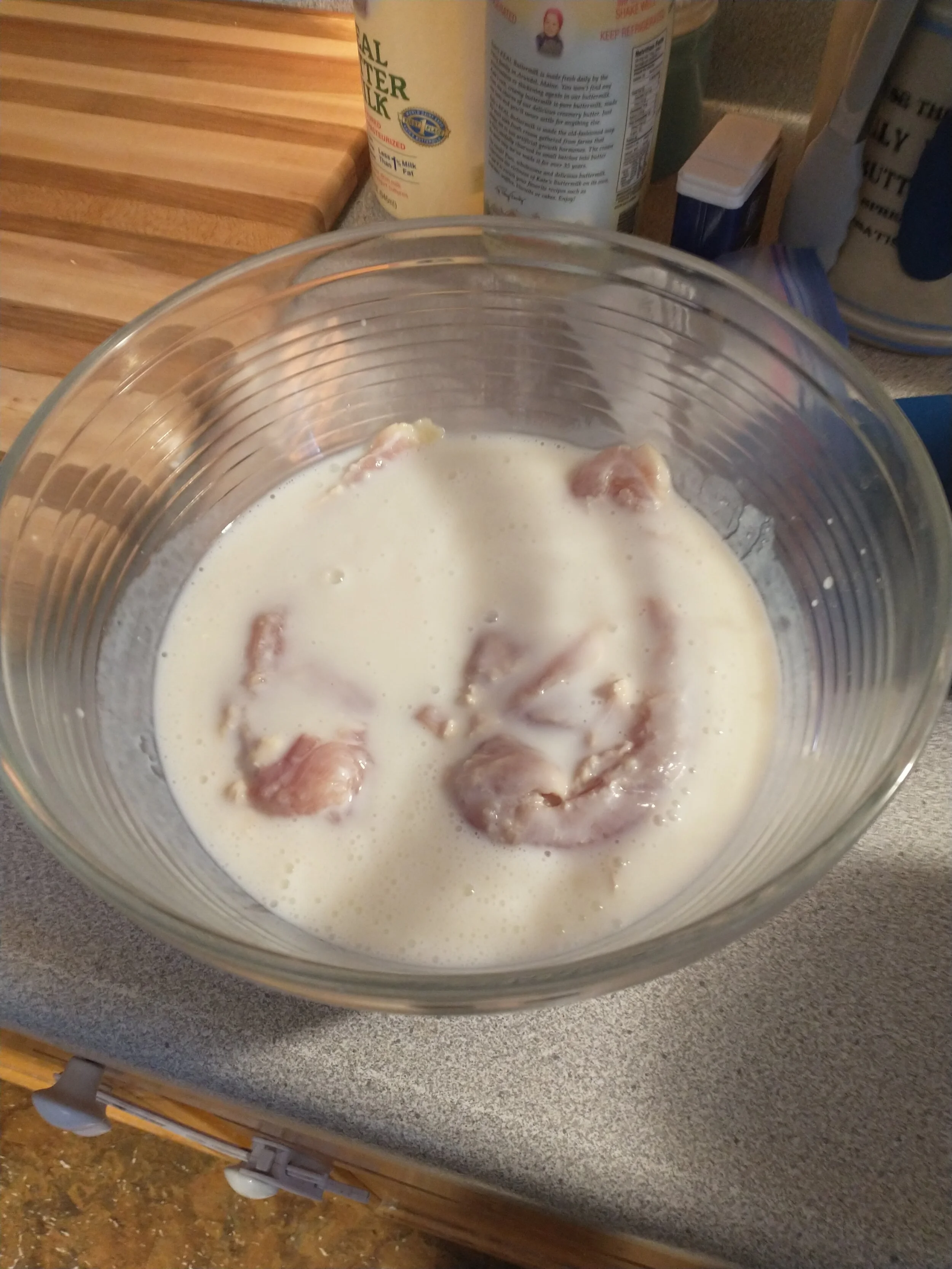
After several hours, remove the chicken and pat dry. Grab yourself another bowl and place your chicken with the cup (or more) of buttermilk. Make sure the chicken is submerged as much as possible. Cover it and sit it to the side.

IMG_20210308_171701313.jpg

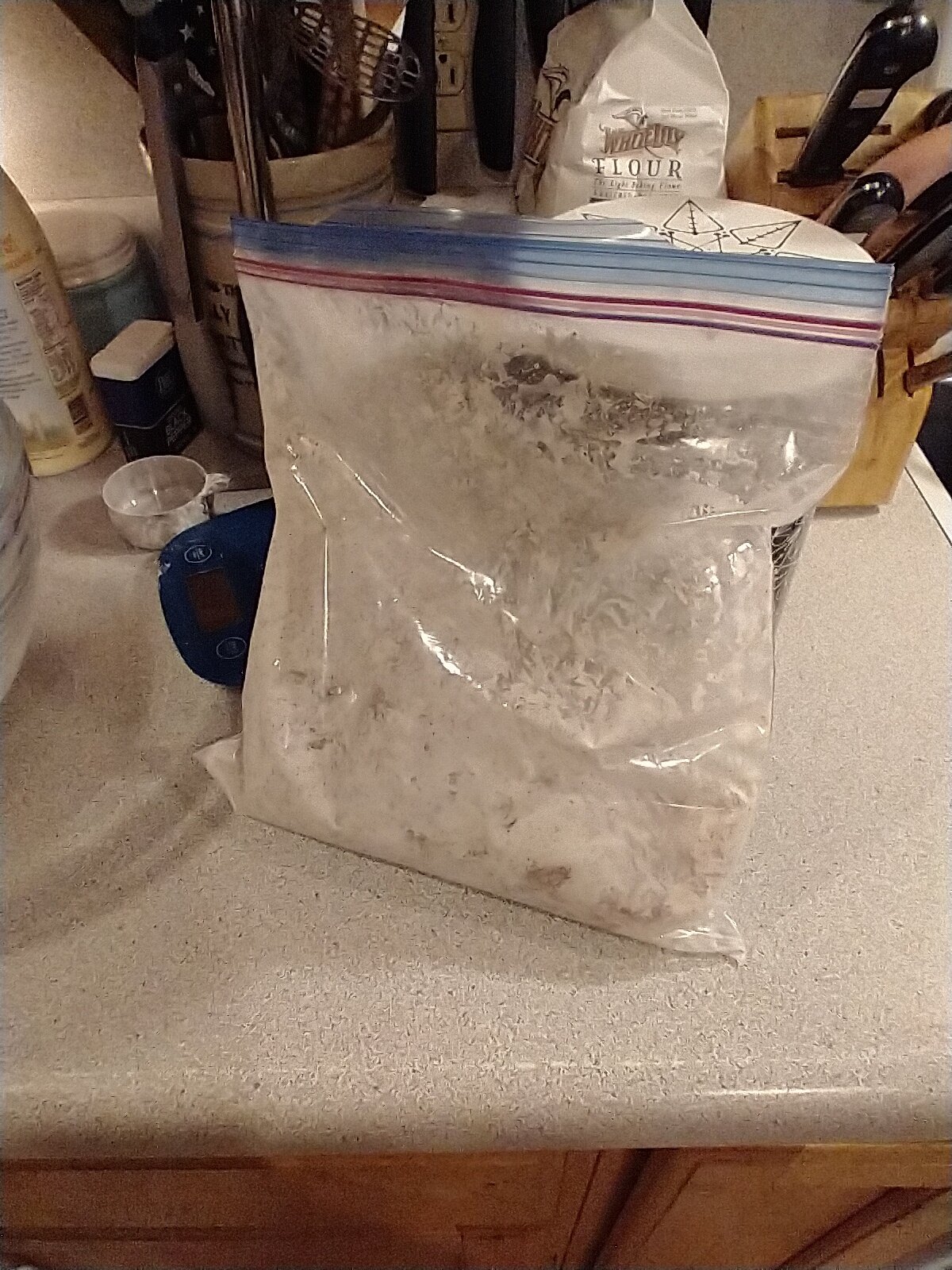
Here is where you want to get both the dredge ready and start heating your oil. I like to get the “dredge” (a term/cooking technique used to coat wet or moist foods with a dry ingredient prior to cooking. Put most simply, dredging involves little more than pulling or rolling the wet food through the dry material to provide an even coating ready) ready first so grab the flour, salt, and pepper and place it in a Ziploc or paper bag. This is Lundy’s process, others use a multi- plate method, one with dry material in one and wet in the another, but the bag method is the one I like the best after trying both.

Grab your chicken and shake off any clinging buttermilk, toss in your dredge bag. Once the pieces are in the bag, shake it until all pieces are covered.

I use a deep cast iron skillet for frying. Some folks use a dutch oven. Whatever you use, make sure you got a lid. Get your oil good and hot. Depending on your range this might be a setting around medium-medium high. If you got a thermometer to check the temp (360 degrees is good) awesome, if not, wait till you see the oil begin to separate or simply toss a pinch of flour in. If it sizzles and pops you should be good to go.

Remove your pieces from the bag, give them a good shake to remove any excess flour batter, and place them in your skillet. Don’t overcrowd if you can help it. You wanna cook them on that first side about 6 minutes or so, but be mindful to check it often as it doesn’t take much to burn your skin. Flip and cover the skillet. This time can very, but plan to cook at least another 8-12 minutes. I stay right by the stove while cooking and probably flip my chicken a few more times than necessary, but I do so to try and prevent any burning from happening. I use a internal thermometer to check the temperature and as it starts to reach that 165 degree mark I remove the lid for those last few minutes to help crisp the skin.

When it’s ready, make sure to have some sort of setup to allow it to cool and drip, carefully remove chicken from the oil. I like to use a baking sheet as a catch pan along with a wire rack/paper towel to allow the bird to rest.

IMG_20210308_175422077.jpg

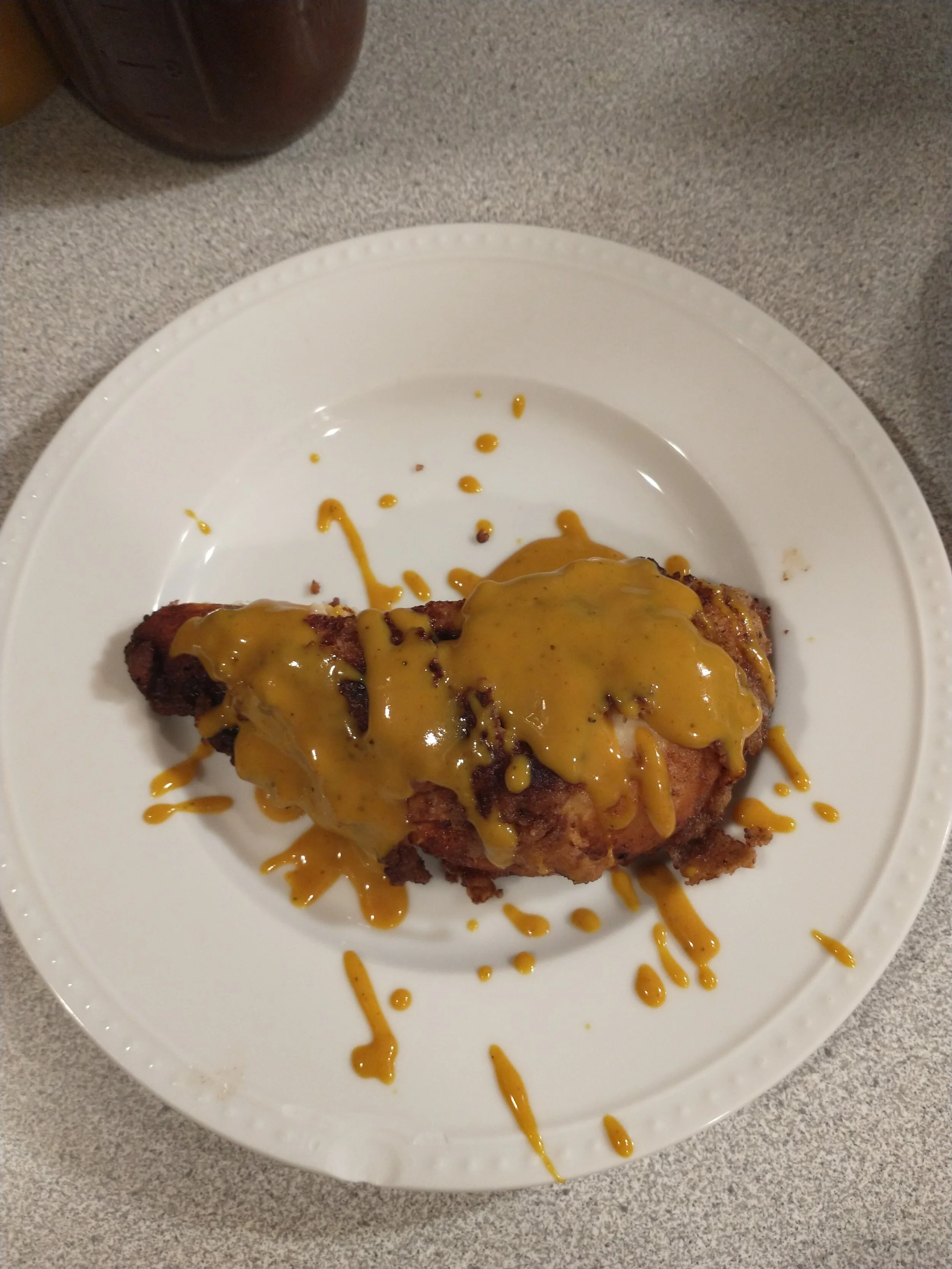
Plate when its cool enough for you to stand it. We decided to eat ours the other night with some of the barbecue sauces I’ve been making. The one above is inspired from the mustard based sauces of South Carolina.

Chewing the fat…

Call it southern food, soul food, or country cuisine the point is fried chicken is comfort food. “Comfort” is that fitting label given to those go-to choices of must have edibles when we need that extra bit of savoring or when we really long to taste something with meaning that offers a chance of reprieve from the day. As I mentioned earlier, this happened a lot at my family table. People gathering around, adults looking for chicken breasts and me looking for one or two drumsticks. Comfort food is something we can enjoy in the company of others, but it’s also something that can be enjoyed alone. I can think of plenty of moments from my past, where after coming home from shift work, I’d open the fridge and spot a piece or two of cold left over chicken. In those wondrous circumstances I almost always chose to forgo warming the bird up, instead opting of a plate of cold chicken with a few splashes of hot sauce (preferably Texas Pete). Just that image of being alone late a night, sitting at a table by myself or even standing at a kitchen counter, the comfort of a familiar dish really hits home.

Faith can move us in the same way. It can be something appreciated with a group of folks while also being something experienced by one’s lonesome self. I’ve felt the divine presence surrounded by people and I’ve felt that same divine spirit sitting with me at an empty table, nothing there but myself, God, and a few pieces of cold chicken. Both are holy moments. Both offer comfort. That’s what faith can and should do. It’s definitely what fried chicken does.

I hope if you give this recipe a go that you get the chance to see the benefit both ways offer. I hope you get to share a piece with a loved one or with a neighbor…

And I pray. I pray you have the discipline to save at least one piece for one of those late night “refrigerator raids” where it’s just you and God sharing a bit of “comfort” together. The chicken isn’t needed of course, but it doesn’t hurt to have it.

Cheers,

~tBSB

Sharing A Not-So-Secret BBQ Sauce

March 4, 2021 justin cox
Communion Cookery.png

Chewing the fat…

Back in North Carolina, I once opened a sermon by telling those in the congregation I was about to present them with a heavy laden theological question. A few ears perked up, some of which belonged to the senior minister as I’m sure he thought, “Oh Lord, what’s Justin gonna say now?”

I then went on to pose the question every North Carolinian has to have an answered for; are you in favor of tomato based BBQ sauce or do you prefer vinegar? The ice breaker got the chuckles I was desiring and I got plenty of feedback after the service from those who came to shake my hand. Near the end of the fellowship line I spotted the Minister of Education. A seasoned pastor and theological powerhouse in Baptist thought, he came over and commended me on the joke, and then promptly told me that neither sauce could hold a candle to Alabama barbecue. No need to guess where he grew up.

Like denominations, barbecue and the sauce that accompanies it, come in a variety of “flavors.” In North Carolina, the state is split with the western portion being prone to enjoy tomato while the eastern part of the state longs for the tangy kick of vinegar. There’s “Lexington style” too, but that’s a conversation for another day. About the only doctrine held by both sides is that BBQ must be from the hog and plated in the categories of “pulled, chopped, or sliced.”

Of course this is regionalism and local pride at it’s finest. Travel down to South Carolina and you’ll find a mustard based sauce. Tennessee does it’s own thing, with Memphis championing a dry rub. Texas is where brisket is king and from what I’ve gathered those folk tend to push back against any sauce-slathering on their meats. Alabama has a famous “Come Back Sauce” for their BBQ made with mayonnaise (I’ve had some ribs at the famous Dream Land Barbecue and they were legit!), Kansas City in Missouri has a sweet sauce they favor, and the list could keep on going…

Whether it is sauce or rub that makes the dish shine a little brighter, the point is folks have preferences and methods in how they BBQ…and cooking hamburgers and hot dogs on the grill ain’t it. Utter that to pit master and it’s considered heresy.

So for today’s offering, I’m going to pass along a BBQ sauce recipe that I’ve altered a bit from Tupelo Honey Cafe. For me its a solid all around sauce. I haven’t marinated with it yet, but I’ve slapped it on everything from fried chicken thighs and breast to drizzling it on ground beef tortillas. As you’ll see I go a little hard with the heat, but there’s room for adjustment if your palate, or stomach, demands less.

IMG_20210225_135150506.jpg

Ingredients: This recipe makes just over 3 cups of sauce

Half cup firmly packed brown sugar, half cup diced sweet onion, 3-4 large cloves of garlic (finely diced), 1-2 jalapeno peppers (finely diced), half cup apple cider vinegar, 2 Tbsp Worcestershire sauce, 2 Cups of ketchup, half cup of sorghum syrup (molasses can be substituted), tsp of hot pepper sauce, half a cup of root beer, tsp of lemon juice, and a tsp of each…sea salt, ground pepper, chili powder, cayenne pepper, crushed red pepper, ground cumin, coriander, and dry mustard. If you happen to have any…some hatch pepper powder does wonders.

IMG_20210225_142431919.jpg

EVERYTHING goes in the pot at once, so grab you a good sized one. The one I use might be a bit overkill, but a large pot for me is a safe bet. Combine everything with big swooping stirs and set your burner to a higher heat. Bring it to a boil and then back off on the heat so that its at a nice simmer, for me this is somewhere in the medium-low range. Let this go on for about 30-40 minutes uncovered, stirring here and there. During this time don’t be afraid to taste! Does it need more heat? Add more chili powder, red pepper flakes, or whatever you think is missing. This is where you’re looking to complete the seasoning process so doing your dialing in now.

When the taste is where you want it and it’s simmered for at least half an hour, remove from heat and let it cool to room temperature. Once it has, grab yourself a nice large mason jar or a few small ones and transfer the sauce. Toss in the fridge.

A large container like this for my house will last up to about 2-3 weeks before its gone.

A large container like this for my house will last up to about 2-3 weeks before its gone.

One Last Chew…

Some folks get pretty territorial over cooking processes and sauce flavors. I’m not exempt from this either. My spouse once told me that years ago during a flight she’d picked up a magazine on the plane and saw a “letters to the editors” section where a Texan wrote, “Folks in NC couldn’t BBQ their way out of a paper bag.”

Every time I tell that story there’s a part of me that chuckles and a part of me that rages, “how dare he?!?”

The truth of the matter is I’ve never met an expression of BBQ that I didn’t like. As long as it was cooked with a bit of history and some tradition I’ve found value in it. I mentioned Dream Land BBQ in Alabama earlier and I still remember their “free appetizer” as I sat waiting for my order of ribs; a small plate of twangy sauce with a couple of pieces of sliced white bread. It was delicious. It wasn’t NC BBQ, it wasn’t home, but it was delicious.

My point is, be it BBQ or even other expressions of faith outside of one’s practiced own, there’s opportunity to discover value and appreciate the diversity in different groups. When you find meaning in another, don’t view it as abandoning your own, but instead expanding what you already know.

The complicated Baptist faith is what I consider my “home base. It’s where I start from. NC BBQ is too. But, and I’m pretty sure I’m paraphrasing this idea from the NakedPastor, I have a lot of other camps I travel to where I find sustenance that feeds my faith.

For me it all comes back to reciprocity. I’m always looking to share my sauce or faith with those looking to share theirs with me. Jesus’ describes something similar in both Matthew’s Gospel account in chapter 10 and in Luke’s too. Reciprocity is possible when both parties are “people of peace.”

With that thought in mind, maybe…just maybe, I’d be willing to let that comment from a Texas BBQ fan go in the hopes we could one day swap brisket for a chopped BBQ plate. That’s my hope any way.

Cheers,

~tBSB

Dood's Table Biscuits: My Grandmother's "Pinched" Method

February 23, 2021 justin cox
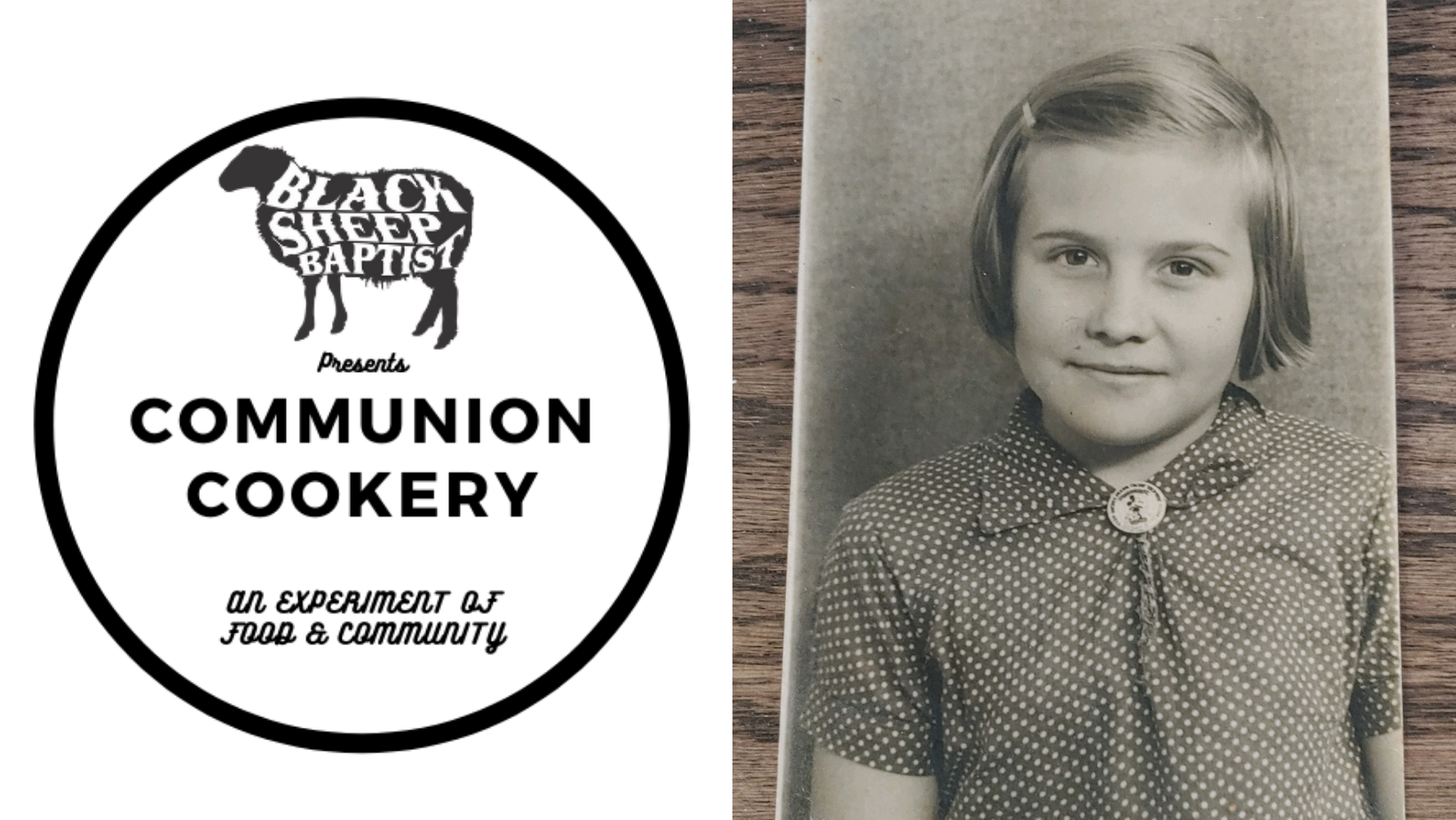
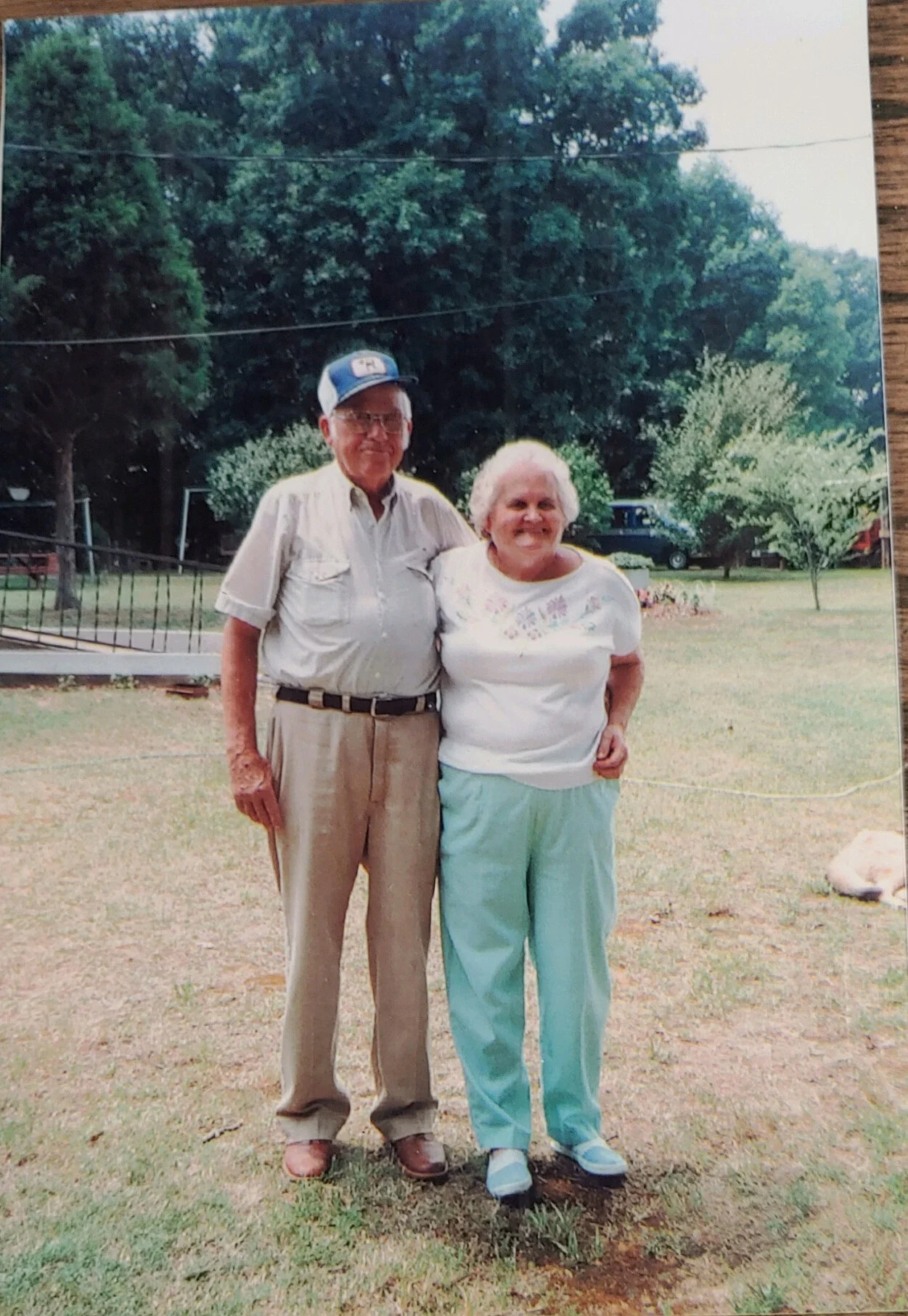
My grandmother Emma Mae Stigall, 10 yrs old.

My grandmother Emma Mae Stigall, 10 yrs old.

I can’t tell you about these biscuits without telling you about my grandmother, Emma Mae “Dood” Stigall.

Chewing the Fat…

Grandmothers for many are the first saints we know. They’ve got enough lived experience to produce wisdom and demand a level of reverence from even the wildest of grandchildren. Growing up, my grandparents were part of my everyday life. They lived within an earshot of our homes (we lived in front of them in a trailer when I was small and behind them when my parents built a house a few years later). “Dood” (her nickname) was the wife of a farmer meaning she kept to a farmer’s schedule herself. She rose early to cook and bake, and by the time I got old enough to pay attention to that schedule, I saw she’d purposefully try and get her work done early in the day so that she could “lie down” in the afternoon and watch her “stories.” You’d want to call it a day at 3pm too if you woke before most roosters.

My grandmother’s presence in the kitchen was well polished. Proficiency at her craft was the sought goal. While I believe she took pride in her cooking, part of which included hearing people “dote on” on about it, attempting to pass on her skills to her children/grandchildren just wasn’t a priority. My mother told me once of a memory where she asked my grandmother if she’d show her how to make biscuits. Her response went something like, “No, because if I show you how you’ll have to make them the rest of your life.” There’s a lot to unpack there. Societal norms and expectations being part of that discussion for sure. My mother never got the recipe and as far as I know no one else in the family did either.

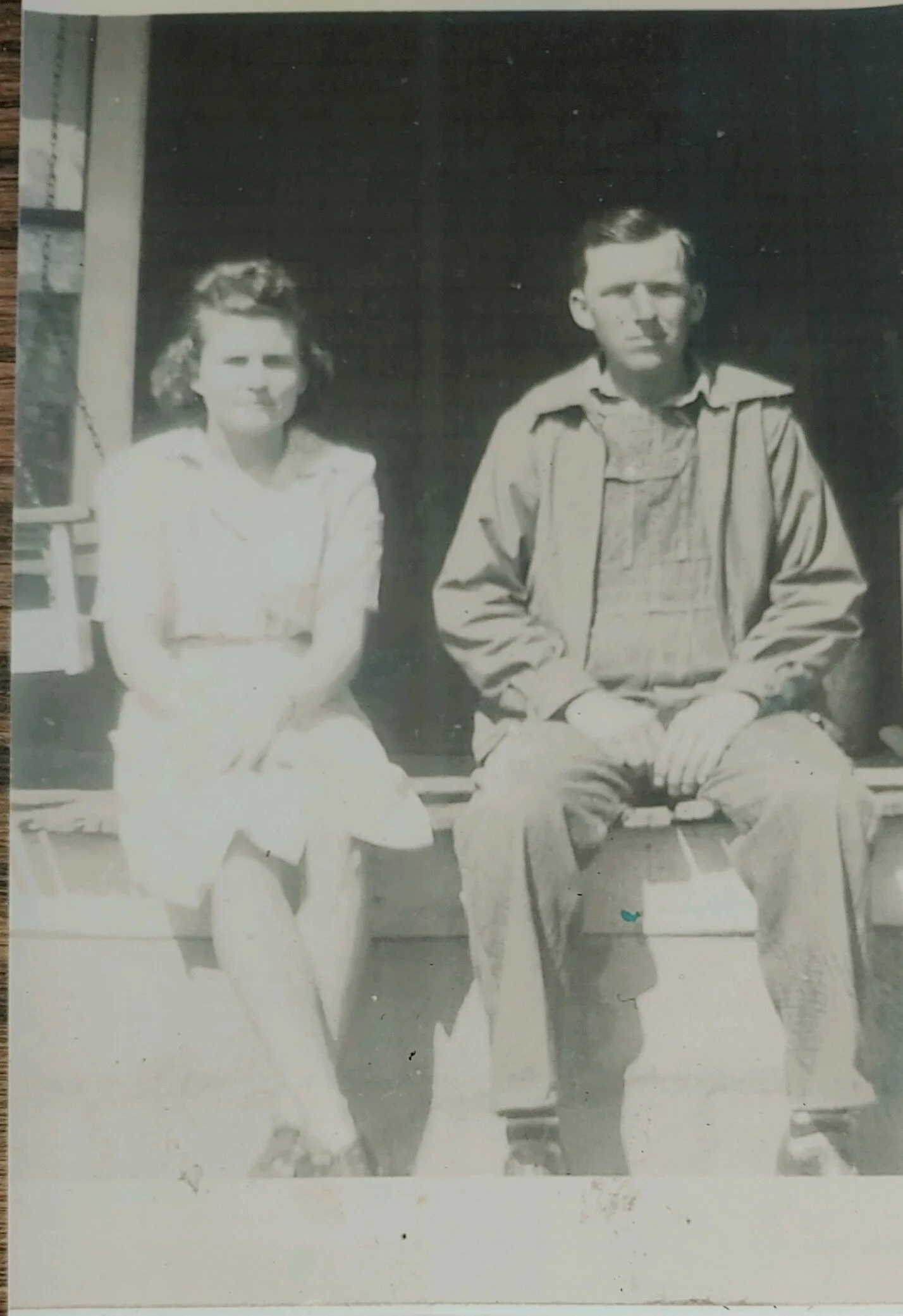
My grandmother with my grandfather, Calvin “Bun” Stigall, on their wedding day 1943.

My grandmother with my grandfather, Calvin “Bun” Stigall, on their wedding day 1943.

I knew starting this baking and cooking journey I’d be in search of much of what I tasted in my grandmother’s kitchen. Corn bread, chili beans, biscuits, etc…There’s life-giving memories there. Intertwined with the thought and care she put in her dishes. I’m searching for those memories in my experimenting, looking to reconnect with my grandmother and the food that made it’s way onto her table and to our family. Alright, enough Chewing the Fat for now…

This recipe is extremely close to what I remember. I’ve piece-mealed it the best I can . I can’t imagine my grandmother using this much butter, pretty sure she probably used shortening, but the method and look is what makes it distinctly hers. I’ve dubbed them table biscuits because of how well they can be presented; straight from the oven, still in the skillet, onto the table for folks to grab.

Preheat you oven to 450 degrees.

Ingredients needed

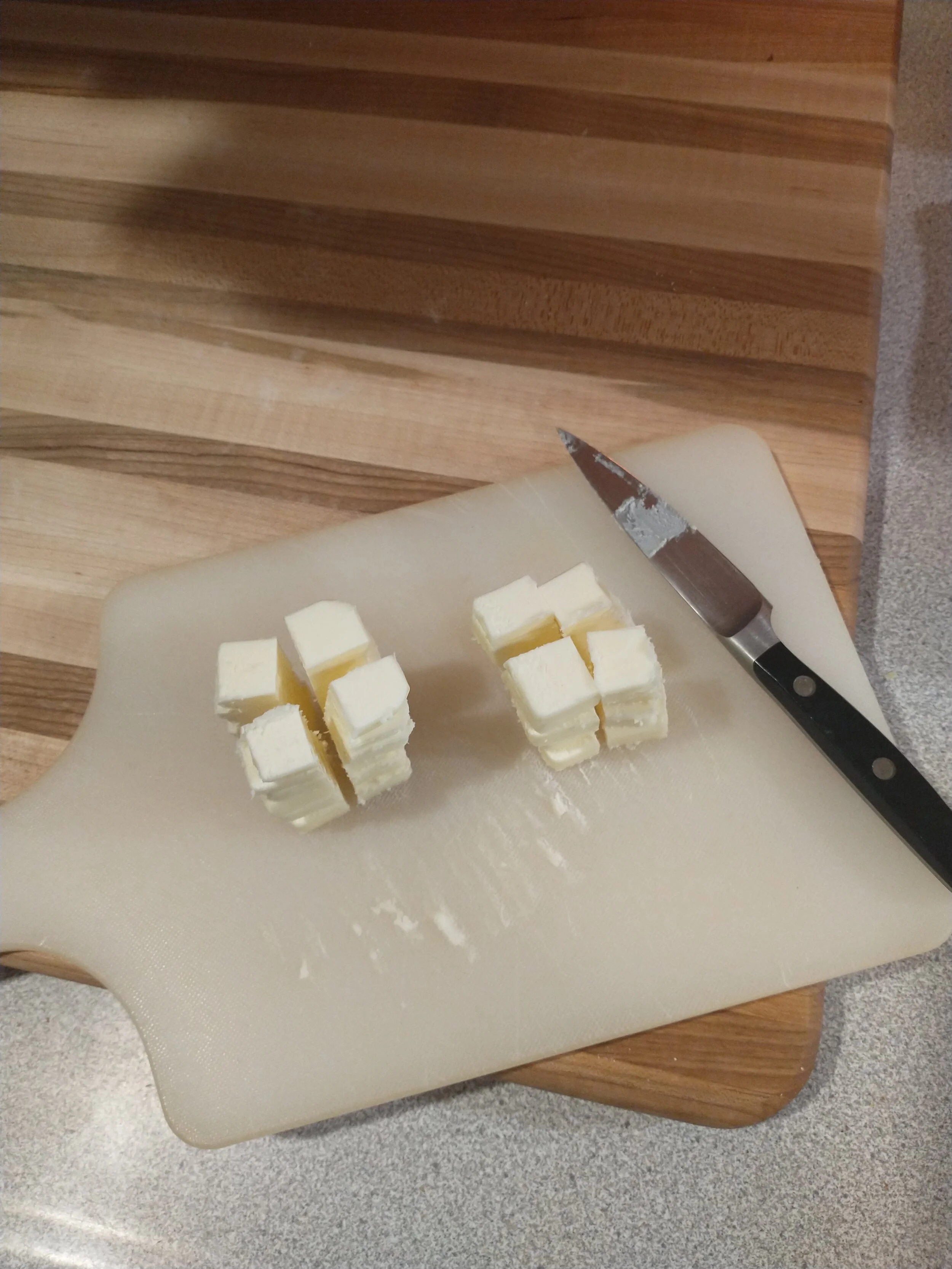
2.5 cups of self rising flour (I weigh out about 300g worth), 1/2 tsp of kosher salt, 1 stick of chilled/cold butter (sliced into pads and then quartered OR your butter can be frozen and grated), One cup of buttermilk. And it’s not a bad idea to keep extra flour & buttermilk handy.

IMG_20210219_065830328.jpg

Whisk your flour and salt together in a decent size bowl. Add in your butter, the above picture is how I “pad and quarter” mine, and work it into the mixture with a pastry cutter. When the butter is about the size of small peas, make a well and add the buttermilk. If you use a grater you can obviously skip this step.

I use a spatula to combine the wet/dry ingredients making sure to pull in the dough that might want to stick to the outside of the mixing bowl. Once you have a nice clump of dough, dust the top of it a bit with some extra flour and flour your hands too as the dough will probably be a bit on the wet side and wanting to stick to your fingers.

IMG_20210219_071438585_HDR.jpg

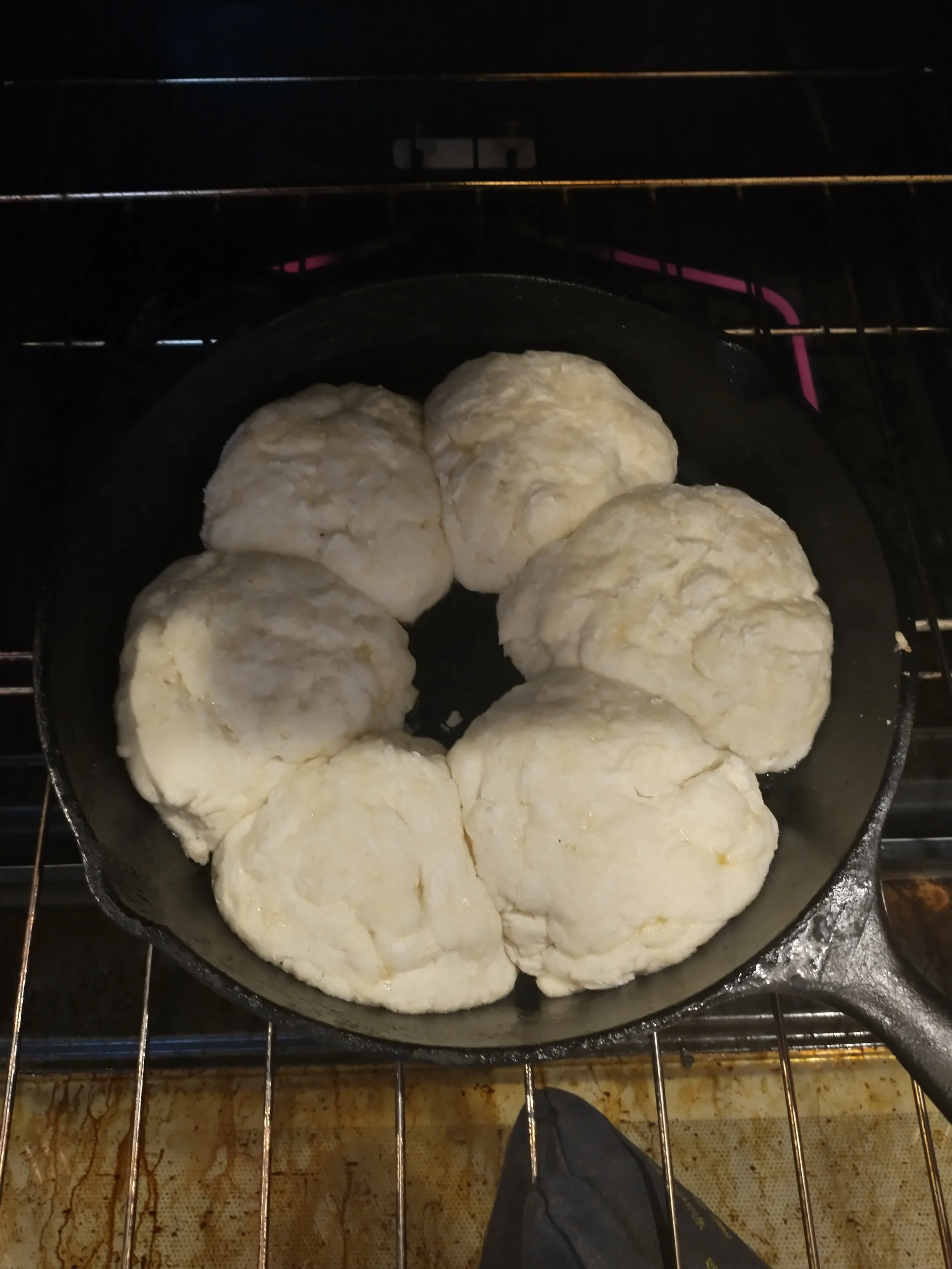
Grab a cast iron skillet and rub it down with a bit of butter. “Pinch” off a piece of dough and lightly mold it into a biscuit like shape. Place along the outer edge of the skillet and just keep at it until you make a complete circle. The way I do it sees the biscuits touch each other on the sides, but there’s a small hole left in the middle. The batches I make produce about 5-6 large biscuits. The pic above is when I rotated them around the 7 minute mark, yours wont be that big when you first put them in there!

Place in your oven. The oven at the parsonage takes about 15 minutes to bake these on the middle rack. Again rotate the pan around the halfway point.

IMG_20210219_073429736_HDR.jpg

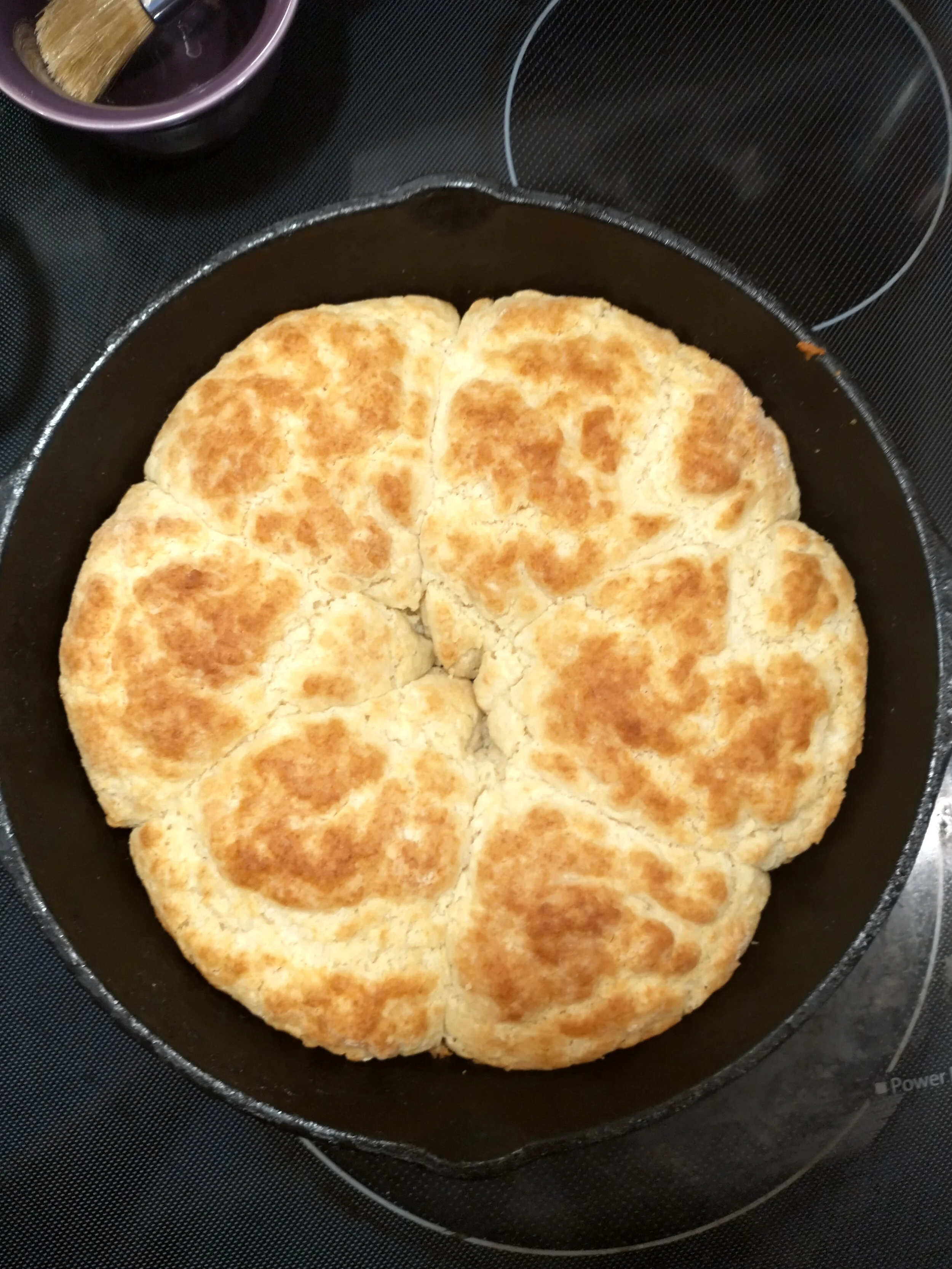
Take them out when they have a nice brown top. I brush mine with a bit of melted butter on the top for good measure.

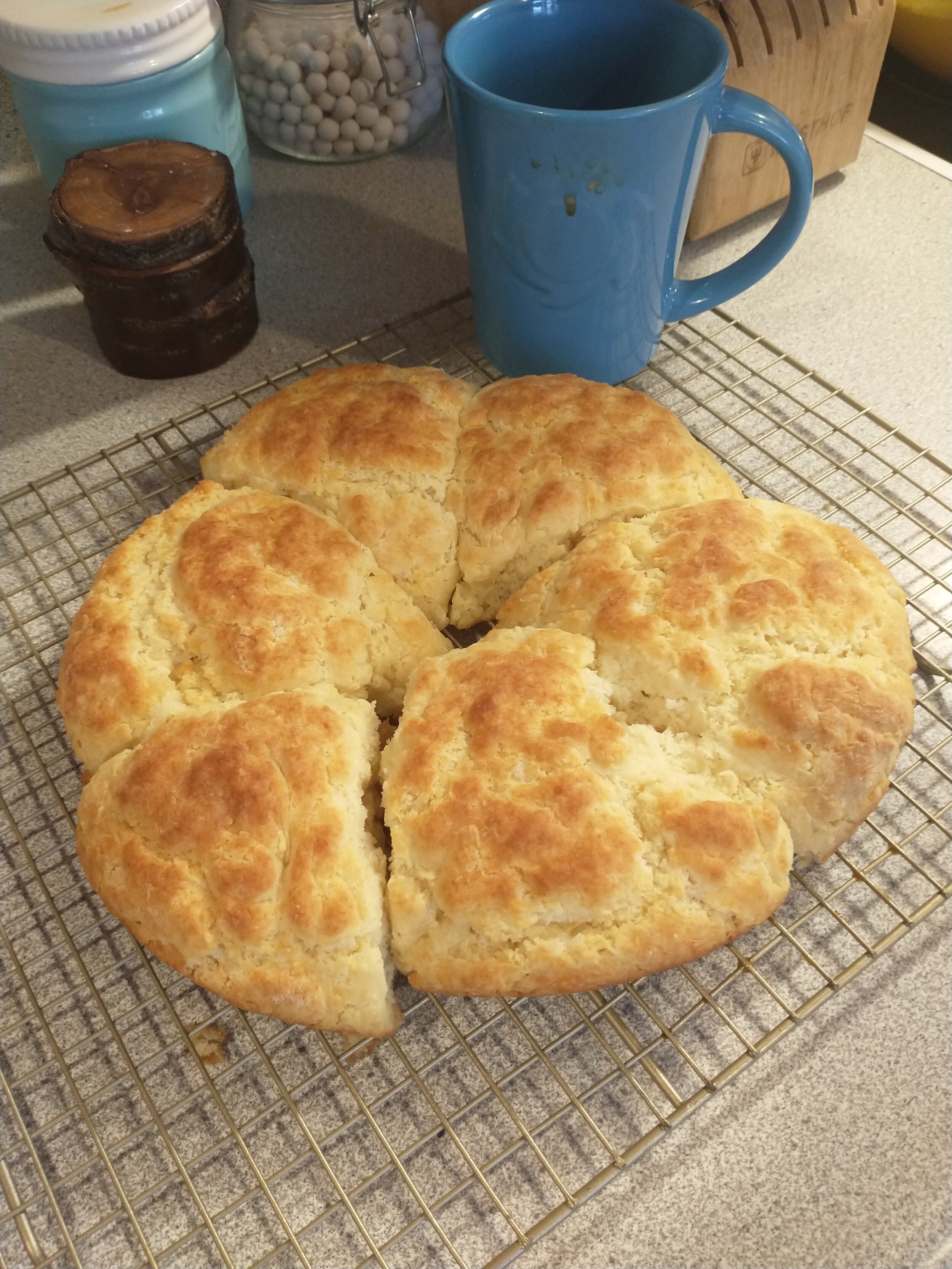
After making these biscuits several times I noticed something that was very much a characteristic of my grandmother; nothing goes to waste. Where other biscuit recipes produce scraps or leftovers/reworked dough, Dood’s does not. Every bit of the dough is used which speaks to my grandmother’s experience of being a child during the Great Depression where every resources needed to be maximized.

IMG_20210219_073733669.jpg

One Last Chew…

“My biscuits ain’t fancy, but my family likes them,” was what my grandmother used to say about her biscuits. There was a humbleness about this, but enough people complimented them that there was little doubt of them being something special. In fact just about everything she made was exceptionally good. Once at the dinner table my still “sorta new to the family” uncle was asked by my grandmother if he was going to try any of her such and such. He mistakenly asked if what she pushing on him was any good. My mother interjected before my grandmother had the chance and said, “When have you ever had something of my mamma’s that wasn’t good?” For a fella who was a bit of loudmouth and often needed the last cute word he nodded and let out a sheepish, “Never.”

My grandparents on their 50th Wedding Anniversary, 1993

My grandparents on their 50th Wedding Anniversary, 1993

There’s a understood southern defense known as the “Aw-shucks” method. It’s where southerners hold their cards or expertise close to their chest. Some times it’s done as to not seem uppity or pretentious. Other times it’s because we want to see how far the person who’s talking will carry on about something we obviously know more about then they do. And then there is that humble component that those in the Appalachian region seem to inherit and carry; you don’t brag on yourself if you can help it. My grandmother’s cooking was something that was bragged about, but never by her. She would have probably never called her cooking a “calling” or gift but that’s what it was. I’m sure she’d think it silly for me to go on and on about how special her food was or how her kinfolk and neighbors were lucky to reap the rewards of her kitchen labor. However, I hope she sees what I’m doing with what she gave me; a call to cook for those you love and feed those that need something to eat. I’m sure she’d give a bit of a chuckle at knowing her biscuits have found their way to Vermont where I’ve shared them with church folks who pour maple syrup on them, with folks who are transplants like me from far off lands like Alabama who had similar saintly figures in their lives, and even those through social media platforms who requested the recipe so they could make it with there “breakfast for supper” meal that evening.

Maw-maw, your “not fancy” biscuits are making the rounds. And I’m pretty sure more then just your family will and do like them.

Wiping tears,

~tBSB

Jes' Pie Crust: Practice & Repetition Required

February 18, 2021 justin cox
Ronni Lundy’s Victuals can be found/purchased at your local book store or on Amazon.

Ronni Lundy’s Victuals can be found/purchased at your local book store or on Amazon.

I’ve gone through a few stages in my cooking journey thus far. I call them “kicks” and I’ve spent my kicks having a go at muffins, breads, and of course biscuits. I dabbled in pies for a couple weeks not long ago and now I’ve circled back around to them. I’m currently baking nothing but “chess” or “jes” pies because I’m holding off till summer to make fruit inspired ones from fresh/local produce. My spouse Lauren says I make nothing but “Depression era pies,” but I’m just found of the minimal beauty and flavor found in buttermilk, vinegar, and brown sugar pies. As with most anything one hopes at getting proficient at; practice and repetition is a must. When I first started with pies I would make a single crust, but since adapting this pie crust by Ronni Lundy (yes, I’m referencing Lundy again) I’ve found a sweet spot which produces 3 pie crust that I then use to bake over the course of a week.

Here’s what you’re gonna need for ingredients,

3.5 Cups of all purpose flour(more for dusting), TBSP of sugar, 2 tsp of salt sea, 2 sticks of unsalted butter (I’ve made do with salted butter as well, just toss some of the 2 tsp of sea salt to offset), large egg, 1/2 cup of ice water, TBSP apple cider vinegar.

IMG_20210215_121055317.jpg

Grab a whisk and your mixing bowl and combine the flour, salt, and sugar. Grab your two sticks of butter and cut into “square pads,” then quarter the pads. Add these to the flour, salt, sugar mixture. Using a pastry cutter (or fork, knife, fingers) work down until the butter pieces are about the size of a small pea.

In a separate bowl crack your egg and then beat it lightly. Add the half cup of cold ice water to it along with the vinegar (I like to have extra water on stand by as I always use just a bit more later on if the dough is shaggier then I like). Mix the egg, water, and vinegar together.

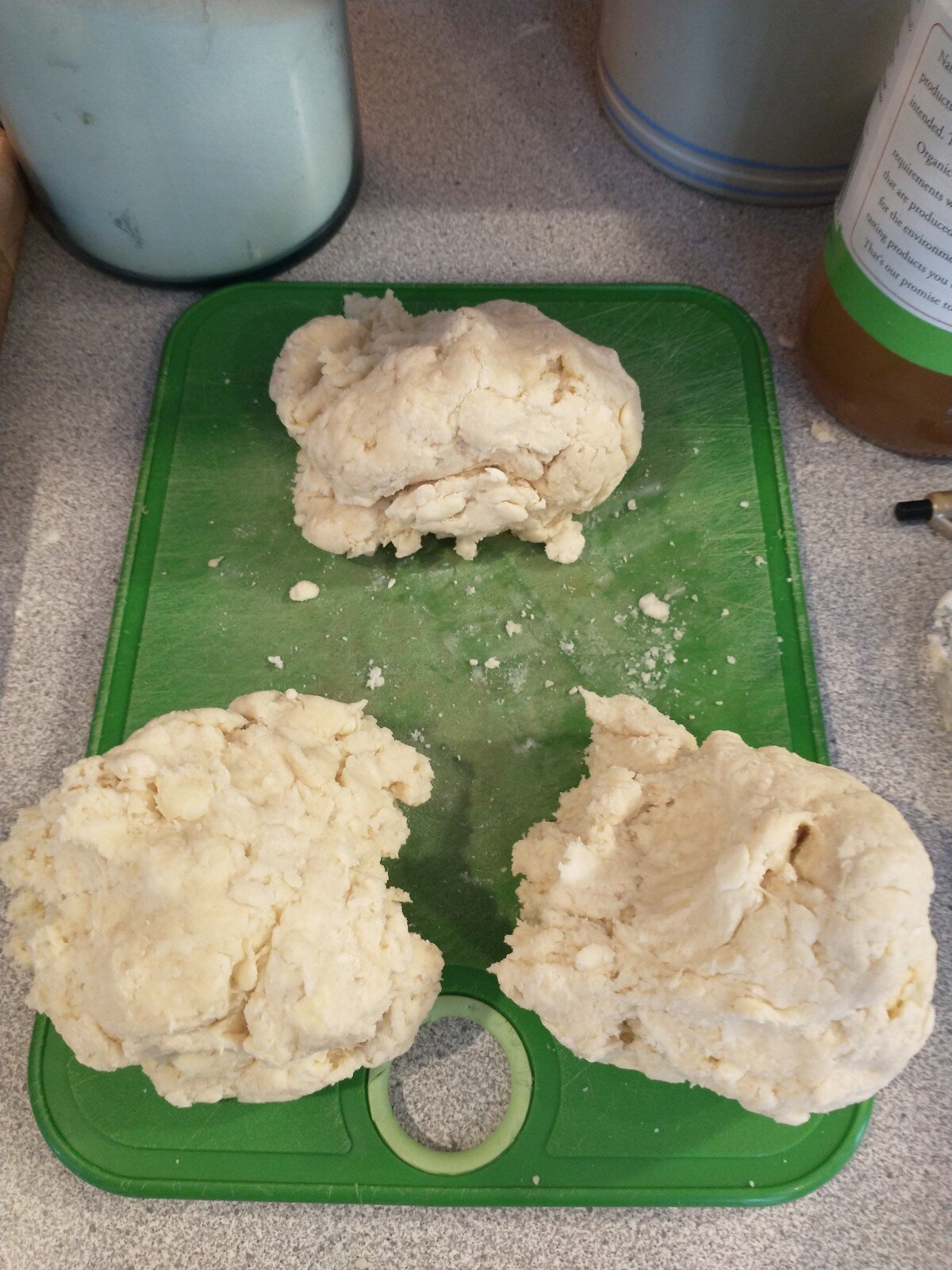
Finally, add your liquid to your dry ingredients ( I prefer using the “well” method) and stir with a wooden spoon or spatula. Be careful not to over mix. If the dough seems to shaggy add more of the ice water. If it’s a little wet add a bit more flour. You’re looking for something that resembles the below image,

A good indicator that you’ve found your “sweet spot” is you’ll less and less dough on the side of your bowl.

A good indicator that you’ve found your “sweet spot” is you’ll less and less dough on the side of your bowl.

IMG_20210215_122949667.jpg

Grab yourself a scale and measure out 3 approximate pieces of dough. You’ll then give them just a little shaping, making them into small discs. Bag them or store them in a container and place them in the fridge.

IMG_20210215_123159772.jpg

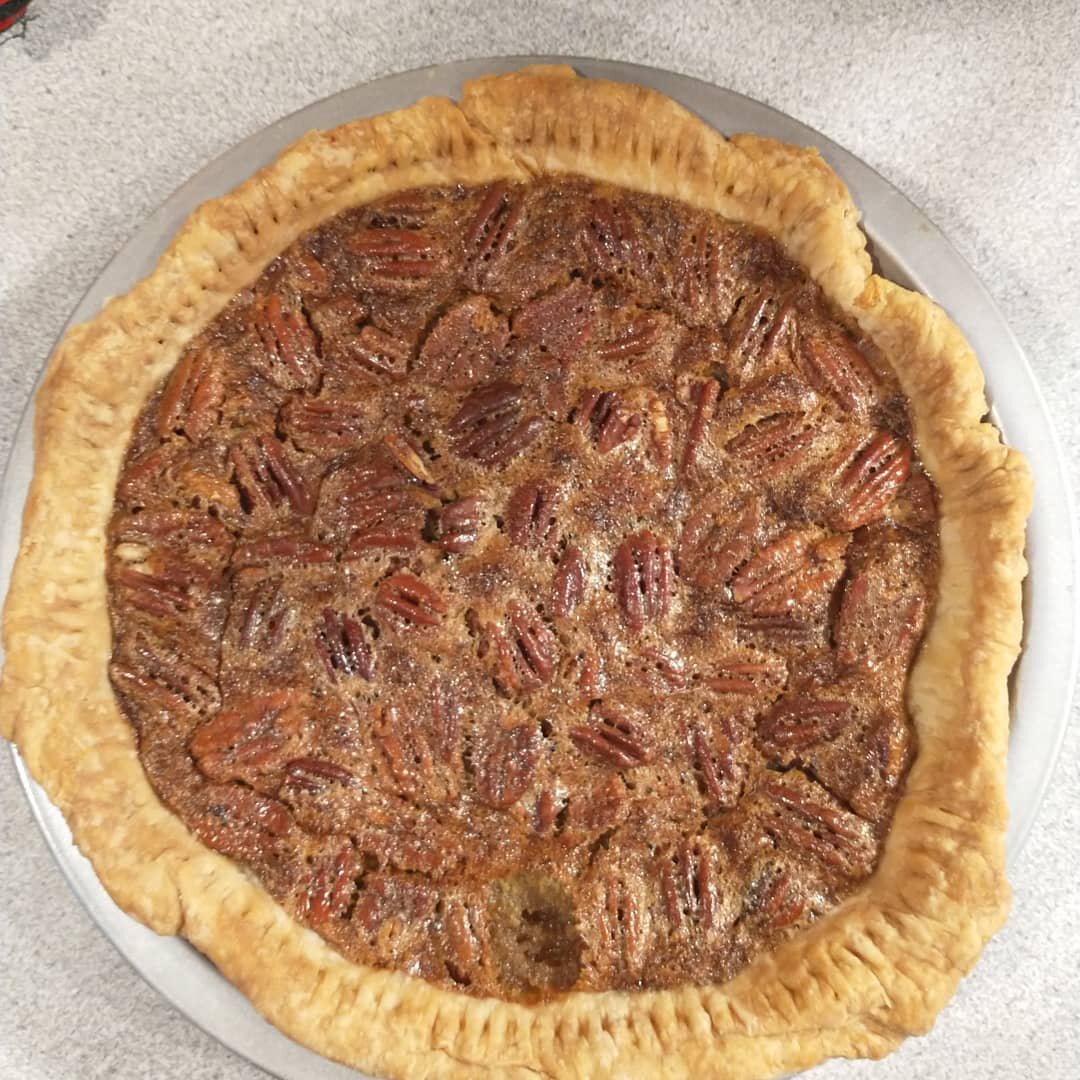
If you plan to bake the same day, give the dough at least an hour in the fridge before using. If you plan to use it the next day or later that week, I recommend removing it at least a half hour before trying to roll it out. Fast forward a bit; with a combination of practice, skill, and some luck…you’ll end up with something like this,

My first “successful” pecan pie. Look for a write up on it soon!

My first “successful” pecan pie. Look for a write up on it soon!

Chewing the fat…

It took me a while to get this ratio down for what I wanted to do. My tweaking’s changed Lundy’s amounts here and there. Her recipe made 4 pie crust, but I discovered through my “newbie” baking status that working with her amounts gave me very little of a forgiving learning curve. When I tried rolling out 4 crust they were a little too thin for my liking, and I attribute that more to my skill set than to her recipe. Adaptability I’m coming to understand is crucial when one enters the kitchen and tries new things. I both rely on a tradition of doing something a particular way, but I’m also given some range to make it my own so that it works well for me. That’s invitational and relational in that I’m receiving something special and am trying to offer something back to it that’s just as life giving.

I also learned it doesn’t take much to burn a pie crust! Until I started utilizing tin foil around the edge of the pie tin my crust would be over baked every time. I since invested in a nice “pie crust protector” that has really helped.

I’ll end our time with this, go easy on yourself if you’re just starting out. It doesn’t take much to muck something up when it goes in the oven. It took me 4 tries and 3 different recipes before my pecan pie came out as something presentable (not to mention the discouragement I harbored when people kept telling me it was an “easy” pie to bake). Sometimes our bakes are edible and sometimes there not. I’ve had to scrap a more then one bake attempt, and while I loath the idea of wasting, I also know I don’t have to eat or feel guilty for not eating everything that’s put in front of me. Take you’re experimenting with a couple of grace filled grains of salt and look for progress with each attempt. Build off what you learn and for God’s sake find some folks to share it with!

As you were,
~tBSB

Flour, Sugar, and Cream: Pretentious Free Biscuits From My Hometown

February 14, 2021 justin cox
Facebookcoverpost (1).png

Heads up from the get go, because this recipe is so simple there’s going to be a fair amount of “Chewing the Fat” as part of this post. You’ve been warned.

But first the ingredients and recipe,

2 cups of self rising flour, 2 TBSP of sugar, 1/4 cup of shortening (about 47g), 3/4 cup of heavy cream, and 2-3 TBSP of buttermilk or extra cream.

Here is the recipe as it is written in the book,

“Stir together flour and sugar. Cut in shortening until mixture resembles coarse crumbs. Add cream to flour mixture, stir quickly to make soft dough - it may take 2-3 tablespoons additional cream or buttermilk are required to make a soft dough. Press quickly into a ball, past out on lightly floured board. Cut with biscuit cutter. Place on lightly greased baking sheet in a 425 degree oven 8 to 10 minutes or until lightly browned.”

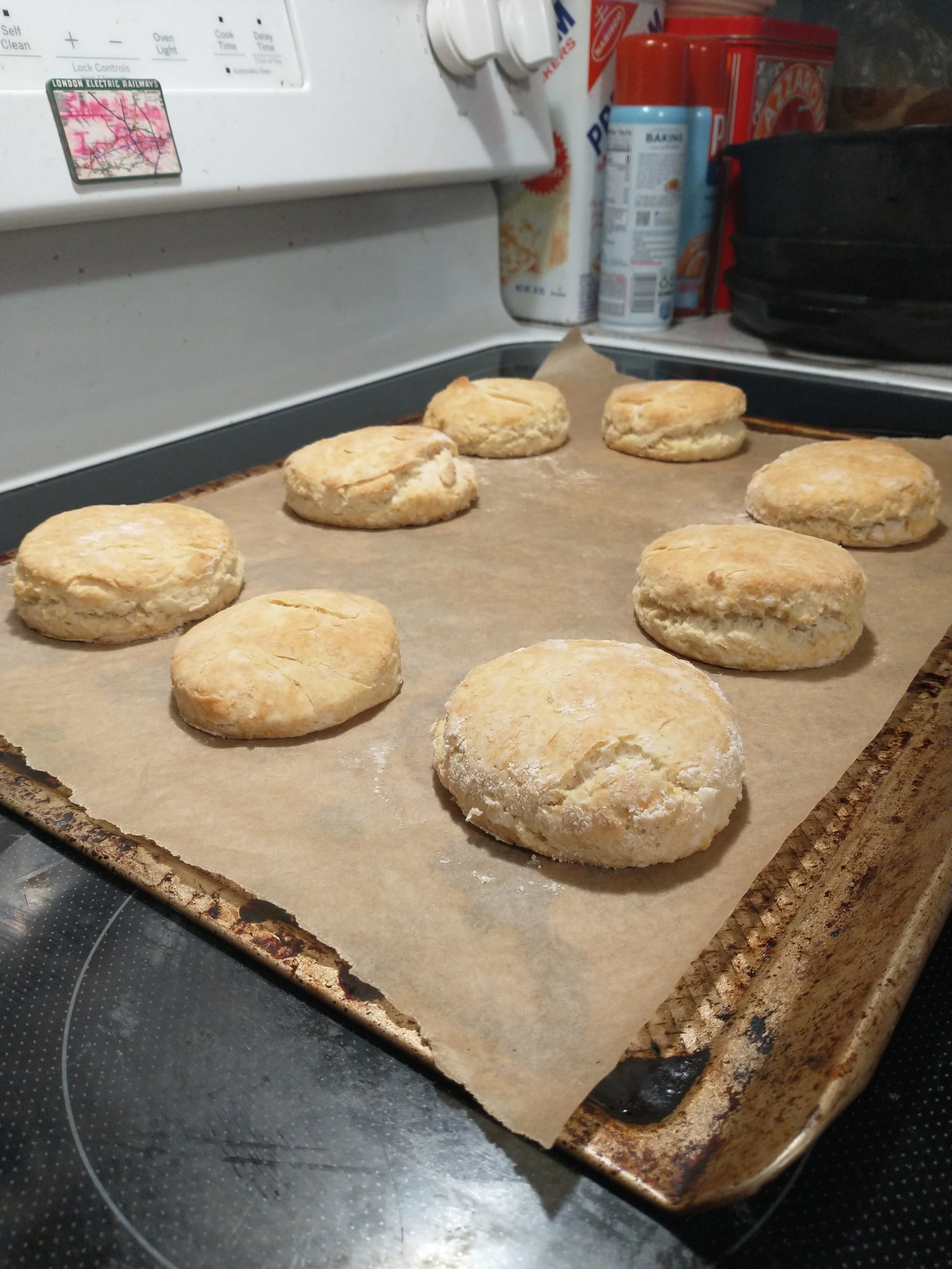
I followed this recipe pretty closely. I did need 3 additional TBSP of liquid. I chose buttermilk since I wanted to use the last bit I had in the fridge. I forwent the greased pan and used my go to parchment paper. My biscuits took closer to 12-13 minutes at 425. Like I do with all my biscuits, I rotate the pan half way through. I even threw a bit of melted butter on top for good measure.

The heavy cream really makes these babies fall apart and melt in the mouth.

The heavy cream really makes these babies fall apart and melt in the mouth.

As you can see above, I went with two different sizes when I started cutting. I chose a 2” and close to 3” cutter. I like a big biscuit, and I think my neighbors who I shared these with probably do too, so that’s one reason. The other smaller size is helpful in two ways; it keeps my consumption smaller and I like to use the smaller more-worked dough as “testers.” Smaller ones are my samplings for myself and family, the larger ones go out the door. And to offer you a recommendation, one I learned firsthand myself, if you’re trying a new recipe…cut it in half. That way if you mess up or don’t like it you don’t waste ingredients and only feel half as bad.

CHEWING THE FAT…

Alright, you been properly warned,

So this recipe came from a place that hit me right in the feels. During Christmas this past year I asked my parents for some very country/home grown items for Christmas. I requested a care package of grits, cornmeal, and hush puppy mix from Guildford Mills (a place that does stone ground everything and is located about 15 minutes form where I grew up). I also wanted a pair of Pointer Overalls, the same kind my grandfather used to wear. The grits and cornmeal came no problem, but the overalls proved harder to come by. The country store my grandfather got his from is no longer in business, but my parents frequent another similar establishment but even they said that the Pointer Brand is hard to find. From swapping stories with my mother, the Pointer brand is re-branding and is taking on an even older name in the process. All that to say, they bought me a brand called Round House that’s been in business for over 113 years with its founding in Oklahoma. So a pair of these arrive in the mail after Christmas (Postal Service issues), they’re too big and need to be exchanged, so when the second pair arrives I was surprised to find two cookbooks included inside the box. The cookbooks belonged to my maternal grandmother and had been passed down to my mother. Inside on the back page is my grandmother’s handwriting which has the date and who gave it to her. Needless to say I was “moved” by this surprise.

This particular recipe book came from Körner’s Folly, the life’s work and home of Jule Körner and the town’s namesake. This is from the official website,

“In 1878, Jule Körner began constructing what would become Körner’s Folly. As an interior and furniture designer, decorator, and painter, Jule planned to use this building to showcase his design work to his clients. He filled Körner’s Folly with his interior and furniture designs, as a “catalogue” for his clients to view his work. As Körner’s Folly began to take shape, its unique design defied simple description and the house was constantly under renovation to make way for new designs.”

The house is a bit odd, and I used to think it was like a miniature "Winchester House” in some ways. The fact that it had a “witches corner” didn’t help. Witches corner you ask? This is location at the entrance of the home where guests entering toss a coin into a pot as to draw the attention of an evil spirits that might be accompanying them to stay outside.

A artist rendition inside the recipe book of the witches corner at the Folly.

A artist rendition inside the recipe book of the witches corner at the Folly.

The website goes on to describe the family and the workings of the house and Jule’s career. It mention his design work in Durham, North Carolina but conveniently leaves out some rather “unseemly” details about his designs (Nothing a quick Google search won’t uncover).

Of course this being from my hometown along with my grandmother’s penmanship tucked in the back flap means this book holds a special place to me. I’m beginning to understand how much that place and “my people/my kinfolk” have shaped me. To cook something out of this book is to give a little of myself to those I cook/bake for and these cream biscuits were no exception.

150217924_5675641415794756_1267869551815914554_o.jpg

The recipients of these biscuits were some neighbors. They’d been on my mind that morning after I came home and found a insulated bag hanging from our fence gate the day before the contents consisting of two beers. Now I’ve had beers dropped off before, I’ve even had a bottle or two of whiskey delivered, and on the eve of the election I received a bottle of wine gifted with the hopes from the giver that it would “get me through the night!” Needless to say I wasn’t sure who this benevolent beer bringer was since I had a list of folk in my head who fit the bill. However later on I checked a message on one of my social media platforms and it was from a particular neighbor. He and his family had received some special skull-shaped cinnamon muffins from Lauren and I and through messaging we talked of a time where we might “cheers” one another in the future. His bag of beer was a way to usher that practice in during these pandemic times.

Now I’ve learned one thing here in Lincoln and that’s most people don’t return a container empty. Thus the reason the cream biscuits found there way into the empty insulated bag and placed back on my neighbors property for him and his kin to enjoy.

That’s what it’s all about. It’s about reciprocity. It’s about sharing a little of me with a little bit of you and vice versa. It’s about breaking bread and filling cups. And in some cases those cups are steins. Enough of CHEWING THE FAT. Enough of the sermon. Let’s eat.

And all God’s people said?

Amen.

Sook's Drop Biscuits

February 9, 2021 justin cox
Communion Cookery.png

Marie Rudisill could be described as a “character.”

How could she not be? She was the aunt of famous In Cold Blood author Truman Capote who helped raise him in their home of Monroeville Alabama. Capote would immortalize her in a short story about Christmas fruitcake. This story and the later interviews is spawned led to Rudisill being a frequent guest on the “Tonight Show w/ Jay Leno.” While at first she was asked to demonstrate her baking prowess, her dry and matter of fact view of the world made her a curmudgeon-comic. Here she is giving folks the what-for at 96.

Her book (pictured below) is a collection or recipe’s compiled by herself and Capote with inspiration and influence accredited to many people they both knew through kinship with their “cousin” Sook. The book is currently out of print , but you can find a copy on Amazon. It earned her in 2001 a life time achievement award from the Southern Foodways Alliance. Also, if you’re in for a good read, check out the interview of her from writer Wendell Brock, Sweet as Sugar , Rude as Hell.

IMG_20210205_065812282_HDR.jpg


Thumbing through Rudisill’s work this morning reminded me that our food tells our stories. It tells us of the people we come from and what was important and available to them on their kitchen tables. Not long ago when I was on a “pie kick” I was baking different versions of buttermilk, Tyler, and vinegar pies and my spouse Lauren said to me, “All you do is make Depression era pies.” True, but that’s the kind of pies I remember being around my childhood; those that made do with whatever they had in the pantry.

Making do with what you’ve got. Drop biscuits don’t take much. They are simple in ingredients as most biscuits are. Maybe even more so since they don’t require special handling or shaping. Rudisill’s offering of Sook’s Drop biscuits work well on their own, but I would think could shine even more so when coupled with a bowl of chili beans or creamy chicken dish.

Preheat your oven to 375 degrees.

List of Ingredients

2 cups of sifted flour, 1 tsp of salt, 1 tsp of baking powder, 2 well-beat eggs, and 3/4 cup of heavy cream.

IMG_20210205_063818158.jpg

For this recipe, I used King Arthur all purpose flour and ran it through my sifter. I then added the salt and baking powder before giving the dry ingredients a a quick whisk to combine them all. I beat my eggs in a separate bowl, measured out my heavy cream, before making a “well” and adding the two.

Pardons here, my “well” runneth over.

Pardons here, my “well” runneth over.

I used a spatula to combine. The result should be a dough that leans toward the wetter side of things.

IMG_20210205_064922402.jpg

Out came the “scoop” utensil and I was able to get 8 good biscuits from my bowl.

IMG_20210205_065001309.jpg

On to a large baking sheet with parchment paper. The biscuits do expand so I suggest leaving a little room for them to do so. Also, these are non-conforming biscuits meaning they aren’t going to all look alike. Some might lean this way, be a bit bulkier, stand up taller…Embrace their uniqueness and toss them on the middle rack of your oven for about 15 minutes or so (my bake time was right at 17 minutes).

IMG_20210205_065644874.jpg
IMG_20210205_065658924.jpg

When the tops start browning, out they come. They’ll look something like this. The inside should be baked through with some distinguishable “pockets.”

IMG_20210205_071451782.jpg

I packed a half dozen on these up in my travel container and brought them with me to the church. I had a specific parishioner in mind who I thought could use a couple. I was also able to share a few with a tech/service person who had come by to fix our office printer. I asked if he had anything for breakfast that morning and his reply was, “I had a little toast before I hit the road coming here.” He enjoyed the biscuits, walked with me over to the general store for a cup of coffee, and even left with a couple pieces of coffee cake I had made the day before. During this time he shared with me a little about himself. It was a good way to start the morning. Getting people to receive and to share something, well, I think that’s pretty holy.

And all God’s people said?

Amen.


The beginning: Communion Cookery

February 4, 2021 justin cox
Communion Cookery.png

Safe to say I’ve baked A LOT in the last few months. Call it pandemic driven “cabin fever” or a desire to “taste a bit of home” through southern inspired cooking, the range in the parsonage has been in a constant state of pre-heating.

Today we jump right in, more recipe than theology. And what better why to do so than with biscuits.

I’ve been knocking out different takes of the lovable biscuit weekly. Of course these aren’t your Paul Hollywood biscuits, no cookies here. No what you get is something I’ve beginning to see as Blues-like. The old story goes that those that play the musical “Blues” only use about three chords, but play them distinctly differently. So goes the biscuit. Flour, lard, and a liquid and you got yourself something that will pass as a biscuit. But it’s how you bring those things together that makes all the difference.

This morning I used the guidance of southern food enthusiast and historian John Egerton. His book below is a combination of both of his mentioned passions.

IMG_20210204_073429673.jpg

This is the first time I have tried a recipe from this particular book, but not the first time I tried a go at making buttermilk biscuits. While there was some slight tweaks and adjustment on my end, I stayed pretty close to Egerton’s recommendations.

IMG_20210204_065144225.jpg

First, preheat your oven to 450 degrees.

List of Ingredients straight from the book:

2 Cups All Purpose Flour, 3 tsp of baking powder, 1/2 tsp of baking soda,

6 Tbsp of shortening, 2/3 cups of buttermilk

I uses two cups of a very fine self rising-flour from the south, White Lily. I sifted it along with a bit of salt, tsp of baking powder, and 1/2 tsp of baking soda (if you prefer less of an after taste, go with cream of tartar instead of baking soda). You might be asking yourself, why the extra agents if you are already using self-rising flour…I take the Dolly Parton mantra, “the higher the biscuit, the closer to God you’ll get.” I then use a pastry cutter and mix in 6 Tbsp of some form of lard. This morning I went with a combination of solid bacon dripping and duck fat (Egerton suggests shortening). I blend those in real well before finally adding 2/3 cups of buttermilk.

IMG_20210204_070344109.jpg

Throw down some extra flour on your work surface and empty your bowl of biscuit dough on top. I like to add a little additional bit to the top of my dough and keep extra on standby for my cutter. I’m also a fan of the “pat” method instead of rolling. So pat your dough and then give it a good fold.

IMG_20210204_070402035.jpg

Do this 2 or 3 times before patting the dough out once more. You want to get the dough at your preferred thickness. I decided to go with about 1/2 an inch.

IMG_20210204_070458297.jpg

Grab whatever diameter cutter you’d like to use and dip it in some excess flour so that it wont stick. Egerton suggested a 2” cutter, but I went a bit larger, cause hey, who doesn’t like a bigger biscuit?!? You might be tempted to twist the cutter to break the dough away, but don’t. Just lightly “jiggle” it back and forth and the piece should break away just fine. Take your left over dough, shape/pat it again, and make as many as you can. These will look a bit different sense you’ve handled them more, but make great “taste testers.”

IMG_20210204_070639289.jpg

Take your cut biscuits and cook them either in a cast iron skillet or on a flat baking sheet. I like to use a baking sheet for butter milk biscuits as it changes the texture. I’m also a fan of parchment paper.

IMG_20210204_070951284.jpg

By now, your oven should be hot enough. Slide these in close to your middle rack and back for about 8-10 minutes. I like to rotate the baking sheet at the half way point to get as even of a bake as I can.

IMG_20210204_071956324.jpg

Let them cool just enough before giving them a taste. I suggest a good spreading of butter. Those in the VT area will most like reach for maple syrup. For the folks down south, might I suggest mixing a little bit of butter with sorghum syrup.

And all God’s people said?


Amen.

Life Update & Transition: McAfee School of Theology

February 3, 2021 justin cox
unnamed.png

So, the blog is getting a bit of a facelift. Many of my upcoming posts are going to focus on what I’m doing in the kitchen and how that intersects with my idea of Communion, faith, and the neighbors I cook for and eat with. Look for the first of those in the days ahead, but before that, a small “life update” is in order.

Some of you might recall around this time last year I started my pursuit of my Doctor in Ministry (DMin) degree at Pittsburgh Theological Seminary. You can read that post HERE if you want to see how that came to be. I was excited for PTS for multiple reasons; attending a theological school that was associated with Mister Fred Rogers was a huge plus and the distance was something that would allow Lauren and Violet to make the 2 week stays with me (it was only an 8 hour car ride which we saw as “doable” with a toddler). Pittsburgh’s location worked well too as a midpoint in our drives to Michigan. When we journeyed there last January I was nervous with anticipation to meet my fellow cohort members. These were people I had envisioned getting to know over the next 3 years as we journeyed together on our way to researching and completing projects towards our passions and particular ministry contexts. 

High hopes for sure.

And then, Covid.

The pandemic ushered in a change of how my DMin journey was going to be experienced. My cohort moved to “online only” for our summer session as PTS and staff were asked to adapt on the fly.  It was done as well as it could be. I can remember thinking as we completed assignments and long days on Zoom, “Wow. I really wish we were in a classroom to unpack this.” Again, I commend PTS and its leaders for suspending any sort of in person gathering. It was the right decision to make and I was relieved to know that I didn’t need to worry about traveling during the pandemic. 

As we finished up our final session there was talk of what 2021 might hold. Like many in my cohort, there was hope we’d get to meet later in 2021 if the number of Covid cases dropped. However as record numbers began to climb as winter drew near I personally saw this as being very unlikely. It was during the season of Advent where I began to take an “inventory” of where I was in the program. Obviously things were not going the way I expected. The learning environment was one thing, there were other factors too. The cohort model of learning at PTS had a strong emphasis on community and relationships. I was in need of those components as I didn’t attend and wasn’t connected to PTS prior, I didn’t live in Pittsburgh or the surrounding area, and I wasn’t Presbyterian (or raised Presbyterian). While I enjoy being different, even on the fringe of spaces/bubbles at times, all these factors really left me feeling extra isolated. Was I really going to go through a program, one I hoped would be relational, with the possibility of not building community with my cohort for another year? By that time, I would be on my way out of the program and while my work would be meaningful I wasn’t so sure about the connections I would take away with me.

All of this was coupled with PTS doing an inventory of its own too. Structural changes were taking place that would (will) impact the schools future. 

I weighed it all and...

I started reaching out to other theological schools with DMin programs. 

It was during Christmas break after many talks with their admissions team, talks with mentors, and especially Lauren, I decided to transfer to Mercer University and complete my studies at the James and Carolyn McAfee School of Theology.

Screenshot 2021-02-03 at 2.54.08 PM.png

While McAfee is taking the same precautions as PTS, I felt the relational aspects it offered would benefit me immediately and later on down the road after my time there ended. McAfee has Baptist “roots,” Something I appreciate as my Baptist identity has grown in its understanding over the last several years. While I wanted to get away from my “Baptist bubble” by attending PTS, I actually missed being in a space where Baptists were present in some form (shocker I know). This was a move towards reconnecting and my determination to affirm the affiliation and identifier more fully; I’m Baptist dammit! For better or for worse, depending on the day of course. And while McAfee is a Baptist school in its heritage they boast a diverse denominational body of students. Plus this is a Georgia Baptist institution. If you think the difference between GA and NC (NC, where I attended two Baptist-heritage universities in Campbell and Wake Forest) isn’t significant enough just take a look at how the two states do BBQ. 

I rest my case. 

It’s familiar, but not the same. 

While I’m looking forward to seeing what opportunities await me at McAfee, especially professors I’ve admired from afar, I sincerely will miss those I had the privilege of meeting and studying alongside during my year at PTS.  When I approached them with my decision I received nothing but their fullest support and affirmation. Their presence and words to me diffused any awkwardness I thought might be there. They created a sacred space for me to speak freely, to listen, and to be heard. For that I can’t thank them enough. 

So here’s where we are and where we hope to be going.

Perhaps by late 2021 the family and I will be making our way South as “Georgia will be on our minds.”

Pray for us that V takes to liking her car seat better than she does now cause it’s a long haul from VT.

Cheers,

tBSB


Making More Biscuits: A Practice of Breaking Bread Daily

January 21, 2021 justin cox
IMG_20210101_204225447_HDR.jpg

All of this started because of the pandemic.

No wait…

All of this started because I was rereading a book by historian and chef Michael Twitty.

No wait…

All of this started because I missed home. I missed the South. 

I missed tasting black eyed peas and pintos.

I missed grits. 

I missed collard greens flavored with salted pork with a heavy dose of Texas Pete hot sauce.

I missed cornbread.

I missed biscuits and I missed them with gravy.

All of these things led me into the kitchen one morning. It was there that I began to address the nostalgia pains of certain foods, where I found contemplation about myself and neighbors, and where my prayers began to form along with the shaping of biscuits.

Over the past several months, I’ve risen early EVERY morning. Cooking, baking, failing, learning. I’ve shared photos and short videos on social media, but I haven’t really gone “next level” with any of it. This is a hobby, but it's also becoming a passion. Viewing the kitchen as a sanctuary is given me life, it’s offering me consolation. And, I think it’s becoming one of the roots of my vocational “call.” 

I’m on a journey right now. Making my way through all sorts of cookbooks from Southern chefs and those who love the cuisine of the Low Country, Appalachia, the Delta, etc...I’m introducing my New England neighbors and parishioners to the foods that fed me and the tastes I love...and I’m letting them do the same for me (hint, there’s a lot of maple syrup on their end). 

In the coming weeks this section of blacksheepbaptist.com is going to be “living” and evolving into something that doesn’t have a “finished” design in mind just yet. 

The format might change. The look might change. And I’m okay with that and I’m asking you all to be too. My hope is to post twice a week of the things that are coming out of my oven and being developed on my stove top. Some will be recreations from old recipes. Others will be “frankenstein-ish experiments” since I’m starting to learn and develop certain know-hows, just enough mind you, to be both dangerous and courageous in attempting my own culinary creations. 

Mixed in with the butter and bacon drippings is a sacramental emphasis. Breaking bread with and for others has meaning to me on a spiritual level. My intention is to share what I make; always. In doing so, I’m really wanting to see how far I can make the “Communion Table” go. There’s a famous Southern restaurant chain called Waffle House. There open 24 hours a day, 7 days a week, 365 days a year. They never close, but are always “open.” I want to see if Communion can function in the same way.

“I want a Waffle House Theology;
always baking, always sharing, and always open.”

This is the introduction. I’ll be getting things in order for the remainder of January. Look for recipe write ups, recommendations, amateur food pics, and probably a video or two (with full blown early morning right out the bed hair complete with a union suit) in the first week of February. 

I’m looking forward to breaking bread with you, baking with you, and praying with you.

Here we go.

Cheers,

~tBSB

Lincoln pastor finds Christmas message of hope

January 14, 2021 justin cox
This article was written by Christopher Ross for the Addison Independent. It can be read in it original format HERE

This article was written by Christopher Ross for the Addison Independent. It can be read in it original format HERE

LINCOLN — A few months ago, during the dawn hours he reserves for solitude, the Rev. Justin Cox was sitting upstairs in the United Church of Lincoln parsonage making his way through a book about Black culinary history in the South when he came to a passage about soup stock, and paused.

“It just made me want to go downstairs and cook,” said Cox, who grew up in North Carolina. “So I went and found these old turkey bones that were in the freezer that my mother-in-law had stored away for us, and I just made stock. It was so fulfilling. It was like this very contemplative and embodied prayer that I felt like I’d been missing.”

Cox and his spouse, Lauren, and their young daughter, Violet, moved to Lincoln in May 2019 so he could take the job as senior pastor at the church.

“When I first got here it was really just trying to learn and to sit and listen,” he said. “Like I would go and just spend two or three hours with someone. I wanted to know the people. I wanted them to know me. And that was kind of starting to happen.”

And then COVID-19 struck.

“That really shook me because I really hedged my bets on being this present, centered pastor where I’m like hanging out on porches with people, and I don’t get to be that right now,” he said.

Cox went through a stretch of “really bad days” this year coming to terms with that.

“When you can’t meet people face to face, it’s so distant to me,” he said. “It’s like you’re watching ‘Stranger Things’ and you’re in the Upside Down. That’s what it feels like.”

He has felt, too, the heart-sickness of a congregation that yearns to gather but cannot.

“For a lot of people this is a very sacred space and to not be in it is extremely difficult.”

As he and his parishioners and neighbors struggled to make sense of difficult times, cooking has provided Cox with new ways to connect with his community — and reconnect with his Southern roots.

“I literally cook every morning now,” he said. “And then I show up at people’s doors and I’m like, ‘Hey, here’s some biscuits I made. Here’s some cornbread. Here’s all the things that I love that give meaning to me, and I want to share them with you.’ It has been a way for me to love on people when I can’t love on them in the way that I know how.”

In line with how he tends to interpret scriptural stories, Cox sees this new way of connecting as something he stumbled into, or that was presented for him to find, as he made his way through the darkness.

“Jesus kind of goes out into this wilderness, these dark places, these desert places. That is where the divine is very present, and I think we are called to go out into it,” he said. “So if there’s any consolation to the pandemic it has been this ability to look at things a bit differently, to go out into the wilderness and try to reexamine how we look at the divine and how we experience it.”

It’s hard to think of a more important time for this lesson than Christmas Eve this year, when millions of worshippers around the world, separated from one another in pandemic-ravaged places, must trust they are not alone when they raise their voices to Heaven.

“This year things are going to be different,” Cox said.

On Christmas Eve the warmly lit sanctuary of the United Church of Lincoln will remain mostly empty. Children will not saunter down to the front pews to hear a special rendering of the Christmas story. There will be no quiet communal rustling and coughing accompanying the lighting of hundreds of candles, and the light from those candles, dispersed across the homes of these hills, may feel lonely and thus less powerful.

But there will be light nonetheless.

Cox will conduct a service at 6:30 p.m. and it will be streamed live over the internet. The church has created and distributed worship bags with cookies, cocoa and candles so people tuning in will have a few small items in common with their neighbors a couple of houses down, or up on the mountain.

“We tend to whitewash Jesus a lot,” Cox said. “The kingdom work that Jesus talked about — taking care of each other, being there for the widow, calling out those who are being oppressed, being there for the orphans — that’s radical. And the message of compassion — this whole idea of loving our enemies — that’s radical. And sometimes this message comes in the voices of the delicate and the fragile and the oppressed, voices that just shake things up. There is something scandalous about the gospel. It calls us to action.

“I think the message of Christmas is ‘God has come near.’ Maybe that’s the kind of thing we found out during the pandemic. We were reminded that God is always near. We need to be looking, we need to be searching, but it’s something you can hope for. If that’s not the message of Christmas, if it’s not a message of hope, then you need to pack it up and call it a day.”

Contemplative pandemic cooking: Feeding souls and neighbors

January 14, 2021 justin cox
This article was written for Baptist News Global and can be read in its original format HERE

This article was written for Baptist News Global and can be read in its original format HERE

In rural New England, winter comes not only with a down pouring of snow but with a heavy dose of loneliness and isolation. While the wondrous “white stuff” is a nuance that my spouse and I still get excited about, that’s certainly not the case for most of my neighbors.

A recent conversation with one proved as much, as she told me that because of her remote location on the mountain “loneliness is a struggle.” Like any good pastor, I listened and acknowledged her concern.

Yet my pre-pastor default setting when encountering authentic conversation is to slide in a bit of humor. I told her how I actively seek out loneliness — because that’s what you have to do when you have a toddler.

Just to be clear, I love my “spirited” daughter, but if I want to string coherent thoughts together, I have to be creative in my approaches to do so. For me, this means rising around 4 a.m. in order to embrace three to four hours of self-imposed loneliness while the rest of the house sleeps.

When I first started making this alone time a regular occurrence, it felt a lot like my years in seminary. I’d rise early to finish a paper or complete a reading assignment. With slippers shuffling and robe trailing, I’d stumble into the kitchen, grind coffee beans, and boil water for the French press. It was the practice of stringing together the actions needed to produce liquid caffeine that offered me my first glimpse of embodied prayer. Up until then, my habit was to give a small “thanks” to the Creator when I took my first sip, but I discovered my thanks and praise had the potential to start much earlier if I wanted to truly embody it.

That illumination of embodied prayer was a small seed and one that’s still growing.

I’m blessed to be afflicted with the curse of needing to read multiple books at a time. In my rotation now, I’ve found myself going back through Michael Twitty’s The Cooking Gene. Twitty’s work is less cookbook than an anthropological-infused offering of both his own genealogy, spiritual journey and his call to make the food he prepares as his “flag” for others to see and experience.

Food is a means of engagement for Twitty. He uses it often in tension-filled spaces where he interprets by reenacting the role of Black cooks during slavery in plantation settings like Stagville, N.C., as well as locations ranging from Colonial Williamsburg to James Madison’s  Montpelier.

While reading a chapter one morning, I gleaned from Twitty a story of African folklore involving cooking pots. In his telling, cooking pots were “alive,” and if not treated properly, would sprout legs and scatter away from the hearths that didn’t appreciate them. Later Twitty writes of the kitchen table as a place where truthful conversations were possible and describes some in heartfelt detail. In between his descriptive storytelling, he mentions the food present in those settings — greens, cornbread, black-eyed peas — the same food that was present at many meals in my own Southern upbringing.

Twitty’s words moved me one morning, and what I mean is they physically moved me. I found myself reaching for a bookmark after a particular paragraph and rising from the comforts of the well-worn floral chair that sits in the library of the parsonage. My spirit, with two cups of coffee fueling it, started down the narrow steps. My mind was buzzing, but my body still needed the balance of hands to grasp and lean upon the railing during my descent into the kitchen below.

I made a beeline for the low freezer where, after moving several pints of Ben & Jerry’s Netflix and Chill out of the way, I finally saw what I was looking for — a bag of frozen turkey bones. My mother-in-law had stored them safely away during pre-pandemic times.

Along with the bones, I grabbed several carrots for chopping, a generous amount of garlic cloves, an onion that was immediately quartered, and a couple of bay leaves.

But something else was missing. My spirit took me out into the wilderness of the backyard and the herb spiral that still supported batches of parsley. Kissed by the icy dew and washed in the sink, parsley and the rest of the needed ingredients made their way into a large stock pot. With water poured high, my simple creation was placed on one of the stove’s eyes.

My prayer that morning was to answer a prophetic question. Can these bones live again? These words were asked by the Lord to the prophet in the famous Valley of Dry Bones exchange in the 37th chapter of Ezekiel. When asked, the prophet replied, “Sovereign LORD, only you know.” As I stood above the stove watching the contents of my pot move and the ice fall off those frozen dead bones, I too received the same answer Ezekiel got — wait and see (especially when that water gets boiling).

Those bones came back to life as I was making stock from them. The frozen meat left for naught was being repurposed. Heated, cooked and breaking away with an accompanying aroma only flavorful fat can produce.

Right when the water began to boil, I felt the need to submerge myself in the intoxicating smell. I leaned over the pot, placing my head under the hood of the range. With eyes closed and head slightly bowed, I found myself in a state of prayer. I found myself in a place that felt ancient and old. A place that offered connection to others both living and dead.

“With eyes closed and head slightly bowed, I found myself in a state of prayer.”

I breathed in and picked up the smell of life wafting off those bones. I picked up hints of parsley and onion. I sensed the heat rising up to meet my face, leaving moisture on my cheeks. I stayed in this position only for a minute or two, and when I opened my eyes, my glasses were saturated with steam. This prevented me from seeing right away, resulting in what I imagine the Apostle Paul underwent when he encountered the divine, describing his view as being holy distorted by a glass darkly.

Slowly my vision returned, and as I stared at the pot I knew two things: I wanted to cook more even if it meant waking long before the crack of dawn, and I wanted to start seeing my undertaking of cooking and baking as a contemplative practice and a way to  address the nostalgia pains of my Southern roots.

Be it soup stock, vinegar pie or biscuits, my kitchen has become a place of experiment all for the purpose of preparing something I can share later with others. I have discovered the pouring of self into a dish of food, a loaf of bread or a cup holds meaning to me.

My spouse made an observation as we sat and enjoyed coffee one morning. I asked her if she could think of anyone who might enjoy the dinner rolls currently baking in the oven. She suggested a family in our village and then added, “It seems like you’re seeing more people now than before the pandemic.”

She was right.

Of course, visitation isn’t the same. My “seeing folks” is little more than a few minutes of conversations separated by several feet and glass doors, but I am visiting more people because I’m cooking and baking more.

I’ve lost count of the consecutive days I’ve dropped off biscuits to this neighbor or muffins to that one. It’s a habit now. Feeding those around me has become a rewarding habit. It’s rooted in a sacramental understanding. It’s a prayer of hope for the breaking of bread to be a continuation of breaking of hindering prejudices. It’s a prayer that the sharing of a cup is a continuation of the sharing of stories and experiences.

A rural church reimagines the Lord’s Supper as a farm stand

September 10, 2020 justin cox
109079886_1561261244046177_1788832037139686809_n-960x500.jpg

This article originally appeared on Baptist News Global and can be read HERE.

During my last semester at Wake Forest University’s School of Divinity, I walked the brick pathway of Hearnz Plaza with one of my professors. Our conversation’s focus was on my future plans to move away from my native North Carolina and head north to the state of Vermont to become the pastor of a village church (yeah you heard that right, an actual village).

As we talked of the move, I lamented my future loss of fried okra, Krispy Kreme doughnuts and the ability to order mac & cheese as a vegetable on restaurant menus. Yet, there was much excitement around welcoming such a big change. We talked of how I envisioned my role as being a community pastor who sat and walked, laughed and cried, prayed and probably even cussed a little with the folks I planned on doing life with for the foreseeable future.

As we were about to part ways, he told me he was thrilled to see what this call would mean for me, my family and the people I was going to serve as pastor. He then gave me a charge fit for an ordination service: “Just go there and find a new way to keep telling the Jesus story.”

The farm stand

The “Take It Or Leave It” farm stand that sits on the property of the United Church of Lincoln is one of those “new ways.”

Standing at a little more than 6 feet tall and close to 5 feet wide, the farm stand is a visible beacon that first popped up on the edge of the church property two years ago. The white paint that coats the majority of the structure was left over from a previous project (no sense in buying more paint when a neighbor probably has a gallon or two to spare). Lumber was provided by a local company to get the project going. A small green, red and white awning was donated and acts as a bit of shade for folks taking a peek. The “Take It or Leave It” sign is hand painted along with a couple of other designs displaying examples of possible produce that may be found there.

Traveling up and down the road, folks catch sight of it while in the middle of a slight curve that separates the village center from the steady waters of the New Haven River. If a driver were to stop for a better look in the late evening, they would find a small pull-off to accommodate them right in front of the stand. Moseying on up, they might be surprised to discover motion-sensor lights that make navigating the inside of the stand fairly easy. The lights are powered by solar panels which, like the paint and other supplies, were donated by neighbors who own a solar-based energy solution company.

Lights are not the only thing the solar panels help with. Fresh produce doesn’t last long here, but just in case, there’s a simple cool air system that distributes enough chill to keep the vegetables from wilting during the peak temperature weeks of Vermont summers. Rows of both covered and open containers house all sorts of produce — squash, carrots, cabbage, tomatoes, corn, several varieties of beans and more zucchini than any one community should be able to produce, let alone eat.

A bountiful harvest

Hanging baskets were installed in the ceiling to add more storage space, but vegetables are not the only things showing up there. The farm stand has developed into a place where those who see the benefit of it are inclined to utilize it in different ways.

One morning I stopped to scope the usual goods and found small bags of flavored seasoning. A community member had taken some of the chili peppers they had grown and mixed them with salt to create a delicious dry rub. On another occasion, a 5-gallon bucket was left beside the farm stand with freshly picked bouquets of local flowers. A day or two later, someone who had taken some of the flowers home left a touching thank you note of how that small act of thoughtfulness really changed their day for the better. Those with mature green thumbs have dropped off starter plants, mostly in the form of herbs, for people to take home and give home gardening a go for themselves.

The farm stand encourages community and neighborliness through invitation and participation. Several families in the church, especially those closer to the village center, leave and take produce several times a week during the summer and early fall. However, there are many people who have no connection to the church who stop by and make use of the farm stand.

The stand means something to this crowd. Something they find outside of Sunday morning services. This is true to some extent of the church building as well.

Church as village center

I learned of this broader appreciation when hearing how in the early 1980s the church building was destroyed by a fire. As the talk of rebuilding began, there was an outpouring of community concern to keep the church at its center. This decision expressed the collective desire for a place of prayer and worship to be accessible to all. The final result was moving the Methodist church that was farther up the mountain down to the village center and placing it atop the old Baptist church foundation.

Scott Hagley, author of Eat What Is Set before You: a Missiology of the Congregation in Context, describes the value of proximity found in close communities and neighborhoods: “Living within walking distance of one’s church community creates the possibility not only for neighborly connection with one another, but also for the shared rhythms of Christian practice throughout the week.”

“The farm stand has come to represent such a place, an access point that blurs the line of sacredness.”

The farm stand has come to represent such a place, an access point that blurs the line of sacredness by offering a space where those uncomfortable with problematic symbols, like those of church steeples and altar tables, can still come and feel they are fully included.

As a church, we are actively engaging in what our common concerns and hopes for our community are by asking the question of how we can live out the reconciling power of Christ with our neighbors. This question has led us to the table and, more directly, to food and the land yielding it.

Farm stand as Lord’s Supper table

While there is much variety to the Baptist faith, the importance of the Lord’s Supper is unanimously one of two sacred ordinances. Baptist historian Bill Leonard writes in The Challenge of Being Baptist: Owning a Scandalous Past and an Uncertain Future “Baptist churches could reexamine the meaning of believer’s baptism and the Lord’s Supper and the role of these sacraments, not simply within the congregation but within the entire church of Christ.” What is happening at the United Church of Lincoln is a community’s attempt at reexamining the Lord’s Supper, or rather yet, reimagining what an open-table theology could really look like when a church wishes to feed its neighbors.

The farm stand is radical, bold and a new vision of an extended altar table, the bread and wine now replaced with tomatoes and squash.

The “Take It or Leave It” sign hanging from the front is now a contemporary expression of the Psalm: “O, taste and see that the Lord is good.”

“We raised our coffee mugs, and we broke chocolate chip zucchini bread. We offered thanks to God for the company of each other.”

This new image is palpable to a larger community who may not be familiar with older images or language, and it offers the potential to reconcile elements that are thought to be exclusively available only for those holding authority within the church. Yet, like the infinite God experienced in the incarnate person-hood of Jesus, something previously thought unobtainable and lofty in essence, the kingdom of God or God’s new day, has now been made known. It has come near. It is obtainable in the here and now.

How do I know this? On a recent morning I visited a church member’s home. I sat with her and her spouse on their front porch (with a respectful amount of social distancing taking place) and talked of many things, some related specifically to faith and some things not so much. She served me coffee, and I offered them bread I had baked the night before made from an unknown neighbor’s zucchini I took from the farm stand.

We raised our coffee mugs, and we broke chocolate chip zucchini bread. We offered thanks to God for the company of each other. After we blessed those divinely odd elements, we recalled and shared stories worth telling — unaware while we did this of where the Communion table started or where and if it ended.

We practiced remembrance and proclamation. That morning, we found a new way to tell the Jesus story.

Cheers to the God who has asked for our participation.

Cheers to the God who beckons us to find unconventional altars.

Cheers to the iconoclasts who take God up on the offer.

Stepping Back: Modeling the Importance of Well Being During A Pandemic

May 5, 2020 justin cox
Stepping Back_ Modeling the Importance of Well Being During A Pandemic.png

For the better part of two months, clergy and those leaders representing faith communities have been in overdrive in trying to navigate the day to day demands of what it means to offer spiritual guidance to folks right now. Be it in a congregational setting, as a chaplain, or working at a non-profit these times are asking us to totally rethink our interaction with those we are called to serve. Phone calls, emails, and Zoom meeting after Zoom meeting has become the norm.

There has been a great response of rising to the occasion across the board.  Faith leaders from all over have formed online communities and support groups to help one another out. Want to figure out the best way to LiveStream your church’s Sunday service on YouTube while also utilizing Zoom and Facebook Live? There’s a group for that out there. 

And yet, in the need to adapt and to be accessible in creative and imaginative ways there has been a tendency to produce. The need to not only to “shelter in place” to stay ahead of the virus, but a feeling of staying ahead in how fast we could remodel our lifestyles.  Some changes to our lives have been hard and difficult, while others one might argue have been needed and offer us a better chance to see what’s important. No matter how you choose to look at it, it’s been a helluva transition that we need to just come out and own.

I had taken ownership of the stress and pressure I was feeling. I had mouthed those words in my head and my body was certainly feeling it. Weight and tension on my shoulders, my hours of rest were becoming compromised, my body that sat in front of a computer screen for several hours at a time felt like it had been through a demanding workout. 

Something had to give.

It started out by lay-leaders in my church commenting on what they saw; that it appeared I was working more than normal. They asked questions about how I was doing and how I was able to do “church work” from my home office/library when a 2 year old was running around elsewhere in the house. They asked me how I was able to “switch-off” at the end of the day. At first I laughed in response to my struggles. Playing it off as, “Well, I didn’t sign up for this but this is where we’re at.” These comments started to come more frequently, and then during an evening discussion with my spouse while I sat in our living room with a laptop in my lap she told me what she and my daughter were experiencing;

“You're here more, but we see you less.”

That was it. I reached out to those in my congregation that needed to know and requested several days off in order to disconnect. I don’t know why I had hesitated so long, maybe it was because there is a stigma that clergy are supposed to be in hyper-availability mode right now or maybe that voicing my need for help is a sign of weakness when folks right now are looking for signs of hope. I dunno, but I can tell you that when I did let those words finally fly I received more affirmation then I knew what to do with.

So, in trying to keep this short and sweet, hear these words fellow covid-crusaders…

You don’t have to push through this.

You don’t have to weather this storm with no rest.

You have permission to say, “that’s enough.”

You have permission to pay attention to what your body is telling you.

You don’t need to justify needing a mini-sabbatical, a few days off, a “stay-cation.” 

Talk to your people and tell them where you are physically, emotionally, and spiritually. I can almost guarantee you’ll be shown compassion and understanding by most. And for the few that “just don’t get,” well, they don’t have to “get it.” 

I’m thankful I serve a community that helped me name this, supported me in the decision, and are helping me stay “away” right now so that I can come back renewed for what’s next. I count myself fortunate. 

That’s it from me for the next several days. So for now, I’m closing this laptop and am heading into the kitchen to cut up some pickles for my daughter. My prayer for you is to find something as holy and meaningful as that in your time today. 

As you were,

~tBSB

Owning Reality: Seeking Gandalf While Being Frodo...

April 7, 2020 justin cox
New Reality (1).png
“I wish it need not have happened in my time,” said Frodo. “So do I,” said Gandalf, “and so do all who live to see such times. But that is not for them to decide. All we have to decide is what to do with the time that is given us.”

I love this quote by J.R.R. Tolkien from his masterpiece The Lord of the Rings. The exchange is between Frodo Baggins and Gandalf the grey wizard. Frodo has been chosen to bear the burden of carrying the ring of power to its destruction, but the journey is riddled with peril. In a dark moment of despair, Frodo let’s out his fear and frustration with his situation. The scene plays well in the film adaptation by Peter Jackson. Gandalf hears Frodo’s words, lets the grief hang in the air between them, and then offers encouragement. 

I’ve seen these words on social media the past few weeks. I believe the significance of it applies to all of us who’ve had our world and every day normalcy turned upside down through Covid-19. 

Pretty sure I uttered Frodo’s contribution to that conversation a few times already. “I wish this hadn’t happened in my time…” Who wouldn’t with the news we’ve heard coming out across the world? I’ve said some version of this from my position as a first year senior pastor of a community church in Vermont. While I know that congregational ministry can offer new challenges every day, nothing from my past 7 years of student ministry nor my time spent in higher education and seminary truly prepared me for what I’m experiencing now. I, and everybody else, are in uncharted territory.

There is an unspoken pressure within our society today to rename “challenges” as “opportunities”. I know I’ve used expressions with words like creative, re-imagine, and explore to talk with my congregation about how we are moving forward. Those words are authentic and I admit there is some real excitement behind them. But, there is also some anxiety and self imposed pressure behind them too. 

The pressure to translate worship to a completely online platform.

The pressure to experiment with alternative pastoral presence techniques.

The pressure to stay connected. 

The pressure to accept the practices that worked last week might need to be let go and re-thought the following week.

The pressure to become proficient in Zoom videoing. 

The pressure to generate digital content that is high quality and spiritually inspiring.

Let be clear, yes, part of doing some of this might be exciting at times. Part of addressing the mediums of connecting with folks through alternative means can open a lot of doors. One such story that I’ve seen was with one of my own parishioners family members who lives states away and has started joining us online the past few Sundays since their church didn’t have the means to Live-stream or record their Sunday services. It’s amazing that something like this could happen. It’s amazing my church has the ability to offer this. And it’s amazing we live in a time where this is possible. However,  I can hold this moment in awe and see the value it offers, while at the same time, authentically admit that while it’s amazing...It’s not what I envisioned I’d be doing. 

I didn’t want to be a “digitized” pastor. I just want to be a pastor in a community where I can sit with folks and walk with them on a shared journey. 

One of the tools I was gifted in seminary was language that granted me the ability to name those practices that offer me consolation and those that offer desolation. Moments of consolation for me during this time are having conversations with mentors who are helping me process constructively certain issues while laughing at the absurdity of it all over the phone. Moments of desolation see me stressing over audio and visual quality of videos I’ve tried to make 3 times already with different issues arising every time I hit the record button. The hope is that somehow the Spirit is granting me the ability to learn in both instances; to encourage me during those edifying conversations and to learn and accept that I don’t have to be on the cutting technological edge or cave to the pressure of being a wiz at making videos.

It’s at those times I need to remember Gandalf’s words to Frodo, “All we have to decide is what to do with the time that is given us.” Moving forward, for me this means leaning into those moments that give me life, while reigning in those practices that threaten to suck the life out of me. We all have this choice, a choice to decide, and we have the opportune time to do it. 

Let’s make the most of it. And let’s not smash our computers in the process if we can help it.

As you were,

#tBSB

Deja Vu: Criticism of the New Conservative Baptist Network of Southern Baptists

February 15, 2020 justin cox
The Second Chair Issue (1).png

Gonna keep in short and sweet this go around since I feel we’ve seen and heard this sort of rhetoric before.

But first, some context.

Years ago I worked in a chemical plating plant that manufactured all sorts of electronic accessories that made their way into cell phones, computers, and automobiles. These parts came off reels and entered into a large mechanized production line pulled along on gears and drums through chemical baths of nickel and gold. Reels would come in all different sizes, some needed to be changed frequently while others could be over an hour long. On those nights, if everything functioned properly, little was required in keeping the industrial beast moving along. It was easy money and those on the production line spent most of the night sitting and simply watching. This of course required pulling up a chair as to alleviate the standing on hard cement floors and metal grates. One chair was allowed on a line, but many a second found their way there too.  

This wasn’t much of an issue most of the time. However, on some occasions, during early morning walk-throughs by 1st shift supervisors, a comment might be made about that second chair. They would inquire about the nights work to be sure all ran as smoothly as it appeared and only then would they deliver an additional comment about that second chair being on the line. Didn’t matter if the run time met expectations. Didn’t matter if there was little to no downtime in production. Everything was fine, and yet...something had to be said. Something had to be supervised and somebody in their position had to do it. My father who worked there before me said, “You know son, when they say stuff like that, stuff about extra chairs, they really have nothing else to complain about but they gotta come up with something.”

People with authority. People who possess power and influence. People who are on edge. People who are actively searching for a place to exhibit their insecurity. People who are looking for that “second chair.” People intent on discovering a problem.

The “new” Conservative Baptist Network of Southern Baptists reminds me of my former supervisors.

A network proclaiming persecution in a denomination that expunged all the progressive and moderate voices 30+ years ago are now feeling the need to fabricate a new moral struggle within their own body using the same old tactics they have before. Just goes to show that if a movement or ideology is built on a foundation that desires division to sustain itself, we shouldn’t be surprised to see an enemy created in order to appease the need. Instead of their purpose statement being,

A partnership of Southern Baptists where all generations are encouraged, equipped, and empowered to bring positive, biblical solutions that strengthen the SBC in an effort to fulfill the Great Commission and influence culture.

Might I suggest going with,

If there is no enemy to fight then by God we’ll create one to fight” as their motto.

They have taken a look at the production line (the SBC) and sensing that all is running smoothly know that for a people whose identity rest in perceived victimization (a second chair) has to be located and called out. It’s the 1980’s Moral Movement all over again. Let the fracturing continue.

Woe to those institutions who claim to hold the Gospel as a possession to dish out to those they deem worthy.

Heading to Mr. Roger’s Neighborhood: Pursuing My Doctorate of Ministry At Pittsburgh Theological Seminary

December 30, 2019 justin cox
80309412_3851155591576690_1140202199477911552_n.jpg

It’s safe to say that’s it's been awhile since I’ve sat down and written for “blacksheepbaptist.” However my hiatus was intentional and planned. For those that read my last post, I decided to “go dark” for awhile after reading the writings of Paul Kingsnorth. His influence, coupled with my desire to be present with my new congregation, saw my removal from not only my personal site, but from much of social media. As I close out 2019, I have slightly started the process of reentering these spaces, but only doing so when I feel there is something worth saying.

To break the silence I hinted on Instagram a few weeks ago of a life event that will have a substantial impact not only on myself, but on my family and church for the next 3 years. Starting in January of next year I will attend Pittsburgh Theological Seminary where I will pursue my Doctorate in Ministry (DMin). This opportunity comes sooner than I expected, but because of the serendipitous circumstances that led to it, I had to give it serious consideration. 

Ever since I began my theological education, my thought was to one day take on the challenge of entering a PhD (Doctorate in Philosophy) program. However, the more time I spent in higher education I begin to suspect that perhaps a PhD program wasn’t the best fit for me, while at the same time, became aware of the focus of the DMin degree. To offer some perspective on the difference, PhD programs are steeped in research, they require from my understanding heavy residency requirements at the institutions where they are held, and typically last anywhere between 5-8 years. Let me also mention there are ancient and modern language requirements as well as the need to submit GRE scores (Graduate Record Examinations). It’s a process, and one that demands a strong desire and commitment for good reason. In the words of one of my past professors, “If you’re going to consider a PhD, you better be sure you know what you’re signing up for.” Here, here.

79779363_3851155631576686_5299763264127762432_o.jpg


Taking all this into consideration forced me to do a fair amount of self-reflection and self-awareness. As I went through my mental rolodex, I used an expression to assess the situation. “Would a PhD give me life?” Would I be willing to ask my family to possible relocate, or at least be willing to support my traveling extensively several times a week for hours on end to pursue this? Could I ask of myself to revisit Greek or take up Hebrew prior to enrolling? Whether it be now or later, could I expect my congregation to understand the time commitment it would take? These were just the tip of iceberg questions that I visited and ran scenarios through. After a considerable amount of time I had my answer; No...a PhD isn’t for me.  

I had come to this conclusion for the most past by the end of my run at Wake Forest School of Divinity. I mention this because it was during my last semester there where I was required to take a travel course that I found myself in Alabama at the Samuel Dewitt Proctor Conference. While there, I had the chance to meet and talk with several different seminaries and divinity schools. Several offered PhD’s as well as the DMin. I had done my research on many DMin programs and knew that almost all were lucrative institutional programs, meaning there is little financial support outside of loans. The DMin is seen as benefiting the local church so the financial responsibility is placed back on the church if they wish to support their pastors pursuit of obtaining it. As I spoke with different representatives there, most confirmed what I already knew. Yet, when I spoke with the representative from Pittsburgh Theological Seminary (PTS) I found they did offer financial support. I took that bit of information and tucked it away. It was months later when I received a personal email from PTS with additional information about their programs that phone calls started happening, writing samples were sent, recommendation letters requested, and proper paperwork submitted. I’m a firm believer in taking something as far as it will go (I mean come on, I ended up in Vermont under similar circumstances)! A few weeks passed and I got the needed affirmation I was seeking. I was fortunate enough to receive a scholarship through PTS and was recipient of outside scholarships from both the American Baptist Churches USA and the Cooperative Baptist Fellowship. With this support, and the continuing education funds my church in Vermont had allotted me, my DMin from PTS became fully funded. 

Now the question changed slightly; just because I could go, should I actually go?

When discerning a commitment like this one doesn’t do it alone. Being married, my spouse’s input is vital. Without her support this wouldn’t be possible. With the addition of our daughter, I had to decide if school work would take me away from her in such a way that I would regret or even come to resent it. That was a big concern when I was thinking about the PhD, but the DMin is much more flexible with residency requirements being just two visits to campus a year from anywhere between 1-2 weeks stays at a time. My spouse and I had this conversation and we weighed the non-financial cost it would require of us. It was decided that all of us would make the necessary trips. My spouse happens to have a family member in Pittsburgh and so the opportunity to spend time with them became an added incentive. It’s a good halfway point as well for other family members to visit while we’re there. And, while this is no means a vacation, it does allow for the potential to be away from our current setting and offers us to explore a city and culture we have little knowledge of and connection to.

This decision was also given the blessing by those in leadership at my church. Not every church would let a new pastor do this early in their call, so I appreciate their support far more then words can convey. They simply “get” that classroom education is something that makes me tick and what I learn will find its way into sermons and the culture/identity of our church as we grow together. 

Coming to this conclusion of pursuing the DMin has been a long process, and yet I am confident I am making the right decision. In my research, I kept coming across the the labels used to describe both PhD and DMin, one being an “academic” and the other “professional” degree. Those words I see as both helpful and yet limiting. Someone can pursue a PhD in Practical Theology while someone can produce a heavily research project that is structured under the DMin praxis, and because of this, I see no value of one over the other, just a different course of action in the process of pursuit. To each their own. I only suggest to others weighing the option to ask the right questions and evaluate their life circumstances to determine their chances of success in either program. 

Look for more updates on this venture in coming post.

As you were,

~BSB

Going Dark

September 5, 2019 justin cox
Going Dark.png

In my last semester at Wake Forest School of Divinity I enrolled in a class which dealt with finding alternative pulpits. This is to say the intent was to engage in those spaces where prophetic experiences were taking place outside of the traditional Sunday morning hour. For the course, most of the experimental space we explored dealt in the digital realm, i.e. social media. My time in that course forced me to evaluate how I used blacksheepbaptist.com and, in the end, I decided that some social media platforms were not conducive to how I wanted to engage people outside of certain circles. In April of this year I official logged off of Facebook, the platform that defined what social media could be to my generation. I had little regret in my decision.

However, circumstances changed due to my position as the senior pastor of a church in Vermont. Not so much my duty, but my input was desired so I, with some hesitation, logged back into my account in August. While lurking and performing the typical “Facebook stalkings” I’ve determined I haven’t missed much. This revelation, while present from the get go, became all to clear while I was browsing Paul Kingsnorth’s Confessions Of A Recovering Environmentalist. In a chapter entitled “Dark Ecology” Kingsnorth calls out the religion of technology and complexity that is rooted in the belief that advancements in the field are to be held as sacred and essentially the motives needed to obtain new technological breakthroughs are left unquestioned. Instead Kingsnorth offers what he sees as ‘appropriate advances’ that challenge the notion of tech for tech's sake. While humanity races forward to line up for the next iPhone along with the highest rated genetically modified tomato shipped from one coast to the next, Kingsnorth reminds us that, “In exchange for the flashing lights and throbbing engines, they (humanity/we) lost the thing that should be most valuable to a human individual: autonomy. Freedom. Control.” We don’t get to control much in this world, but the little we have is being freely given away by us.

Kingsnorth’s influence by philosopher and Catholic Priest Ivan Illich has been extended to and embraced by me as well. Illich saw what we as a society are now fully experiencing; the things we’ve created...we’ve become dependent upon and this dependency is not issued on the individual level but oversaw by institutions and exploitative organizations. 

Over the next several weeks, I am wanting to lay claim as to why I’m of the same mindset. I’m taking inventory of my life and seeing the areas where I can “go dark” and escape what he refers to as the “progress trap” and instead embrace a dark ecology. For me this means declaring with all the prophetic voice I can muster that an anthropocentric view of creation is not only problematic but destructive and that in order for me to move forward I need at first to withdraw. Thus the need to go dark. 

This process is just that; a process. Where to begin? Social media seems as good a place as any. For so long I embraced the thinking that I could control my content on Instagram and Twitter, while fully realizing I have no input as to how those platforms are used and distributed to other parties. And while I would enjoy removing myself from Facebook, for now, my voice and perspective is needed there as part of my church’s online presence. As for my personal site blacksheepbaptist.com...perhaps it’s time is nigh as well. 

I’m thinking letter writing and stamp licking has more value than post “likes” and status updates. 

I’m thinking the Facetime of the past was better than what we think of as Facetime now. 

“Going dark” doesn’t mean I’m throwing in the towel, it just means I removing my piece from a game that I don’t feel like playing anymore. This withdrawal is to gain perspective and in the words of Kingsnorth to withdraw “from the fray” of things.  Whatever the self perpetuating machine of advancement is pumping out I’m refusing to take part in it. 

This is not quitting, but reclaiming. 

See you in the real world.


"Our Church": It's bigger than a building

July 11, 2019 justin cox
Screenshot_20190711-110116.png

Well, we’ve officially been “flatlanders” right at two months now and are starting to form some type of new routine. Part of that process for me is personally discovering what it means to be present in the village (I’m still wrapping my mind around using that term; village. People often talk about the importance of being present with others. I watched a video not long ago with a speaker describing the signal it sends to others when we leave our cell phone on the table when we meet with them and it encouraged me to either leave mine behind or in my pocket when I sit across from someone. You’d be surprised at how hard it is at times to be present, but just like most things, it becomes rather easy when you’re intentional about it. Small steps are key to making any kind of change “stick”, and those have been helpful to me as I begin to form relationships with my new neighbors.

I was excited about one such relationship possibility forming the other week. I was invited to help take part in the Vermont READS 2019 state-wide reading program. This year, citizens of Vermont are encouraged to read the graphic novel March: Book One written by Congressman and Civil Rights Leader John Lewis. The book is co-authored by Andrew Aydin and illustrated by Nate Powell. The work focuses on John Lewis’ upbringing and introduction to non-violence practices in order to bring attention and change to a very segregated 1950-60’s United States. In reading this work, it becomes very apparent that Lewis’ actions were driven by his faith. Readers will also see the importance of the African American Church during that time as being not only a “house of prayer,” but a community meeting house for Civil Rights activists. I can’t help but think that this role is something the universal church needs to reclaim for our own time today.

My church was fortunate to have received a few copies which will be available for parishioners to borrow. My hope is that by engaging in this text some will feel moved to take part in a community discussion later in the year when students from the local Community School will be sharing their thoughts as well. This is an opportunity for a community to not only “know” what their children are reading, but a chance for them to participate as well.

This collaboration lends itself to a lot of chatter I’ve heard from those in the community that don’t hearken the church doors. For example, a church member was talking recently to an individual who doesn’t attend any church service and was explaining who I was. “Oh, he's our new pastor.” You see, this thing we’re part of is bigger then a building. I feel the same way, just because you don’t attend a church service doesn’t mean you aren’t part of my community.

Here’s to sitting across the table, without our phones, and having real community.

As you were,


~tBSB


Settling in the Green Mountain State: An Update On Our Move North.

June 1, 2019 justin cox
Strolling back to the parsonage

Strolling back to the parsonage

For all paperwork purposes, today is the official start of my becoming the new senior pastor of a United Church in Vermont. For 5 months, Lauren and I have packed and prepared for this moment all the while with Violet at our feet. We left Winston-Salem in a whirlwind; our house on the market and hooding/graduation altered to fit our early departure. Even the act of actually leaving proved difficult as one of our cats became spooked and hid in a crawl space for several hours. So much for planning and smooth sails.

Wake Divinity helped make my intimate graduation ceremony truly special.

Wake Divinity helped make my intimate graduation ceremony truly special.


Vermont has welcomed us with colder temperatures, something we are appreciative for after coming from the land of perpetual humidity. We had meals awaiting us in the fridge with a few different jugs of maple syrup added for good measure. Our belongings showed up later in the week and several of my new parishioners showed up to lend a hand in getting the items off the trailer and into the parsonage. Getting unloaded was one thing, finding a home for them was another challenge. Fortunately, several folks volunteered to come over and “distract” Violet for a few hours each day so Lauren and I could get stuff put away.

Enjoying an evening bonfire, guitar strumming, and sampling of Vermont’s local brew with some of my new neighbors.

Enjoying an evening bonfire, guitar strumming, and sampling of Vermont’s local brew with some of my new neighbors.


There has been so much generosity I could blush. I’ll save those stories for a more personal setting. Folks give pretty freely here. That was a draw fo us as a family. We saw a place that depending on one another for community...and dared go a bit further by embodying what it means to love thy neighbor. Lots of words have been used to describe this move North,


An adventure.

An experiment.

A journey.


I like to think I’m sensitive to language, and while all these descriptors fit, it’s hard not to see what we’ve done as accepting “a call” in the truest and most vulnerable sense. Lauren accepted this call as much as me and while we are certainly not a “two for one” package. Her role alongside me will be cardinal. I’ve often pushed back against the term “professional” and have even found myself at odds with “vocation.” Being “called” is about the only thing that I feel comfortable with claiming. Call leaves some opportunity and chance up in the air for God’s Spirit to move in and out of freely. I didn’t come to Vermont with an agenda or plan as to how to better do church. I came with my family to try and walk with people in life and on a spiritual level. The hope is that together with my neighbors we can find some new ways to tell the Jesus story and see what is possible when the Kingdom of God comes near us.


Sitting in my office this early morning...I’m excited about Sunday.

I’m also pretty excited about the rest of the week too.

IMG_20190601_074750851.jpg


As you were,

~tBSB


← Newer Posts Older Posts →

POWERED BY SQUARESPACE